Was the Milky Way Once a Quasar?
TL;DR
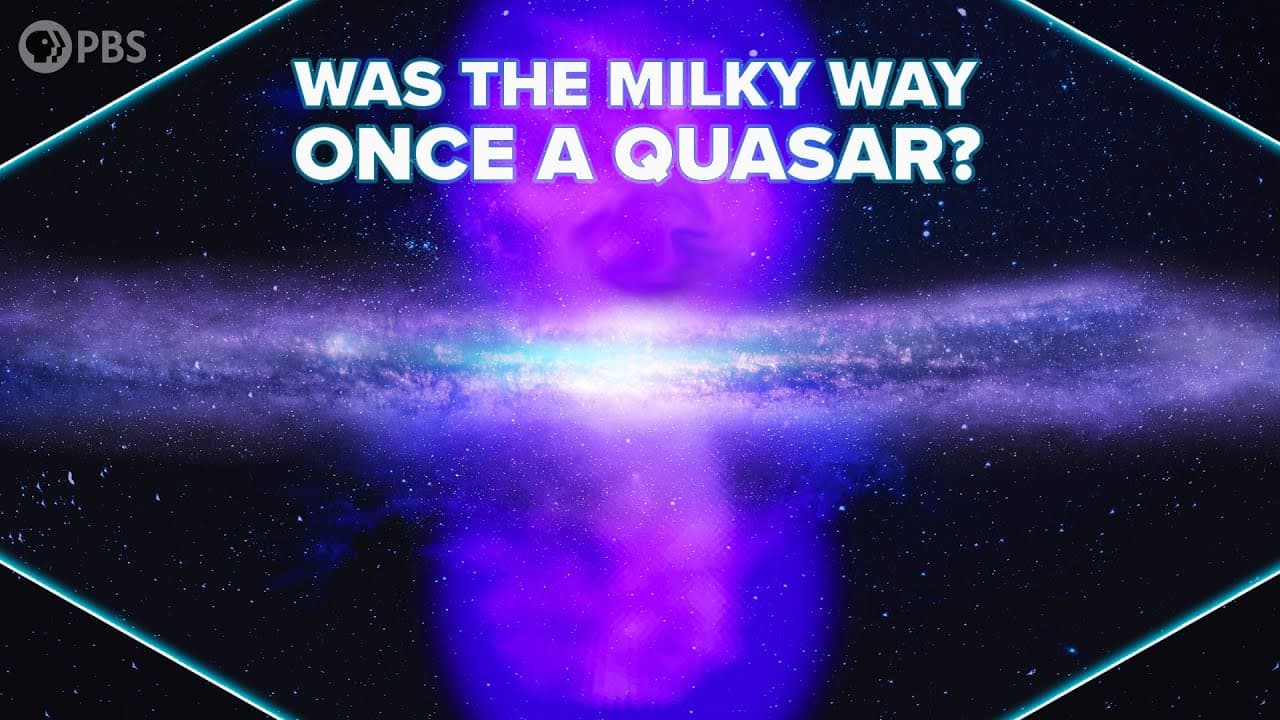
The Milky Way's central black hole, Sagittarius A*, may have been more active in the recent past than previously thought, potentially exhibiting quasar-like behavior. This activity could explain the presence of the Fermi Bubbles, massive gamma-ray emitting structures extending from the galaxy's center. Understanding these phenomena helps reveal the dynamic history of our galaxy.
Transcript
The Milky Way galaxy is relatively calm by the destructive standards of the rest of the Universe, and compared to its own very violent past. But just recently we discovered that its violent past was much more recent than we thought - and could even happen again. You may be wondering why I'm not floating somewhere off in space. You'd think it would ... Read More
Key Insights
- Sagittarius A* is the supermassive black hole at the center of the Milky Way.
- The Milky Way has a relatively calm present state compared to its violent past.
- Fermi Bubbles are massive gamma-ray emitting structures discovered in the Milky Way.
- These bubbles may have formed from past activity of Sagittarius A* or starburst events.
- Inverse Compton Scattering is the process generating gamma rays in the Fermi Bubbles.
- The Fermi Bubbles contain energy equivalent to 100,000 supernova explosions.
- Recent studies suggest Sagittarius A*'s activity may be increasing again.
- Radio bubbles similar to Fermi Bubbles have been discovered, indicating recent activity.
Install to Summarize YouTube Videos and Get Transcripts
Explore YouTube Video Summarizer or Get YouTube Transcript Extractor
Questions & Answers
Q: How were the Fermi Bubbles discovered?
The Fermi Bubbles were discovered in 2010 by astronomers using the Fermi Gamma-ray Space Telescope. They were looking for evidence of dark matter in the Milky Way's core and instead found massive high-energy gamma-ray structures extending 25,000 light years above and below the galactic plane. These bubbles were hidden by the gamma-ray glow of the galactic plane until their distinct energy spectrum was identified.
Q: What is the significance of the Fermi Bubbles?
The Fermi Bubbles are significant because they provide evidence of past energetic activity in the Milky Way, likely linked to either a quasar-like phase of Sagittarius A* or a starburst event. Understanding these bubbles helps scientists uncover the dynamic history of our galaxy and the processes that have shaped its evolution. They also highlight the potential for future activity at the galactic center.
Q: What processes generate gamma rays in the Fermi Bubbles?
Gamma rays in the Fermi Bubbles are generated by a process called Inverse Compton Scattering. In this process, extremely energetic electrons interact with lower-energy light, boosting the light's energy into the gamma-ray regime. This high-energy interaction is what produces the gamma rays observed in the Fermi Bubbles, indicating a significant past release of energy in the Milky Way.
Q: Could the Milky Way have been a quasar?
The Milky Way likely experienced a quasar-like phase in its past, where Sagittarius A*, its central black hole, was much more active. During this phase, the black hole would have consumed large amounts of matter, converting some of it into energy and emitting it as light, similar to quasars. This activity could have contributed to the formation of the Fermi Bubbles, though it was not as intense as a full quasar.
Q: What role do supernovae play in the formation of the Fermi Bubbles?
Supernovae may have played a role in the formation of the Fermi Bubbles by contributing to the energy required to create these structures. In a starburst event, numerous massive stars form and quickly explode as supernovae, releasing significant energy. This could have helped shape the bubbles, possibly in conjunction with activity from Sagittarius A*, smoothing out the energy distribution within the bubbles.
Q: How do recent discoveries of radio bubbles relate to the Fermi Bubbles?
Recent discoveries of smaller radio bubbles near the Milky Way's center suggest ongoing activity similar to that which created the Fermi Bubbles. These radio bubbles, detected by the MeerKAT telescope, extend only 1400 light years above and below the galactic plane and are likely generated by electrons accelerated by magnetic fields. They indicate more recent, albeit less energetic, events at the galactic center.
Q: Is there a risk of the Fermi Bubbles forming again?
There is no immediate risk of new Fermi Bubbles forming, but recent observations suggest increasing activity at the Milky Way's center. While the Earth's atmosphere protects us from gamma-ray radiation, any future starburst or quasar-like activity could significantly impact the galaxy's dynamics. However, such events are unpredictable and may not occur for millions of years.
Q: What evidence suggests Sagittarius A*'s activity is increasing?
Evidence of increasing activity from Sagittarius A* includes recent observations of heightened X-ray emissions over the past four years. This uptick in activity, while not indicative of imminent Fermi Bubble formation, suggests that the central black hole may be entering a more active phase. Continued monitoring of these emissions will provide further insights into the behavior of Sagittarius A* and its influence on the Milky Way.
Summary & Key Takeaways
-
The Milky Way's central black hole, Sagittarius A*, may have been more active in the recent past than previously thought. This activity could explain the presence of the Fermi Bubbles, massive gamma-ray emitting structures extending from the galaxy's center. Understanding these phenomena helps reveal the dynamic history of our galaxy.
-
The Fermi Bubbles, extending 25,000 light years above and below the Milky Way's plane, were discovered using the Fermi Gamma-ray Space Telescope. They are thought to be the result of either past quasar-like activity from Sagittarius A* or a massive starburst event, both of which could have provided the necessary energy.
-
Recent discoveries of smaller radio bubbles suggest ongoing activity at the Milky Way's center. These findings, combined with increasing X-ray activity from Sagittarius A*, hint at the potential for future energetic events. Understanding these processes aids in comprehending the complex dynamics and history of our galaxy.
Read in Other Languages (beta)
Share This Summary 📚
Summarize YouTube Videos and Get Video Transcripts with 1-Click
Try YouTube Summary with ChatGPT & Claude or YouTube Transcript Generator
Explore More Summaries from PBS Space Time 📚


Summarize YouTube Videos and Get Video Transcripts with 1-Click
Try YouTube Summary with ChatGPT & Claude or YouTube Transcript Generator