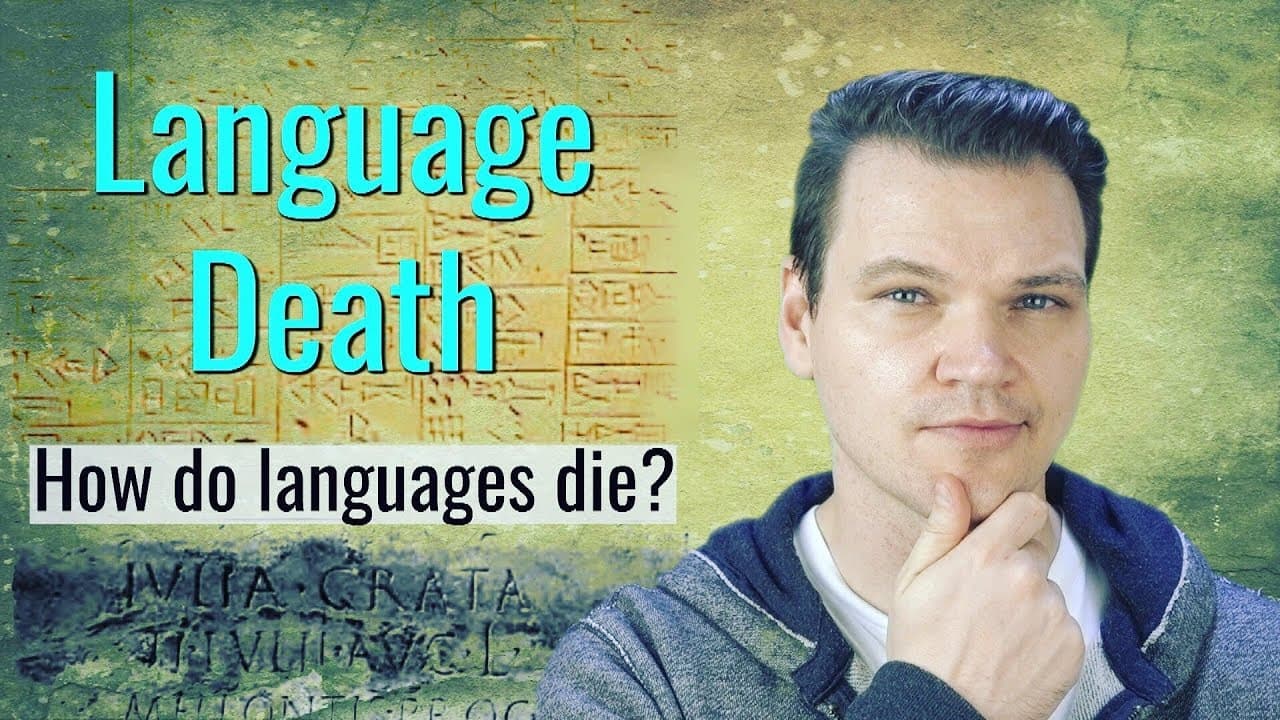
Language Death: How do languages die?
TL;DR
Languages die through gradual, sudden, or radical processes.
Transcript
Hello everyone welcome to the Langfocus Channel and my name is Paul. Today's topic is language death. Normally on this channel when I talk about a language, it's usually a living language, a language that's still spoken by native speakers today and continues to grow and evolve. But there are also dead languages and extinct languages. Languages are... Read More
Key Insights
- Language death occurs when a language loses its native speakers, becoming either dead or extinct. Dead languages may still be used in certain contexts, while extinct languages have no speakers at all.
- Gradual language death happens when a language loses speakers over generations due to the dominance of a more prestigious language, as seen with Cornish and Gaulish.
- Bottom-to-top language death involves a language ceasing to be spoken in casual contexts but continuing in formal or religious settings, exemplified by Latin and Old Church Slavonic.
- Sudden language death results from catastrophic events that rapidly eliminate a language's speakers, such as the black war in Tasmania that affected indigenous languages.
- Radical language death occurs when speakers abruptly stop using their language due to political repression or violence, as seen in El Salvador with Lenca and Cacaopera languages.
- The Mandan language illustrates both sudden and gradual language death, impacted by disease and the growing influence of English.
- Language death impacts cultural heritage, as languages carry unique cultural knowledge and perspectives, exemplified by the endangered Kallawaya language of Bolivia.
- Efforts to revitalize endangered languages involve documentation, learning by new speakers, and community engagement, with political support enhancing success.
Install to Summarize YouTube Videos and Get Transcripts
Explore YouTube Video Summarizer or Get YouTube Transcript Extractor
Questions & Answers
Q: What is the difference between a dead and an extinct language?
A dead language is one that no longer has native speakers but may still be used in certain contexts, such as religious or literary purposes. An extinct language, on the other hand, has no living speakers and is not used in any form. Latin is an example of a dead language, while Sumerian is an example of an extinct language.
Q: How does gradual language death occur?
Gradual language death occurs when speakers of a language gradually shift to a more dominant or prestigious language over generations. This often happens when a community becomes bilingual, but with each generation, fewer people speak the original language fluently. Eventually, the original language ceases to be spoken entirely, as seen with Cornish and Gaulish.
Q: What is bottom-to-top language death?
Bottom-to-top language death occurs when a language stops being used in everyday casual contexts but continues to be used in formal or religious settings. This type of language death is characterized by the language's survival in specific contexts, such as Latin, which is still used in religious ceremonies despite not being spoken natively.
Q: Can you provide an example of sudden language death?
Sudden language death occurs when a language's speakers are rapidly eliminated due to catastrophic events, such as natural disasters or violence. An example is the black war in Tasmania during the 1830s, where the native population was nearly wiped out by European colonists, leading to the sudden death of indigenous languages.
Q: What causes radical language death?
Radical language death is caused by political repression or threats of violence, leading speakers to abruptly stop using their language to avoid persecution. Unlike sudden language death, the speakers are not eliminated but choose to stop using their language for safety. An example is the 1930s uprising in El Salvador, where many aboriginals stopped speaking their native languages.
Q: How did the Mandan language die?
The Mandan language experienced both sudden and gradual language death. The population of Mandan speakers was severely reduced by smallpox outbreaks, and the remaining speakers gradually shifted to English due to its growing influence. This combination of catastrophic events and gradual language shift led to the language's extinction with the death of its last speaker, Edwin Benson, in 2016.
Q: Why is language death a concern for cultural heritage?
Language death is a concern for cultural heritage because languages carry unique cultural knowledge, traditions, and perspectives. When a language dies, the cultural identity and historical knowledge associated with it are lost. For example, the Kallawaya language in Bolivia contains specific medicinal knowledge that would disappear if the language becomes extinct.
Q: What are some strategies for revitalizing endangered languages?
Revitalizing endangered languages involves several strategies, including documenting the language, teaching it to new speakers, and fostering community engagement to encourage its use. Successful revitalization efforts often require political support to create favorable conditions for the language's survival and growth. Community motivation and enthusiasm are also crucial for these efforts to succeed.
Summary & Key Takeaways
-
Language death occurs when a language loses all its native speakers, becoming either dead or extinct. Dead languages may still be used in specific contexts, while extinct languages have no speakers.
-
Languages can die gradually, through bottom-to-top processes, or suddenly due to catastrophic events. Each type of language death affects cultural heritage and linguistic diversity differently.
-
Revitalization efforts for endangered languages require documentation, learning by new speakers, and community involvement. Political support can enhance the success of these efforts.
Read in Other Languages (beta)
Share This Summary 📚
Summarize YouTube Videos and Get Video Transcripts with 1-Click
Try YouTube Summary with ChatGPT & Claude or YouTube Transcript Generator
Explore More Summaries from Langfocus 📚


Summarize YouTube Videos and Get Video Transcripts with 1-Click
Try YouTube Summary with ChatGPT & Claude or YouTube Transcript Generator