What Is a Darlington Pair Transistor and How Does It Work?
TL;DR
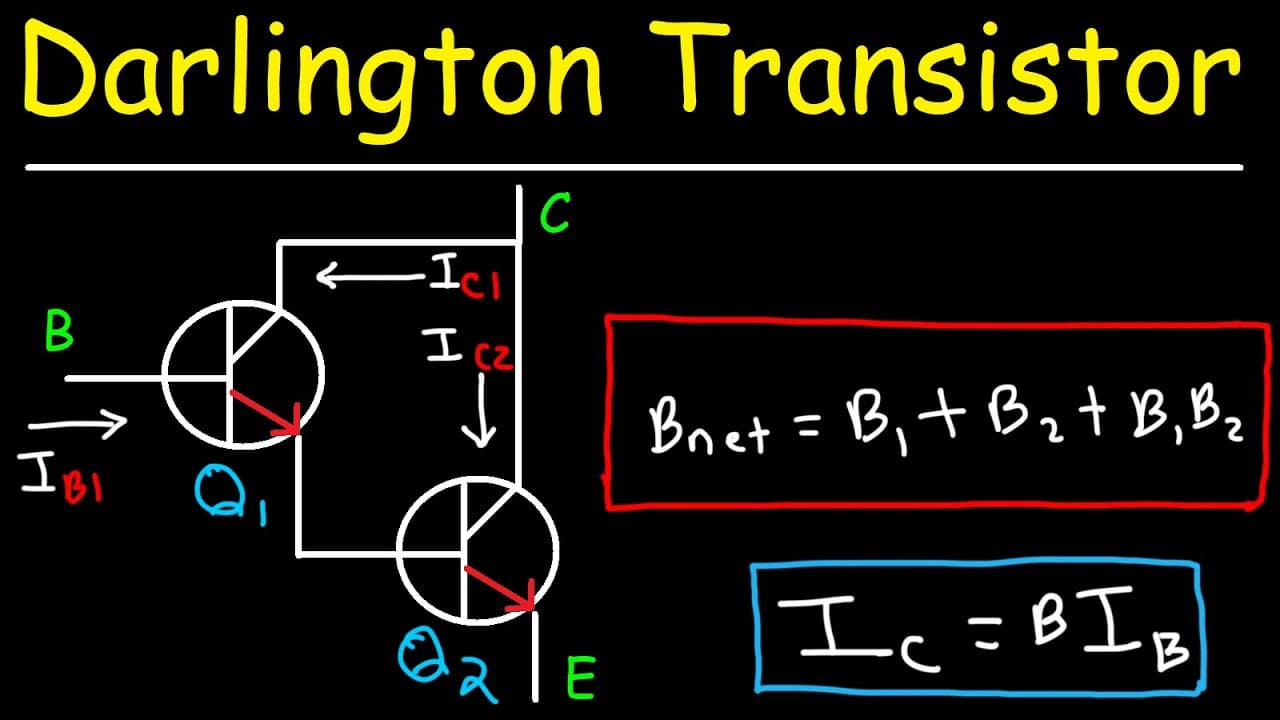
A Darlington Pair Transistor consists of two connected NPN transistors, enhancing current gain significantly. The overall beta, or current gain, is calculated using the formula beta1 + beta2 + (beta1 x beta2), resulting in much higher gains compared to individual transistors. This configuration is particularly useful in applications requiring high current amplification, like amplifiers and motor control circuits.
Transcript
in this video we're going to talk about some of the advantages of the Darlington pair transistor this particular transistor is very useful for achieving very high current gains the way you design it is by connecting two NPN transistors together this is q1 the first transistor and this is q2 so what you want to do is you want to collect I mean that ... Read More
Key Insights
- 👻 The Darlington Pair Transistor allows for high current gains by connecting two NPN transistors together.
- ⚾ By connecting the emitter of the first transistor to the base of the second transistor, and the two collectors together, the overall beta (current gain) can be greatly increased.
- ☺️ The formula to calculate the overall beta is beta 1 + beta 2 + (beta 1 x beta 2).
- ✋ The Darlington Pair Transistor is useful in applications that require high current gains, such as amplifiers and motor control circuits.
- ✋ The net beta of the Darlington Pair Transistor can be much higher compared to the individual beta values of the transistors.
- 🤬 The Darlington Pair Transistor can be represented by a special symbol enclosed in a circle.
- ⚾ The base current of the Darlington Pair Transistor is the same as the base current of the first transistor.
- 🉐 The overall current gain of the Darlington Pair Transistor is significantly greater than that of an individual transistor.
Install to Summarize YouTube Videos and Get Transcripts
Explore YouTube Video Summarizer or Get YouTube Transcript Extractor
Questions & Answers
Q: What is a Darlington Pair Transistor?
A Darlington Pair Transistor is formed by connecting two NPN transistors together to achieve high current gains.
Q: How is the Darlington Pair Transistor connected?
The emitter of the first transistor is connected to the base of the second transistor, and the two collectors are connected together.
Q: How do you calculate the individual collector currents?
The collector current of the first transistor is calculated by multiplying the base current with the beta (current gain) of the first transistor. The same method is applied to calculate the collector current of the second transistor.
Q: What is the overall beta (current gain) of the Darlington Pair Transistor?
The overall beta of the Darlington Pair Transistor is calculated by summing the betas of the two transistors and adding the product of their betas.
Summary & Key Takeaways
-
The Darlington Pair Transistor is formed by connecting two NPN transistors, resulting in a high current gain.
-
The emitter of the first transistor is connected to the base of the second transistor, and the two collectors are connected together.
-
By calculating the base current, individual collector currents, and overall beta (current gain), the advantages of the Darlington Pair Transistor can be understood.
Read in Other Languages (beta)
Share This Summary 📚
Summarize YouTube Videos and Get Video Transcripts with 1-Click
Try YouTube Summary with ChatGPT & Claude or YouTube Transcript Generator
Explore More Summaries from The Organic Chemistry Tutor 📚




Summarize YouTube Videos and Get Video Transcripts with 1-Click
Try YouTube Summary with ChatGPT & Claude or YouTube Transcript Generator