Handmade holograms are really weird
TL;DR
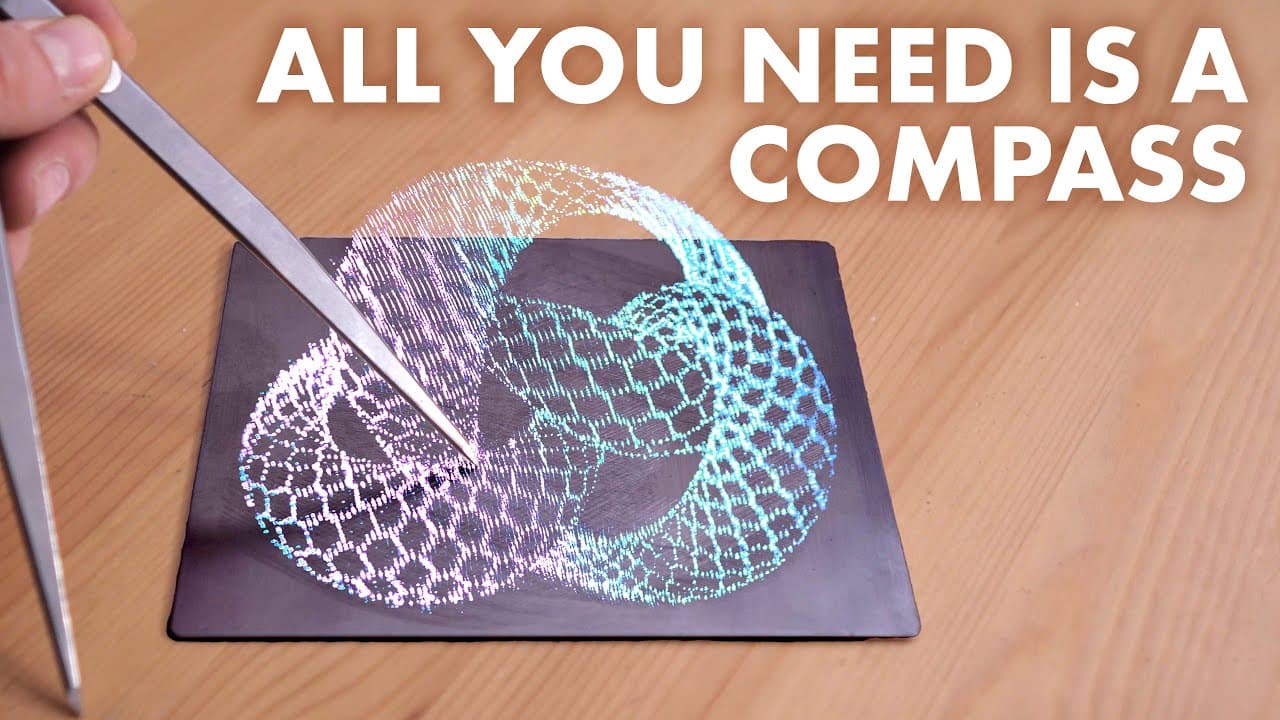
This video explores the process of creating handmade holograms using a simple technique of making scratches in a shiny surface, revealing how etch holograms work and providing insights into creating more complex 3D holograms.
Transcript
- This is a hologram that I made by hand. This is also a handmade hologram, but as you can see, it was made by someone who actually knows what they're doing. Both holograms were made using the same technique, and this one and this one, the technique is deceptively simple. You just make scratches in a shiny surface. I made my holograms on sheets of ... Read More
Key Insights
- ✨ Handmade holograms can be created by making scratches or etches on a shiny surface, such as an acrylic sheet.
- 🫠 The method of etching arcs determines the depth and position of objects in the hologram.
- 🫠 The shape of the arcs and their curvature affects the distortion of the holographic image.
- ❓ Complex holograms with multiple objects at different depths require precise adjustments of the etching technique.
- ❓ The correct curve for etching can be determined mathematically, and CNC processes can be used to accurately replicate the curve.
- ⚖️ Traditional holograms and handmade holograms created using the etching technique are similar in principle but differ in scale and complexity.
- 🫠 Accidental etch holograms, such as those seen in wiper fluid lines on a windshield, demonstrate the effect of arc curvature on perceived depth.
Install to Summarize YouTube Videos and Get Transcripts
Explore YouTube Video Summarizer or Get YouTube Transcript Extractor
Questions & Answers
Q: How are handmade holograms created using the etching technique?
Handmade holograms are created by scoring arcs on a shiny surface, such as an acrylic sheet, and using light glints off the etched lines to create a 3D effect. More complex holograms are created by drawing shapes and etching multiple points.
Q: Why does the image in handmade holograms warp and distort when the viewing angle is changed?
The image in handmade holograms warps and distorts because the arcs used for etching are not the correct shape. Most people creating etch holograms use approximations to the correct curve, causing the image to warp. To achieve a distortion-free hologram, the arcs should follow a specific curve.
Q: How can objects at different depths be created in handmade holograms?
Objects at different depths in handmade holograms can be created by adjusting the curvature of the arcs used for etching. Tighter arcs result in objects appearing closer to the surface, while straighter arcs make them appear further away. Curvatures between these extremes allow for creating objects at various depths.
Q: Can opaque objects with hidden objects behind them be created in handmade holograms?
Yes, by adjusting the position and length of the etched lines, opaque objects with hidden objects behind them can be created in handmade holograms. The viewing angle determines which objects become visible, allowing for the illusion of objects appearing and disappearing.
Summary & Key Takeaways
-
The video discusses the process of creating handmade holograms using scratches made on a shiny surface, similar to the etching technique used for holograms on credit cards.
-
The technique involves scoring arcs on an acrylic sheet and using light glints off the etched lines to create a 3D effect.
-
More complex holograms can be created by drawing shapes and etching multiple points, allowing for objects at different depths and distortion of the images.
Read in Other Languages (beta)
Share This Summary 📚
Summarize YouTube Videos and Get Video Transcripts with 1-Click
Try YouTube Summary with ChatGPT & Claude or YouTube Transcript Generator
Explore More Summaries from Steve Mould 📚
Summarize YouTube Videos and Get Video Transcripts with 1-Click
Try YouTube Summary with ChatGPT & Claude or YouTube Transcript Generator