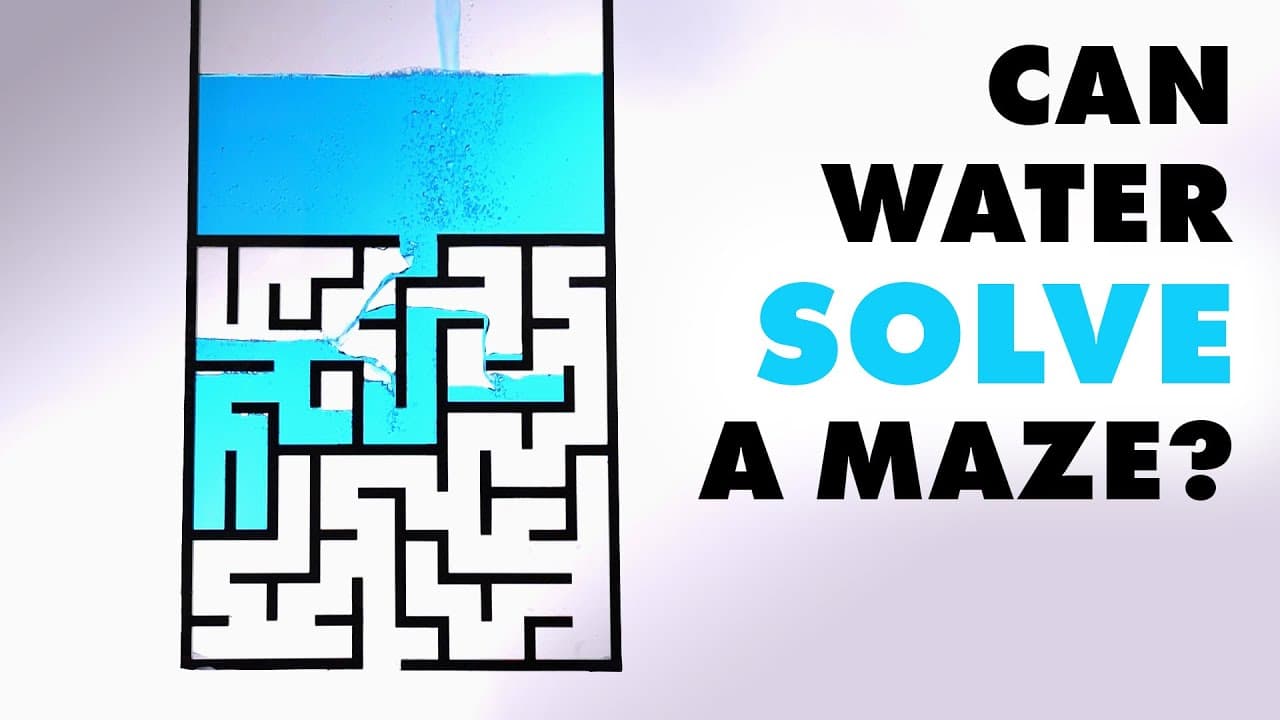
Can water solve a maze?
TL;DR
In this video, the creator tests a water maze simulation and analyzes how the water solves the maze, discussing concepts such as air pressure, surface tension, and geometry.
Transcript
(upbeat music) - So many people sent me this simulation of water pouring through a maze by Bergman Joe. And it makes sense that you sent it to me 'cause this is the kind of thing that I would make for real. So of course when I saw it, I had to make it for real. I actually made four mazes in total, a simpler one and a more complex one, and I also ma... Read More
Key Insights
- 😲 Water solving mazes in real life works differently from simulations and can be influenced by factors such as air pressure, surface tension, and maze geometry.
- 🤽 Air pressure plays a crucial role in guiding the water through the correct path in the maze.
- 😲 Surface tension prevents the water from entering certain regions of the maze, and multiple surface tensions can create significant resistance.
- 😲 The geometry of the maze can impact how the water flows and influences its ability to solve the maze.
- 😲 Creating watertight mazes can be challenging due to the complexity of bonding acrylic layers.
Install to Summarize YouTube Videos and Get Transcripts
Explore YouTube Video Summarizer or Get YouTube Transcript Extractor
Questions & Answers
Q: How does the water solve the maze in the simpler version?
The water in the simpler maze uses air pressure to find the correct path. Whenever the water encounters an incorrect path, the air pressure inside the closed path pushes back against the water, guiding it to the correct path.
Q: Why doesn't the water enter certain regions of the maze?
In certain regions of the maze, air pressure prevents the water from entering. Air, being less dense than water, cannot rise to allow the water entry. Additionally, surface tension also plays a role in blocking the water's passage.
Q: What happens when the maze is not watertight?
In the more complex maze, which is not completely watertight, the water leaks from the tank to the outside world. However, there are no significant leaks within the maze itself.
Q: How does surface tension affect the flow of water in the maze?
Surface tension can create resistance within the maze, resulting in obstacles for the flow of water. Multiple bits of surface tension can accumulate and prevent the water from continuing its path, causing a halt in the maze.
Summary & Key Takeaways
-
The video showcases the creator making and testing two mazes, a simpler one and a more complex one, to understand how water solves mazes.
-
The water in the simpler maze uses air pressure to find the correct path, while in the more complex maze, the water is hindered by the maze's geometry.
-
Surface tension plays a significant role in preventing the water from filling certain areas of the maze, and the resistance created by multiple surface tensions can bring the maze to a halt.
Read in Other Languages (beta)
Share This Summary 📚
Summarize YouTube Videos and Get Video Transcripts with 1-Click
Try YouTube Summary with ChatGPT & Claude or YouTube Transcript Generator
Explore More Summaries from Steve Mould 📚




Summarize YouTube Videos and Get Video Transcripts with 1-Click
Try YouTube Summary with ChatGPT & Claude or YouTube Transcript Generator