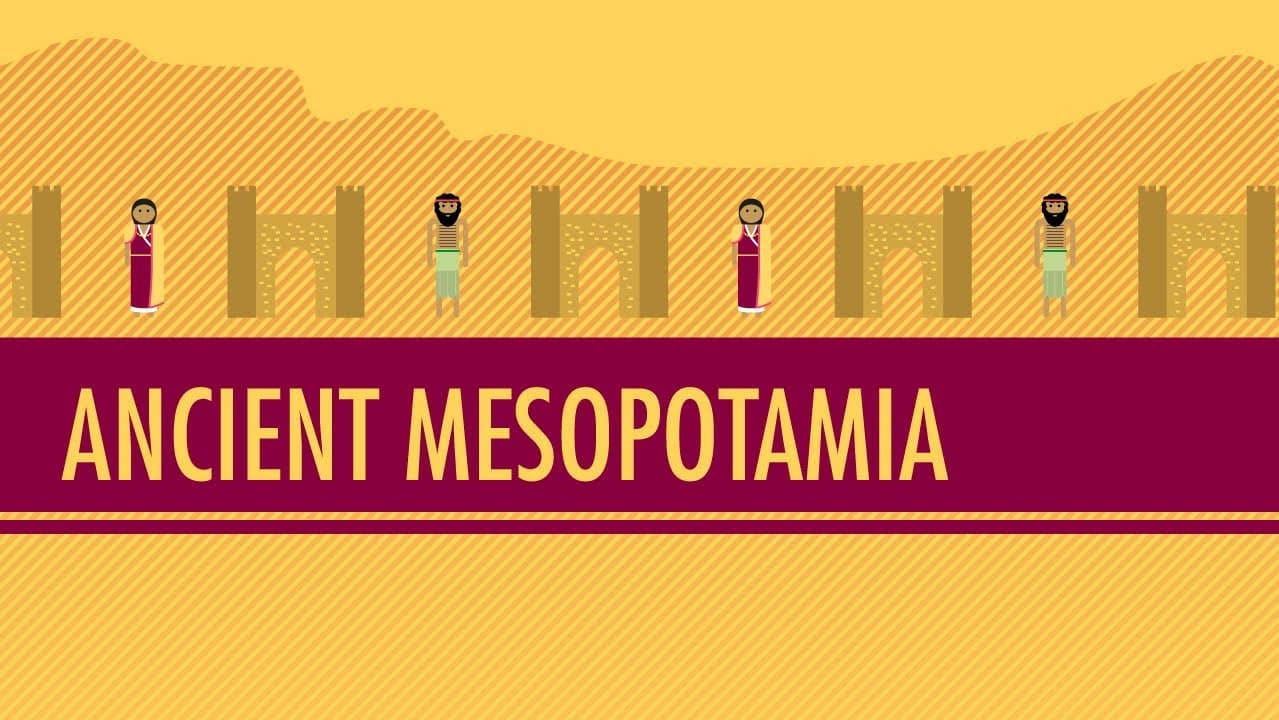
Mesopotamia: Crash Course World History #3
TL;DR
Explores Mesopotamia's history, innovations, and empires.
Transcript
Hi there. I'm John Green, you're watching Crash Course World History, and today we're going to talk about "Iraq" No, you purportedly smart globe. We're going to talk about Mesopotamia. I love Mesopotamia because it helped create two of my favorite things: Writing and taxes. Why do I like taxes? Because before taxes, the only certainty was death. Mr... Read More
Key Insights
- Mesopotamia is credited with the creation of writing and taxes, pivotal innovations that shaped societal structures and governance.
- Early Mesopotamian cities operated under a proto-socialist system where farmers contributed crops to public storehouses, supporting workers with grain wages.
- The conflict between rural and urban life, exemplified in the Epic of Gilgamesh, highlights the enduring tension between country and city living.
- Writing, specifically cuneiform, was a significant development in Mesopotamia, used initially for recording transactions and contributing to class distinctions.
- The transition of power from temple priests to kings marked a shift in societal structure, with kings assuming quasi-religious roles through sacred marriages.
- Hammurabi's Code, known for its harshness, introduced the presumption of innocence and established a legal framework influencing future legal systems.
- The Neo-Assyrian Empire exemplified early imperialism, with a brutal and efficient military expanding their territory and employing harsh control methods.
- Empires like the Assyrians faced challenges in maintaining control over diverse populations, ultimately leading to their downfall when their worldview was challenged.
Install to Summarize YouTube Videos and Get Transcripts
Explore YouTube Video Summarizer or Get YouTube Transcript Extractor
Questions & Answers
Q: What role did writing play in Mesopotamian society?
Writing, particularly cuneiform, was crucial in Mesopotamian society for recording transactions and creating historical records. It introduced class distinctions, as not everyone could read or write, and played a role in the administration and governance, allowing for more complex societal structures and legal systems.
Q: How did the power dynamics shift in Mesopotamian city-states?
Initially, power in Mesopotamian city-states was held by temple priests who claimed communication with the gods. Over time, power shifted to kings, often military leaders or wealthy landowners, who assumed religious roles through practices like sacred marriages, thus consolidating political and religious authority.
Q: What is the significance of Hammurabi's Code?
Hammurabi's Code is significant as one of the earliest and most comprehensive written legal codes, establishing laws and penalties that influenced future legal systems. It introduced the presumption of innocence and emphasized retributive justice, as seen in the 'eye for an eye' principle, highlighting the harshness of ancient legal practices.
Q: How did the Neo-Assyrian Empire maintain control over its territories?
The Neo-Assyrian Empire maintained control through a brutal and efficient military, employing strategies like deportation to separate populations from their cultural roots and using skilled labor where needed. Their governance relied on fear and propaganda, promoting the king's divinity and the empire's might to ensure compliance and deter rebellion.
Q: What challenges did empires like the Assyrians face?
Empires like the Assyrians faced challenges in unifying diverse and multi-ethnic populations, which made administration difficult. Their reliance on continuous conquest to maintain their worldview and prevent apocalyptic beliefs from manifesting meant that any military defeat could destabilize their authority and lead to the empire's collapse.
Q: How did early Mesopotamian societies organize labor and resources?
Early Mesopotamian societies organized labor and resources through a proto-socialist system where farmers contributed crops to public storehouses. These resources were then distributed as grain wages to workers, allowing for specialization in various trades and ensuring a stable food supply for urban populations.
Q: What was the impact of the Assyrian military on their empire?
The Assyrian military had a significant impact on their empire, enabling rapid expansion and control over vast territories. Their meritocratic approach to leadership and brutal tactics, including deportation and punishment of rebels, allowed them to maintain dominance, although it also fostered resentment and instability that contributed to their eventual downfall.
Q: Why did the Assyrian Empire eventually collapse?
The Assyrian Empire eventually collapsed due to overextension beyond their administrative capabilities and the loss of a battle, which challenged their apocalyptic worldview. The failure to maintain continuous conquest undermined their authority, leading to internal instability and making them vulnerable to external invasions that ultimately led to their demise.
Summary & Key Takeaways
-
John Green discusses the historical significance of Mesopotamia, highlighting its contributions to writing and taxation, which were crucial in shaping early civilizations. The video explores the societal structures, including proto-socialism and the shift of power from religious to secular leaders, as seen in the rise of kingship.
-
The video delves into the development of writing in Mesopotamia, particularly cuneiform, which played a crucial role in recording history and creating class distinctions. It also touches on the transition from temple-led to king-led societies, with kings taking on religious roles to consolidate power.
-
The Neo-Assyrian Empire is examined as an early example of imperialism, characterized by its brutal military tactics and effective control over a vast territory. The video concludes with the eventual decline of the Assyrian Empire due to overextension and the collapse of their apocalyptic worldview.
Read in Other Languages (beta)
Share This Summary 📚
Summarize YouTube Videos and Get Video Transcripts with 1-Click
Try YouTube Summary with ChatGPT & Claude or YouTube Transcript Generator
Explore More Summaries from CrashCourse 📚





Summarize YouTube Videos and Get Video Transcripts with 1-Click
Try YouTube Summary with ChatGPT & Claude or YouTube Transcript Generator