How to Effectively Revise and Edit Translations
TL;DR
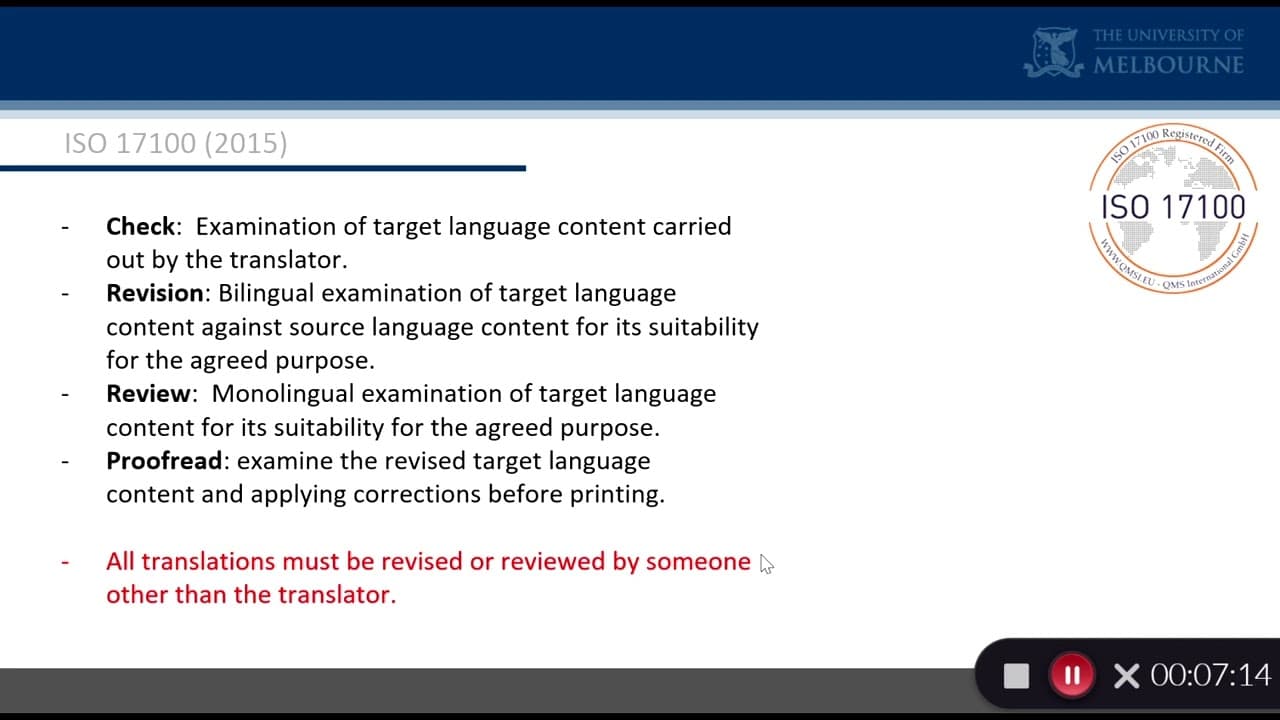
To effectively revise and edit translations, focus on correcting errors while maintaining the original author's voice. Utilize tools like Track Changes for tracking revisions, and ensure at least one thorough review for accuracy and coherence. Familiarize yourself with international standards such as ISO 17100 to enhance the quality of your translation work.
Transcript
This is a basic presentation of some of the terms that we use for what do you do when you've finished your translation. Basically revising... That is the basic term. There's a first lesson that is the most important one and so I give it straightaway. This is from Brian Mossop. There is no greater joy than the drive to alter someone else's text. Whe... Read More
Key Insights
- 🛟 Revising preserves the original voice of the author in translations.
- 🦮 Editors prepare translations for publication according to specific style guides.
- 🐕🦺 International standards like ISO 17100 provide guidelines for language service providers.
- 🏣 Post-editing corrects machine-generated translations for accuracy.
- 🐕🦺 TEP (translating, editing, proofreading) is a term used to communicate the comprehensive services translators offer.
- 👣 Track Changes tools in word processing software help keep track of revisions.
- ❓ All translations should undergo at least one revision for accuracy and cohesiveness.
Install to Summarize YouTube Videos and Get Transcripts
Explore YouTube Video Summarizer or Get YouTube Transcript Extractor
Questions & Answers
Q: What is the difference between revising and editing in translation?
Revising corrects errors while maintaining the author's voice, whereas editing focuses on preparing the text for publication according to specific style guides.
Q: Why is it important to have two people review every translation?
Having two reviewers increases accuracy and ensures that all errors are caught, enhancing the overall quality of the translation.
Q: What is post-editing in translation?
Post-editing involves correcting machine-generated translations to improve accuracy and readability, a vital task in the translation industry.
Q: How can translators communicate their editing and proofreading services to clients effectively?
Using terms like TEP (translating, editing, proofreading) in quotes and invoices can help clients understand the full scope of services translators offer.
Summary & Key Takeaways
-
Revising a translation involves correcting errors without altering the original voice of the author.
-
Editors prepare translations for publication according to specific style guides.
-
International standards like ISO 17100 dictate terminology and practices for language service providers.
Read in Other Languages (beta)
Share This Summary 📚
Summarize YouTube Videos and Get Video Transcripts with 1-Click
Try YouTube Summary with ChatGPT & Claude or YouTube Transcript Generator
Explore More Summaries from Anthony Pym 📚



Summarize YouTube Videos and Get Video Transcripts with 1-Click
Try YouTube Summary with ChatGPT & Claude or YouTube Transcript Generator