Trappist - 1 Update for 07/09/2017
TL;DR
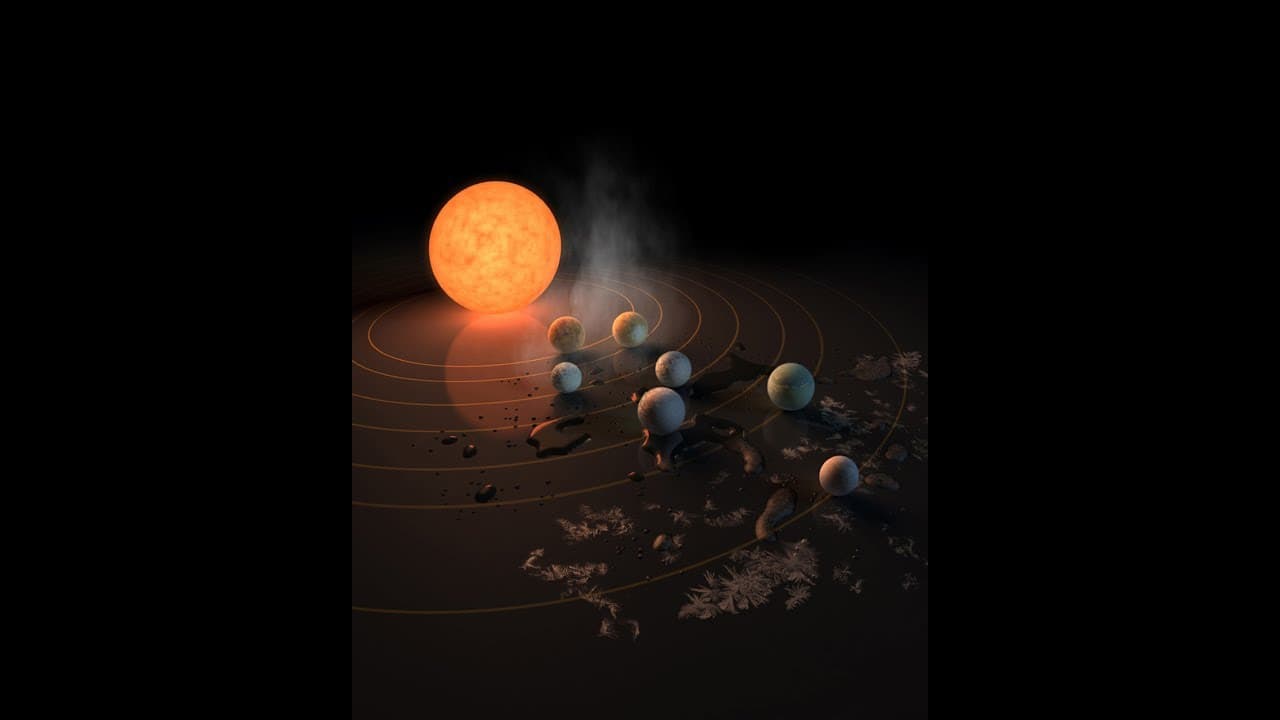
New findings on the Trappist-1 system suggest potential habitability, challenges related to the star's activity and radiation, the possibility of panspermia, and future opportunities for in-depth study using the James Webb Space Telescope.
Transcript
This is an update in my continuing coverage of the Trappist - 1 system, a star with at least seven earth-sized planets, all thought to be terrestrial in nature, some of which could be potentially habitable. Much debate has surrounded the complicated system in determining its characteristics and just how habitable those worlds might be. For more bac... Read More
Key Insights
- 🤩 The star in the Trappist-1 system is stable, but its activity may pose challenges to potential habitability.
- 🤩 The orbital resonances in the system suggest the presence of water on the planets, but radiation from the star may be depleting it.
- ❓ The James Webb Space Telescope will offer significant opportunities for studying the Trappist-1 system.
- 💁 The absence of large moons in the Trappist-1 system may impact tide-related factors relevant to the formation of life.
- 🥺 Panspermia is more likely in the Trappist-1 system than in our own, potentially leading to related life on multiple planets.
- 🧑🏭 Trappist-1 presents a complex environment with various factors affecting habitability and the search for biosignatures.
- 🦕 The chemistry and odds favor the possibility of simple life in the universe, making Trappist-1 an important system for studying exoplanet atmospheres.
Install to Summarize YouTube Videos and Get Transcripts
Explore YouTube Video Summarizer or Get YouTube Transcript Extractor
Questions & Answers
Q: How stable is the star in the Trappist-1 system for supporting life?
The star in the Trappist-1 system is considered stable for life since it appears to be a single-star system without larger companions. This stability allows for accurate determination of planet sizes and supports the possibility of habitability.
Q: How does the star's activity affect the planets in the Trappist-1 system?
The star's activity, including star spots and flaring, could impact the atmospheres of the planets. Flaring can change the chemical composition of the atmospheres regularly and potentially hinder the development of life.
Q: What is the significance of the orbital resonances seen in the Trappist-1 system?
The orbital resonances observed in the Trappist-1 system are difficult to explain with current models. This suggests that the planets may have formed further out in an ice-rich area and later transitioned to rocky planets, potentially indicating the presence of significant amounts of water.
Q: How will the James Webb Space Telescope contribute to studying the Trappist-1 system?
The launch of the James Webb Space Telescope in late 2018 will provide a more comprehensive study of the Trappist-1 system. It will allow for in-depth analysis of the atmospheres of these planets, potentially identifying biosignature gases and providing greater insight into their habitability.
Summary & Key Takeaways
-
The star in the Trappist-1 system appears to be stable for life, with no companions larger than a brown dwarf, allowing for accurate determination of planet sizes.
-
The star's activity, including star spots and flaring, could negatively impact the atmospheres and potential habitability of the planets.
-
The orbital resonances of the planets are difficult to explain, leading to the suggestion of a new model that favors the presence of water on the planets.
-
Studies suggest that radiation from the star may be robbing the planets of water, but more research is needed to determine habitability.
Read in Other Languages (beta)
Share This Summary 📚
Summarize YouTube Videos and Get Video Transcripts with 1-Click
Try YouTube Summary with ChatGPT & Claude or YouTube Transcript Generator
Explore More Summaries from John Michael Godier 📚

Summarize YouTube Videos and Get Video Transcripts with 1-Click
Try YouTube Summary with ChatGPT & Claude or YouTube Transcript Generator