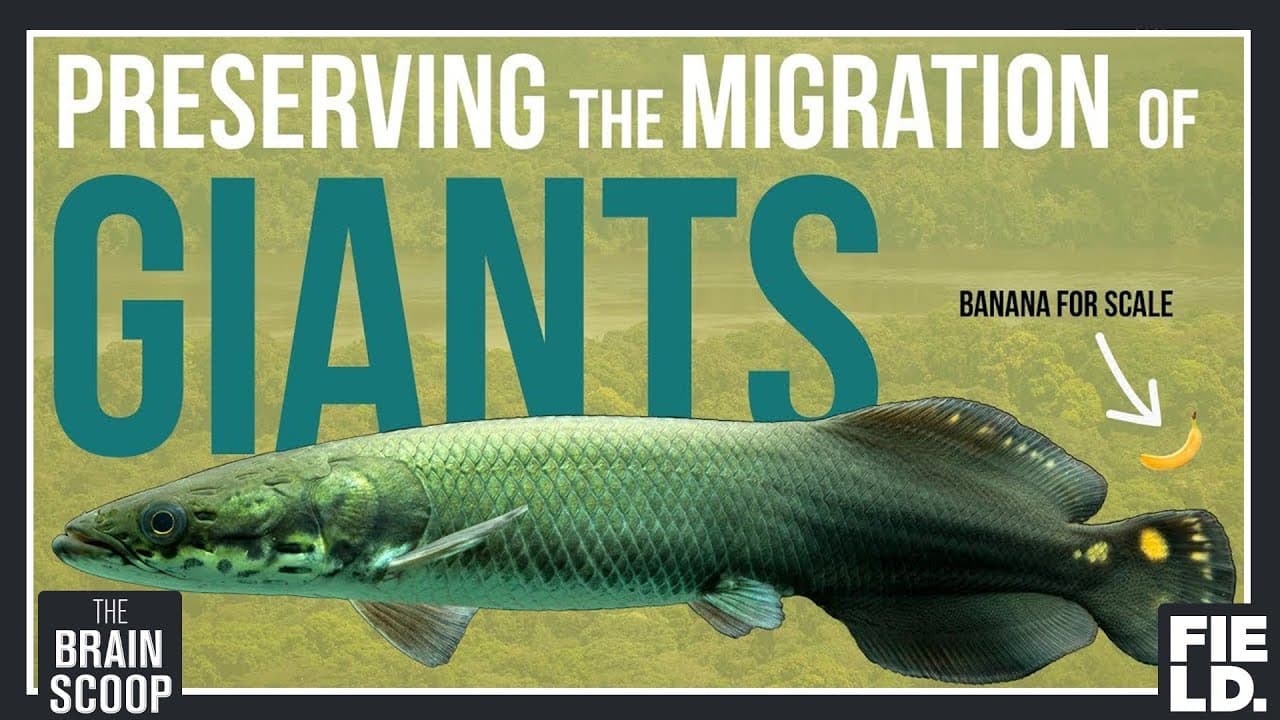
Preserving the Migration of Giants: Guyana's Arapaima
TL;DR
Dr. Lesley de Souza studies and protects the arapaima fish in South America, involving local communities.
Transcript
[MUSIC PLAYING] EMILY: This is Dr. Lesley de Souza. She's a conservation scientist and an ichthyologist, which means she studies fish, primarily those in South America, and one group in particular, the arapaima. A genus of freshwater fish that can get up to nearly 10 feet, or 3 meters in length. When she's not here at the Field Museum, she's conduc... Read More
Key Insights
- 🙃 Dr. de Souza's work focuses on studying the movement patterns of arapaima fish in South America.
- ❓ Collaboration with indigenous communities is essential for successful conservation efforts.
- 🙃 Using radio telemetry, Dr. de Souza tracks the arapaima's movements with minimal impact on the fish.
- 🛟 Creating a protected area in Guyana is crucial for preserving the arapaima's habitat and the well-being of local communities.
- 🐟 Local knowledge is invaluable in understanding and conserving the arapaima fish and its ecosystem.
- 👨🔬 Conservation efforts for the arapaima involve a combination of scientific research and community engagement.
- 🌎 Protecting the arapaima contributes to the larger goal of conserving freshwater biodiversity in South America.
Install to Summarize YouTube Videos and Get Transcripts
Explore YouTube Video Summarizer or Get YouTube Transcript Extractor
Questions & Answers
Q: Why does Dr. Lesley de Souza study the arapaima fish?
Dr. de Souza focuses on the arapaima because it is endemic to the region and its populations were declining, prompting local communities to seek protection for the species.
Q: How does Dr. de Souza track the movement of the arapaima fish?
Dr. de Souza uses radio telemetry, inserting transmitters into the fish's stomach cavity and monitoring their movements, ensuring minimal harm to the fish.
Q: What role do indigenous communities play in Dr. de Souza's research?
Indigenous communities collaborate with Dr. de Souza, contributing local knowledge and participating in fieldwork to protect the arapaima and their habitat.
Q: What is the significance of creating a protected area for the arapaima in Guyana?
Establishing a protected area not only preserves the biodiversity of the arapaima but also safeguards the cultural and livelihood aspects of the local communities.
Summary & Key Takeaways
-
Dr. Lesley de Souza studies the arapaima fish in South America, focusing on its movement patterns and habitat needs.
-
She works closely with indigenous communities in Guyana to create a protected area for the arapaima and ensure their conservation.
-
By using radio telemetry and collaborating with locals, Dr. de Souza aims to protect the arapaima and its ecosystem.
Read in Other Languages (beta)
Share This Summary 📚
Summarize YouTube Videos and Get Video Transcripts with 1-Click
Try YouTube Summary with ChatGPT & Claude or YouTube Transcript Generator
Explore More Summaries from thebrainscoop 📚


Summarize YouTube Videos and Get Video Transcripts with 1-Click
Try YouTube Summary with ChatGPT & Claude or YouTube Transcript Generator