How Do Random Forests Handle Missing Data and Clustering?
TL;DR
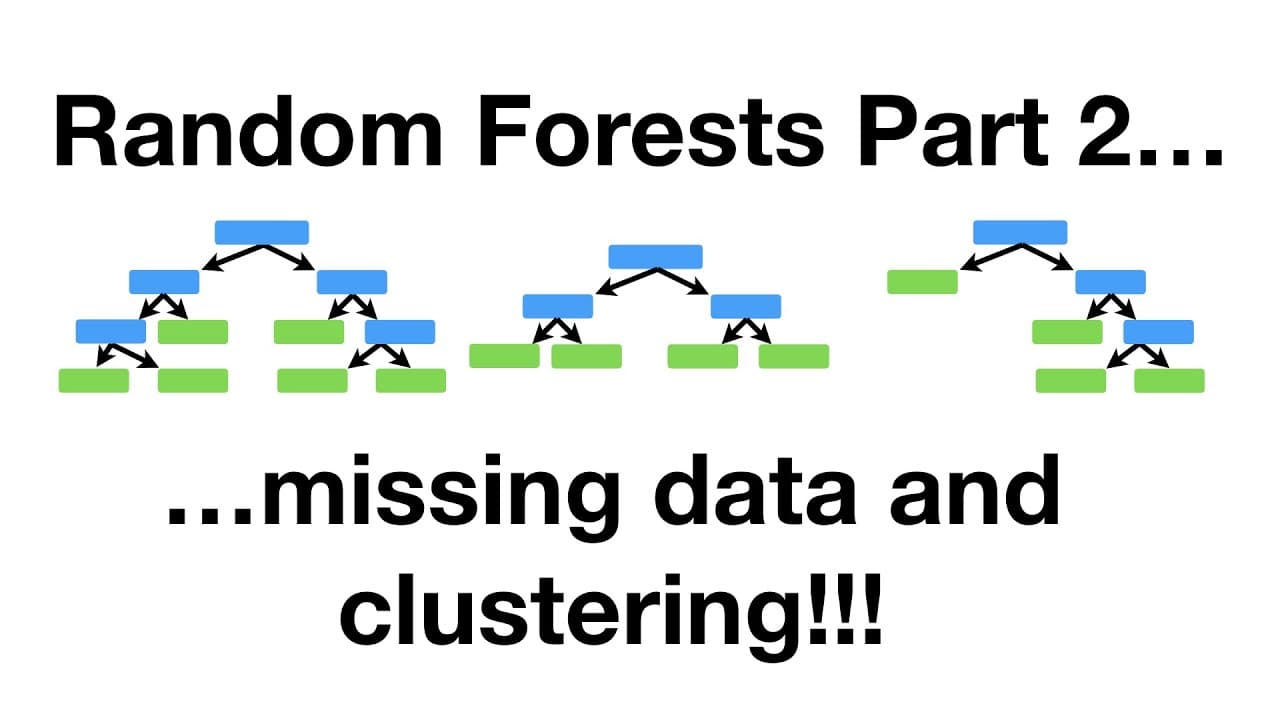
Random forests address missing data by making initial guesses based on the most common values and refining them through similarity calculations. They create proximity matrices to track sample relationships, allowing for more accurate classifications in iterative steps. This method ultimately improves data handling for better analysis and insights.
Transcript
random force part - yep it hooray it's true stead quest hello I'm Josh stommer and welcome to stack quest today we're doing random forests part two and we're gonna focus on missing data and sample clustering to be honest the sample clustering aspect of random forests is my favorite part so I'm really excited we're gonna cover it here's our data set... Read More
Key Insights
- 😒 Random forests use initial guesses and similarity calculations to handle missing data effectively.
- 🌲 Sample clustering involves building trees to identify similarities and optimize data analysis.
- 🦻 Proximity matrices track sample similarities, aiding in refining missing data for accurate classification.
- 🎟️ Iterative methods help improve missing data guesses in random forests for precise analysis.
- 👶 Missing data categorization in new samples involves iterative guesswork based on existing data classifications.
- 😒 Random forests use tree runs and proximity matrices to refine missing data values for accurate classification.
- 🥵 Heat maps and MDS plots can be generated from proximity matrices in random forests for visual data analysis.
Install to Summarize YouTube Videos and Get Transcripts
Explore YouTube Video Summarizer or Get YouTube Transcript Extractor
Questions & Answers
Q: How does random forest handle missing data in the original dataset?
Random forests make an initial guess based on common values in the dataset and gradually refine the guess through similarity calculations to deal with missing data effectively.
Q: What is sample clustering in the context of random forests?
Sample clustering in random forests involves building trees to track sample similarities and identify patterns, helping refine missing data values for accurate analysis.
Q: How does random forest use proximity matrices to determine similarity between samples?
Proximity matrices track which samples end up in the same leaf nodes in trees, indicating similarity, and are used to refine missing data guesses through weighted calculations.
Q: How is missing data classification improved in random forests?
Iterative methods in random forests involve refining missing data values through multiple tree runs, proximity calculations, and weighted averages until the classifications converge for accurate analysis.
Summary & Key Takeaways
-
Random forests analyze missing data by initially guessing common values and refining them through similarity calculations.
-
Sample clustering in random forests involves building trees to track similarities and create an optimized data set.
-
Iterative methods are used to refine missing data values for accurate classification in random forests.
Read in Other Languages (beta)
Share This Summary 📚
Summarize YouTube Videos and Get Video Transcripts with 1-Click
Try YouTube Summary with ChatGPT & Claude or YouTube Transcript Generator
Explore More Summaries from StatQuest with Josh Starmer 📚


Summarize YouTube Videos and Get Video Transcripts with 1-Click
Try YouTube Summary with ChatGPT & Claude or YouTube Transcript Generator