What Is UMAP and How Does It Transform Data?
TL;DR
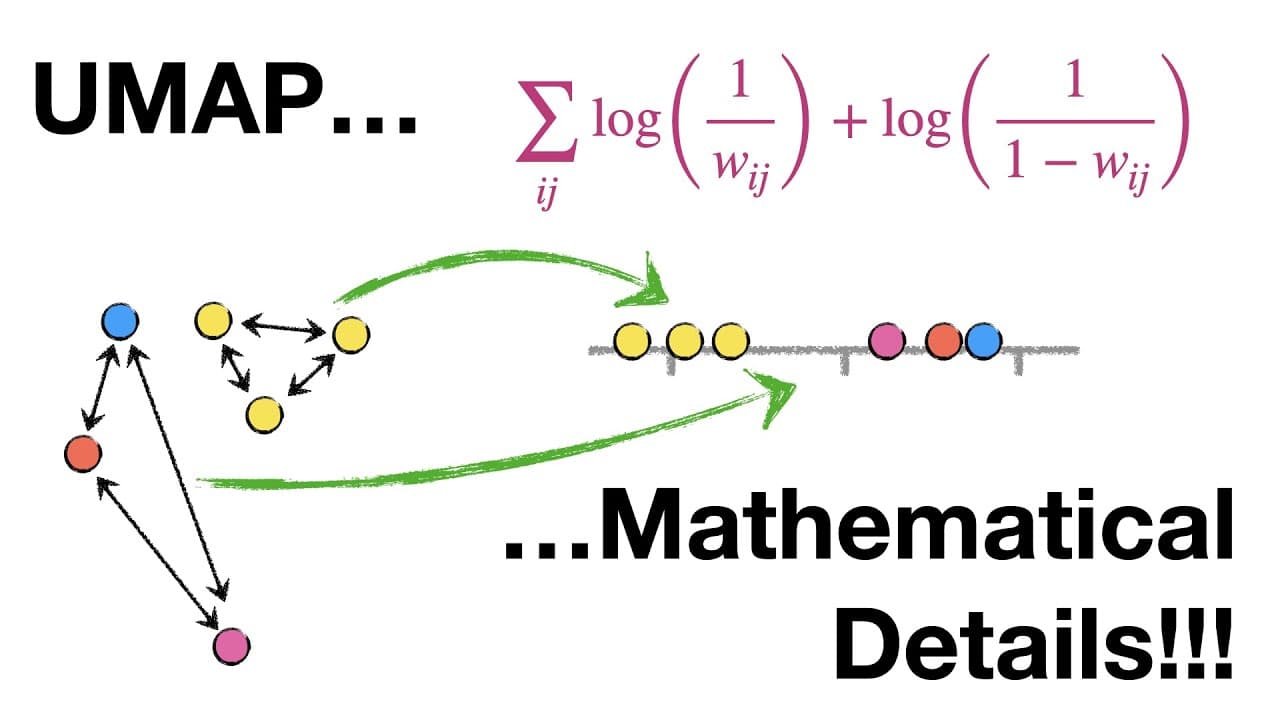
UMAP transforms high-dimensional data into low-dimensional representations by calculating similarity scores from raw distances using a specified sigma parameter. Adjusting sigma shapes the curves to align with desired similarity scores, while stochastic gradient descent optimizes the positioning of points in the low-dimensional space, resulting in a structured cluster representation.
Transcript
let's do some math bam stat quest yeah hello i'm josh starmer and welcome to stat quest today we're going to talk about umap mathematical details this stat quest is sponsored by lightning and grid.ai with lightning you can design build and scale models with ease focus on the business and research problems that matter to you lightning takes care of ... Read More
Key Insights
- 💯 UMAP transforms raw distances into similarity scores based on high-dimensional neighbors and specified parameters.
- 💯 Adjusting the sigma parameter in UMAP alters similarity scores and curve shapes, impacting the representation of clusters.
- 😘 Stochastic gradient descent is utilized in UMAP to optimize the low-dimensional graph by moving points incrementally.
- 💯 Symmetrical similarity scores between points in UMAP clusters are achieved through a specialized formula derived from theoretical frameworks like topology and fuzzy sets.
- 👻 UMAP provides control over the tightness of low-dimensional points' packing, allowing for customization in the representation of data clusters.
Install to Summarize YouTube Videos and Get Transcripts
Explore YouTube Video Summarizer or Get YouTube Transcript Extractor
Questions & Answers
Q: How does UMAP transform raw distances into similarity scores?
UMAP transforms raw distances by determining the number of high-dimensional neighbors for each point and calculating similarity scores based on a mathematical equation involving raw distances, nearest neighbors, and a sigma parameter.
Q: How does adjusting the sigma parameter affect similarity scores in UMAP?
Adjusting the sigma parameter in UMAP changes the shape of the similarity score curves, impacting the scores assigned to different points and ultimately influencing the symmetrical representation of clusters.
Q: What role does stochastic gradient descent play in optimizing the low-dimensional graph in UMAP?
Stochastic gradient descent is used in UMAP to move individual points in the low-dimensional graph incrementally, optimizing their positions based on neighbor and not-neighbor scores to achieve an accurate representation of the high-dimensional data.
Q: How does UMAP ensure symmetrical similarity scores between points in clusters?
UMAP employs a formula, derived from theoretical frameworks like topology and fuzzy sets, to calculate symmetrical similarity scores between points in clusters, ensuring a balanced representation based on the specified parameters.
Summary & Key Takeaways
-
UMAP transforms raw distances into similarity scores by determining high-dimensional neighbors and using specified parameters.
-
The similarity scores are calculated using an equation involving raw distances, nearest neighbors, and a variable sigma.
-
The process involves adjusting sigma to change similarity scores and shape curves, ultimately achieving a symmetrical cluster representation.
Read in Other Languages (beta)
Share This Summary 📚
Summarize YouTube Videos and Get Video Transcripts with 1-Click
Try YouTube Summary with ChatGPT & Claude or YouTube Transcript Generator
Explore More Summaries from StatQuest with Josh Starmer 📚


Summarize YouTube Videos and Get Video Transcripts with 1-Click
Try YouTube Summary with ChatGPT & Claude or YouTube Transcript Generator