Refrigerators, Heat Pumps, and Coefficient of Perfomance - Thermodynamics & Physics
TL;DR
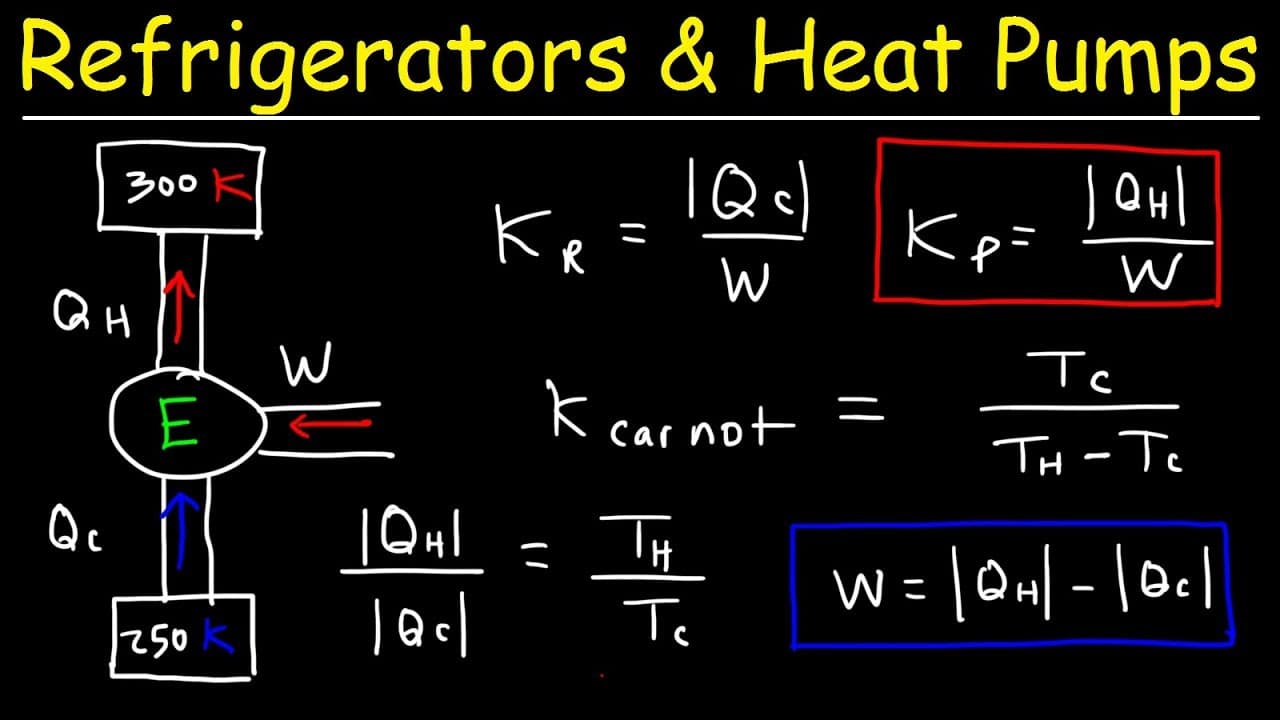
This video explains how to solve problems related to heat pumps and refrigerators, including calculating the coefficient of performance and energy transfer.
Transcript
in this video we're going to solve some basic problems associated with heat pumps and refrigerators so let's start with this problem a refrigerator uses 1500 joules of mechanical work to absorb 4500 joules from the cold reservoir at 250 kelvin the hot reservoir is at 300 kelvin calculate the coefficient of performance for this refrigerator so let's... Read More
Key Insights
- 🥵 Refrigerators require mechanical work to transfer heat from a cold reservoir to a hot reservoir.
- 🥵 The coefficient of performance for a refrigerator is calculated by dividing the heat absorbed by the absolute value of the work done.
- 😅 The maximum coefficient of performance for an ideal refrigerator is determined using temperature values of the cold and hot reservoirs.
- 🥵 Cardinal refrigerators and heat pumps have different equations to calculate energy transfer and coefficient of performance.
Install to Summarize YouTube Videos and Get Transcripts
Explore YouTube Video Summarizer or Get YouTube Transcript Extractor
Questions & Answers
Q: How is the coefficient of performance calculated for a refrigerator?
The coefficient of performance (k) for a refrigerator is calculated by dividing the heat absorbed (QC) by the absolute value of the work done (|W|). In the example given, QC is 4500 J and |W| is 1500 J, resulting in a coefficient of performance of 3.
Q: What is the maximum coefficient of performance for an ideal refrigerator?
The maximum coefficient of performance for an ideal refrigerator is calculated using the formula TC / (TH - TC), where TC is the temperature of the cold reservoir and TH is the temperature of the hot reservoir. In the example, TC is 250 K and TH is 300 K, resulting in a maximum coefficient of performance of 5.
Q: How do you calculate the amount of energy transferred to the hot reservoir in a cardinal refrigerator?
For a cardinal refrigerator, the equation QH / QC = TH / TC is used, where QH is the energy transferred to the hot reservoir and QC is the energy taken from the cold reservoir. In the example, QC is 4000 J, TC is 270 K, and TH is 300 K. Cross multiplying and solving gives QH as 4444 J.
Q: How is the coefficient of performance calculated for a heat pump?
The coefficient of performance for a heat pump is calculated by dividing the heat transferred to the hot reservoir (QH) by the work done (W). In the example given, QH is calculated as 10,000 J, and W is 2500 J, resulting in a coefficient of performance of 4.
Summary & Key Takeaways
-
The video discusses a problem involving a refrigerator that uses 1500 J of mechanical work to absorb 4500 J from the cold reservoir at 250 K. The hot reservoir is at 300 K, and the coefficient of performance is calculated to be 3.
-
The maximum coefficient of performance for an ideal refrigerator is calculated using the formula TC / (TH - TC), which is 5 for this problem.
-
In another scenario, a cardinal refrigerator takes 4000 J of heat energy from the cold reservoir at 270 K and pumps it to the hot reservoir at 300 K. The amount of energy transferred to the hot reservoir and the work needed to accomplish this is calculated.
-
Lastly, the video explains how to calculate the amount of heat energy transferred to the hot reservoir in a heat pump with a coefficient of performance of 4 that uses 2500 J of mechanical work.
Read in Other Languages (beta)
Share This Summary 📚
Summarize YouTube Videos and Get Video Transcripts with 1-Click
Try YouTube Summary with ChatGPT & Claude or YouTube Transcript Generator
Explore More Summaries from The Organic Chemistry Tutor 📚






Summarize YouTube Videos and Get Video Transcripts with 1-Click
Try YouTube Summary with ChatGPT & Claude or YouTube Transcript Generator