Pi and Buffon's Matches - Numberphile
TL;DR
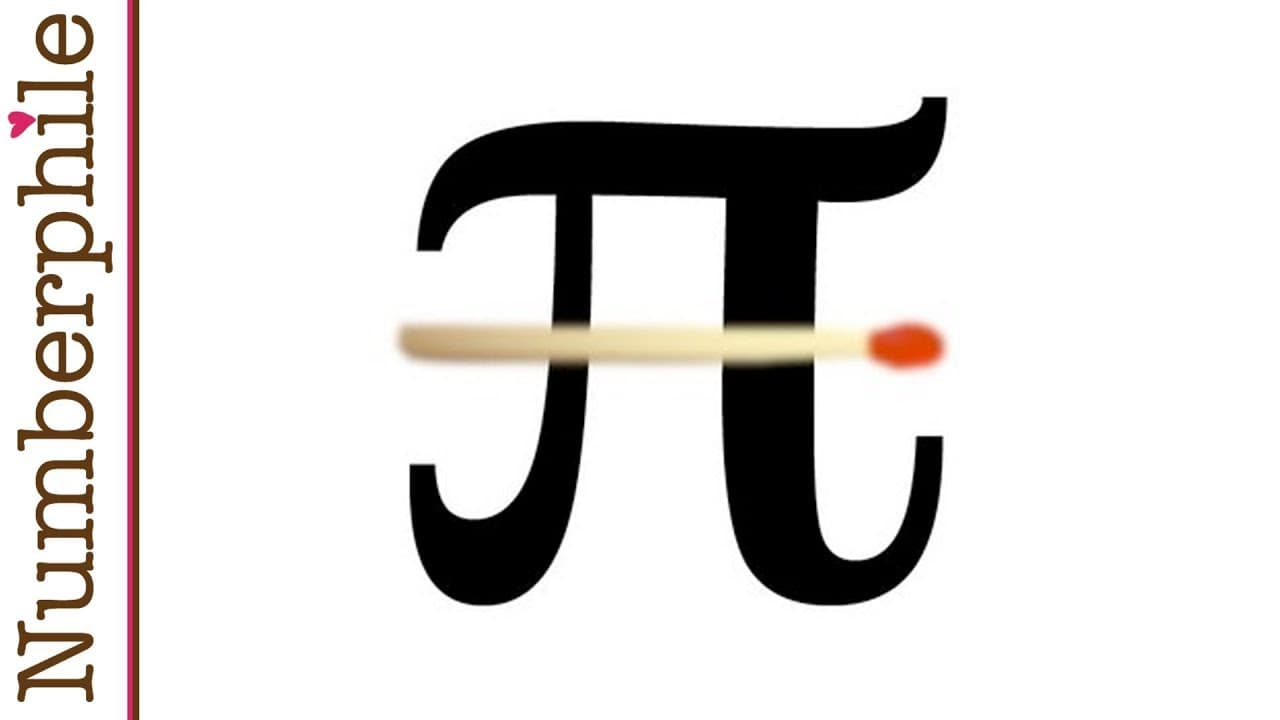
Using matches on a board, the video demonstrates a method to estimate pi through Buffon's needle trick.
Transcript
TONY PADILLA: We're going to do Buffon's needle trick. So this is named after Georges Louie Leclerc, and this is a method that he proposed for working out pi. So basically he proposed that you would chuck a bunch of needles just randomly on a floor. You can work out pi from that, yeah. BRADY HARAN: Go on, then. TONY PADILLA: Due to the random natur... Read More
Key Insights
- 👏 Buffon's needle trick uses random sampling and probability theory to approximate mathematical constants like pi.
- 🤨 Sample size plays a crucial role in the accuracy of estimating pi using the match experiment.
- 🇲🇪 The experiment illustrates a Monte Carlo simulation approach to mathematical estimation.
- 🪡 Understanding probability density and angle measurements are essential in Buffon's needle experiment.
- 🤨 Increasing the number of matches enhances the accuracy of pi estimation.
- 🤗 Buffon's needle trick serves as a practical visualization of mathematical concepts through a hands-on experiment.
- ❓ The method can be generalized to understand the role of probability in mathematical calculations.
Install to Summarize YouTube Videos and Get Transcripts
Explore YouTube Video Summarizer or Get YouTube Transcript Extractor
Questions & Answers
Q: What is Buffon's needle trick and how does it relate to estimating pi?
Buffon's needle trick, named after Georges Louis Leclerc, involves randomly tossing objects (like matches) on a board to calculate pi by counting the intersections with drawn lines. It showcases a probabilistic approach to estimating mathematical constants like pi.
Q: How does the randomness of match placements contribute to the accuracy of pi estimation?
The random distribution of matches on the board allows for a statistical approach to estimating pi. The more matches placed randomly, the closer the estimation can get to the actual value of pi, showcasing the significance of sample size in probabilistic methods.
Q: What role does probability theory play in Buffon's needle experiment?
Probability theory is essential in Buffon's needle experiment as it helps calculate the likelihood of matches crossing drawn lines based on angle measurements and position probabilities. Integrating these probabilities allows for a method to estimate pi through random sampling.
Q: Can the method demonstrated with matches be applied to other mathematical constants or problems?
The method demonstrated with matches can be adapted to other math problems involving probabilistic approaches or sampling methods. It showcases a creative and visual way to understand mathematical concepts and constants beyond just estimating pi.
Summary & Key Takeaways
-
Buffon's needle trick involves using matches to estimate the value of pi by randomly scattering them on a board and counting how many cross drawn lines.
-
By utilizing probability theory and integrating angles, the experiment showcases a method to approximate pi.
-
The accuracy of the estimation improves with more matches, as demonstrated by a mathematician using over 3,000 needles.
Read in Other Languages (beta)
Share This Summary 📚
Summarize YouTube Videos and Get Video Transcripts with 1-Click
Try YouTube Summary with ChatGPT & Claude or YouTube Transcript Generator
Explore More Summaries from Numberphile 📚




Summarize YouTube Videos and Get Video Transcripts with 1-Click
Try YouTube Summary with ChatGPT & Claude or YouTube Transcript Generator