What Is Gradient Descent and How Does It Work?
TL;DR
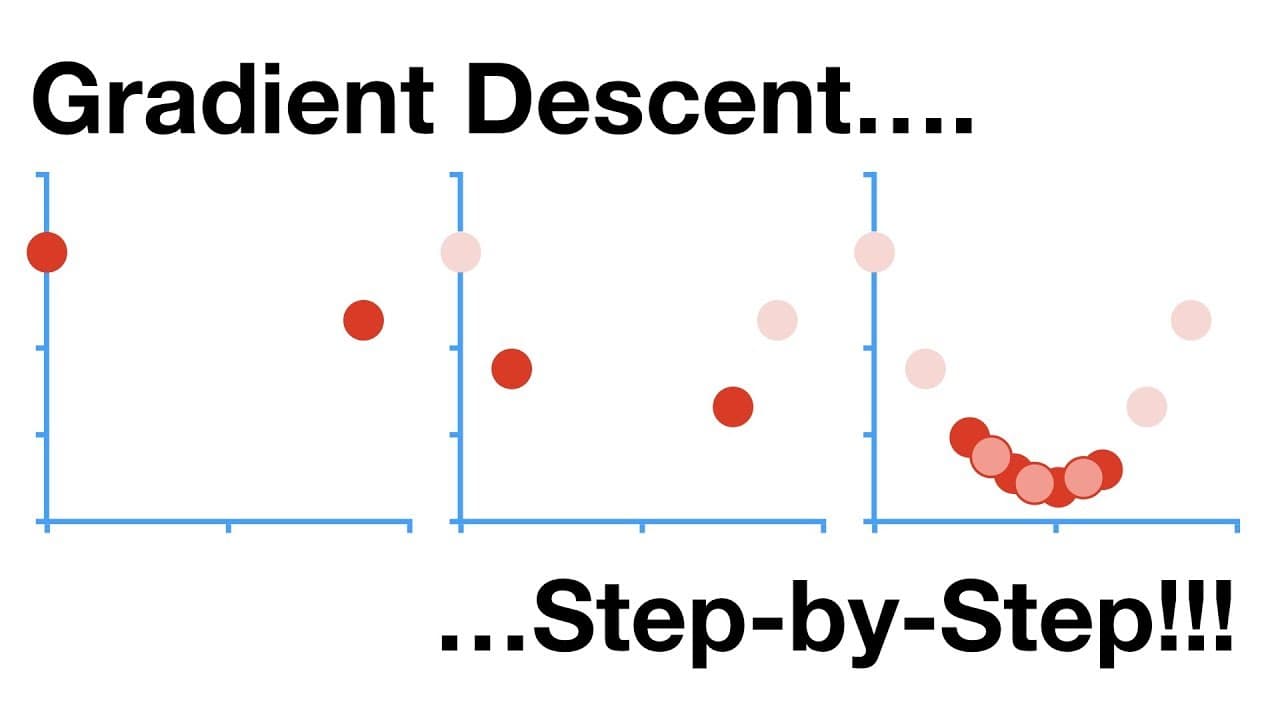
Gradient Descent is an optimization algorithm used to minimize the sum of squared residuals by iteratively adjusting parameters like intercepts and slopes. It takes larger steps when far from the optimal value and smaller steps as it approaches, making it efficient for fitting data in statistics, machine learning, and data science.
Transcript
Gradient Descent is decent at estimating parameters. StatQuest! Hello! I'm Josh Starmer and welcome to StatQuest. Today we're going to learn about Gradient Descent and we're going to go through the algorithm step by step. Note: this StatQuest assumes you already understand the basics of least squares and linear regression, so if you're not already ... Read More
Key Insights
- 🍹 Gradient Descent is a versatile algorithm used in various fields to optimize parameters and minimize the sum of squared residuals.
- ❓ The step size in Gradient Descent is determined by the slope of the curve, ensuring efficient convergence towards the optimal values.
- 🥡 Gradient Descent can handle optimization problems with multiple parameters by taking derivatives and adjusting them iteratively.
Install to Summarize YouTube Videos and Get Transcripts
Explore YouTube Video Summarizer or Get YouTube Transcript Extractor
Questions & Answers
Q: What is the purpose of Gradient Descent in data science?
Gradient Descent is used to optimize parameters by minimizing the sum of squared residuals, enabling better fitting of data and improving predictions.
Q: How does Gradient Descent determine the step size?
Gradient Descent considers the slope of the curve to decide the step size, taking bigger steps when the slope is far from zero and smaller steps when it is closer to zero.
Q: Can Gradient Descent handle optimization problems with multiple parameters?
Yes, Gradient Descent can optimize multiple parameters by taking the derivative of the loss function for each parameter and adjusting them iteratively until convergence.
Q: What is Stochastic Gradient Descent?
Stochastic Gradient Descent is a variant of Gradient Descent that uses randomly selected subsets of the data at each step, reducing computation time when dealing with large datasets.
Key Insights:
- Gradient Descent is a versatile algorithm used in various fields to optimize parameters and minimize the sum of squared residuals.
- The step size in Gradient Descent is determined by the slope of the curve, ensuring efficient convergence towards the optimal values.
- Gradient Descent can handle optimization problems with multiple parameters by taking derivatives and adjusting them iteratively.
- Stochastic Gradient Descent is a variation of Gradient Descent that speeds up computation time by using subsets of the data at each step.
Summary & Key Takeaways
-
Gradient Descent is a powerful algorithm used in statistics, machine learning, and data science to optimize various parameters, such as intercepts, slopes, and clusters.
-
The algorithm works by iteratively calculating the residual, sum of squared residuals, and taking steps towards minimizing this value.
-
The step size in Gradient Descent is determined by the slope of the curve, with bigger steps taken when the slope is far from zero and smaller steps taken when it is closer to zero.
Read in Other Languages (beta)
Share This Summary 📚
Summarize YouTube Videos and Get Video Transcripts with 1-Click
Try YouTube Summary with ChatGPT & Claude or YouTube Transcript Generator
Explore More Summaries from StatQuest with Josh Starmer 📚

Summarize YouTube Videos and Get Video Transcripts with 1-Click
Try YouTube Summary with ChatGPT & Claude or YouTube Transcript Generator