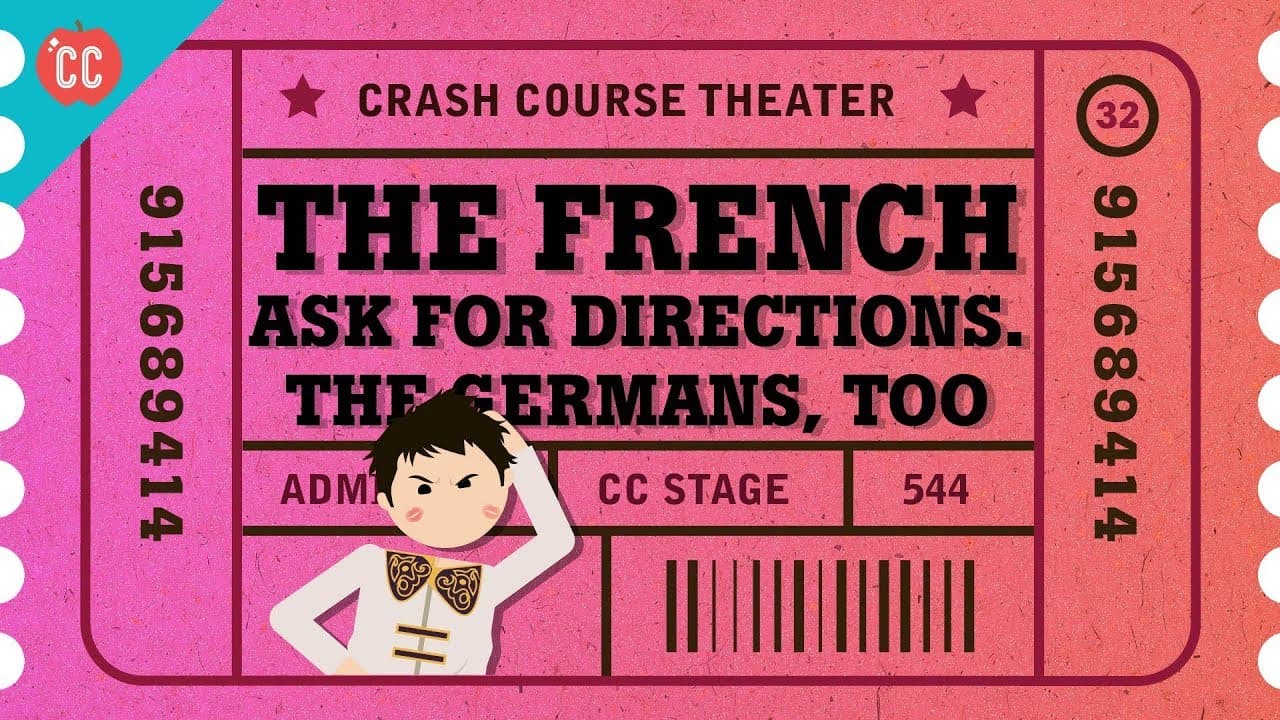
Realism Gets Even More Real: Crash Course Theater #32
TL;DR
Theater realism revolutionized acting and staging in 19th century Europe.
Transcript
Hey there! I’m Mike Rugnetta, this is Crash Course Theater, and did you think we’d finished with French realism? Au contraire! Because remember that whole revolution in playwriting that we looked at last time? Well, it kicked off revolutions in acting and stagecraft, too. We’re going to move between France and Germany, looking at a few of the most... Read More
Key Insights
- Georg II of Saxe-Meiningen revolutionized theater by emphasizing historical accuracy in costumes and props, leading to more realistic performances.
- The Meiningen Court Theater Troupe prioritized meticulous rehearsals and used actual props and costumes from the start, setting a new standard for theatrical productions.
- Andre Antoine founded Theatre Libre in Paris, focusing on ultra-realistic sets and acting, often using unconventional actors like clerks and dressmakers.
- Antoine's productions, such as Tolstoy's 'The Power of Darkness,' featured realistic settings and costumes, captivating audiences despite dark subject matters.
- The FreiBuhne in Berlin and the Independent Theater Society in London were key players in promoting realistic drama, often staging censored plays.
- Francois Delsarte developed a method of actor training linking internal emotions to specific gestures, aiming to bring scientific rigor to theatrical performance.
- The rise of realism in theater led to a shift away from the star system, with troupes like Meiningen emphasizing ensemble work and the importance of extras.
- Realistic theater in the late 19th century was marked by a focus on naturalistic gestures, historically accurate settings, and controversial themes, influencing future theatrical practices.
Install to Summarize YouTube Videos and Get Transcripts
Explore YouTube Video Summarizer or Get YouTube Transcript Extractor
Questions & Answers
Q: What role did Georg II of Saxe-Meiningen play in the evolution of theater realism?
Georg II of Saxe-Meiningen, known as the 'Theater Duke,' played a pivotal role in the evolution of theater realism by insisting on historical accuracy in costumes and props, which led to more authentic performances. He introduced rigorous rehearsal techniques and ensured that every detail of set and lighting was integrated into the play, setting a new standard for theatrical productions.
Q: How did Andre Antoine contribute to the realism movement in theater?
Andre Antoine contributed to the realism movement by founding Theatre Libre in Paris, where he focused on ultra-realistic sets and acting. He was known for using unconventional actors and emphasizing natural gestures and speech. His productions often featured dark subject matter and realistic settings, such as using actual beef carcasses on stage, which captivated audiences and influenced future theatrical practices.
Q: What was the significance of the FreiBuhne and the Independent Theater Society?
The FreiBuhne in Berlin and the Independent Theater Society in London were significant for their roles in promoting realistic drama. They were subscription-based theaters that staged censored plays, providing a platform for works that challenged societal norms. These theaters helped spread the realism movement across Europe by showcasing plays that focused on controversial themes and realistic portrayals of life.
Q: What was Francois Delsarte's contribution to acting methods?
Francois Delsarte contributed to acting methods by developing a system that linked internal emotions to specific outward gestures. His approach aimed to bring scientific rigor to theatrical performance by studying how people naturally express emotions. Delsarte's method was one of the first attempts to apply scientific principles to acting, influencing the development of more realistic acting styles in theater.
Q: How did the Meiningen Court Theater Troupe influence theatrical practices?
The Meiningen Court Theater Troupe influenced theatrical practices by pioneering rehearsal techniques that emphasized the use of actual props and costumes from the start. They also documented the director's decisions in a prompt book to maintain consistency in performances. Their focus on historical accuracy and ensemble work, as opposed to the star system, set a new standard for realism in theater.
Q: What challenges did Andre Antoine face with Theatre Libre's economic model?
Andre Antoine faced challenges with Theatre Libre's economic model because each production ran for only three nights, making it difficult to sustain financially. The high cost of creating ultra-realistic sets, such as purchasing actual dorm room furnishings or using real beef carcasses, added to the financial strain. Despite these challenges, Theatre Libre was influential in advancing the realism movement in theater.
Q: What impact did the production of 'The Power of Darkness' have on audiences?
The production of 'The Power of Darkness' had a significant impact on audiences, as it was a world premiere of a play banned by the Tsar for its dark subject matter. Antoine's realistic portrayal of Russian life and the intense, immersive experience captivated audiences for four hours, demonstrating the power of realism in theater to engage and provoke thought among viewers.
Q: What was the role of subscription-based theaters in promoting realism?
Subscription-based theaters played a crucial role in promoting realism by providing a platform for controversial and censored plays that traditional theaters avoided. By relying on subscriptions, these theaters bypassed the need for approval from censors, allowing them to stage works that pushed the boundaries of societal norms and contributed to the spread of realistic drama across Europe.
Summary & Key Takeaways
-
The late 19th-century European theater saw a shift towards realism, spearheaded by figures like Georg II of Saxe-Meiningen and Andre Antoine. They emphasized historical accuracy in costumes and props, meticulous rehearsals, and realistic set designs, transforming theatrical practices.
-
Andre Antoine's Theatre Libre in Paris was known for its ultra-realistic productions and unconventional casting choices. His approach to set design and acting style influenced the broader movement towards realism in theater, despite economic challenges.
-
Realistic drama gained traction across Europe, with subscription-based theaters like FreiBuhne and the Independent Theater Society staging controversial plays. Francois Delsarte's method of actor training sought to scientifically connect emotions with gestures, furthering the realism movement.
Read in Other Languages (beta)
Share This Summary 📚
Summarize YouTube Videos and Get Video Transcripts with 1-Click
Try YouTube Summary with ChatGPT & Claude or YouTube Transcript Generator
Explore More Summaries from CrashCourse 📚




Summarize YouTube Videos and Get Video Transcripts with 1-Click
Try YouTube Summary with ChatGPT & Claude or YouTube Transcript Generator