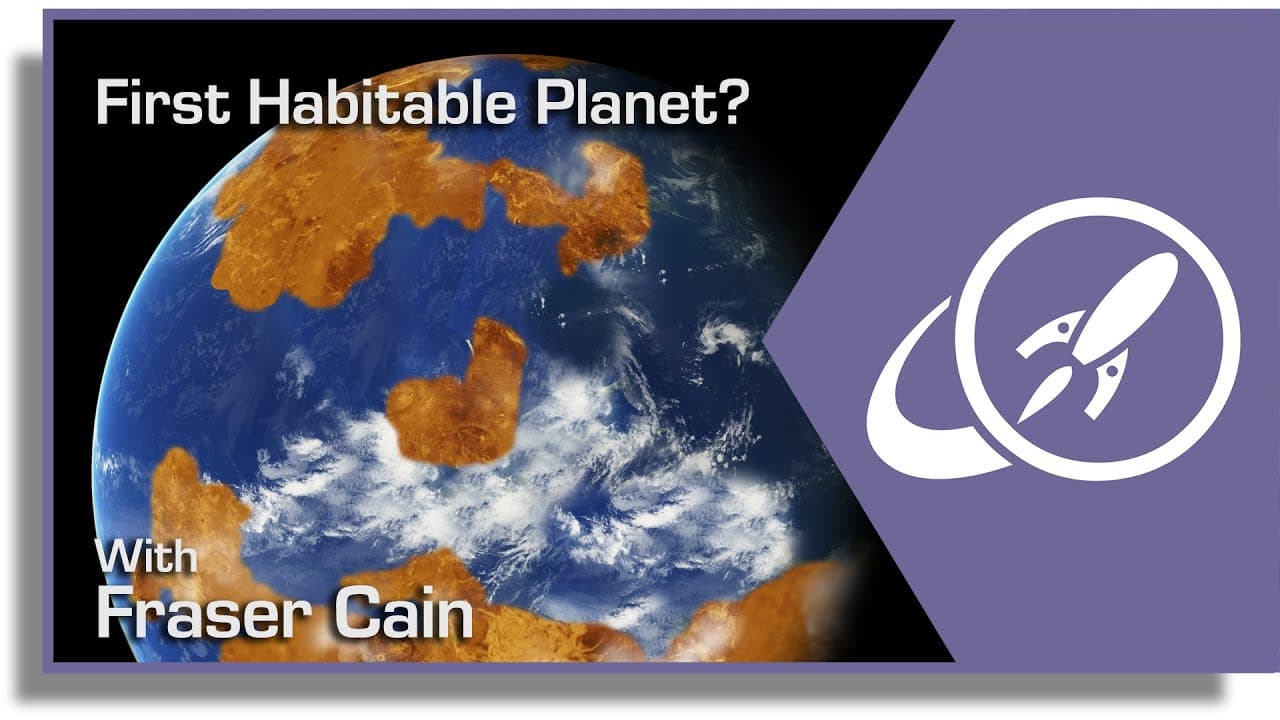
Venus Could Have Supported Life For Billions Of Years. First Habitable Planet In The Solar System?
TL;DR
Venus may have been the first habitable world in our solar system, maintaining stable temperatures for billions of years before a catastrophic event transformed it.
Transcript
after decades of research including multiple Landers and orbiters science can definitively say Venus sucks seriously that place is the worst with its boiling temperature intense pressure sulfuric acid rain and more but was it always this bad according to new research from NASA and various universities in Sweden in the u.s. Venus might have actually... Read More
Key Insights
- ❓ Venus may have been habitable for billions of years before a catastrophic event transformed its climate.
- 👨🔬 Research suggests Venus had a composition similar to Earth's in its ancient past, with shallow seas and an Earth-like atmosphere.
- ❓ Simulations show Venus could have maintained stable temperatures for almost three billion years.
- 💄 A massive volcanic resurfacing event likely triggered a runaway greenhouse effect on Venus, making it uninhabitable.
- 👶 Further exploration with new technology is needed to uncover Venus's mysterious history and potential for past habitability.
- 😀 The Plucky Soviet Venera program successfully landed on Venus, providing valuable data despite the harsh conditions it faced.
- ✋ Venus's extreme conditions today, such as high temperatures and pressure, make it inhospitable for life as we know it.
Install to Summarize YouTube Videos and Get Transcripts
Explore YouTube Video Summarizer or Get YouTube Transcript Extractor
Questions & Answers
Q: What conditions currently exist on Venus that prevent it from being habitable?
Venus today has extreme temperatures, pressure, and acidic conditions, making it inhospitable for life as we know it. It experiences temperatures hot enough to melt lead and atmospheric pressure 90 times that of Earth.
Q: How did researchers determine Venus's ancient composition and atmosphere?
Astronomers calculated Venus's ancient composition based on the ratio between deuterium and hydrogen in its atmosphere. They inferred that Venus had a thicker nitrogen atmosphere and shallow seas similar to Earth in the past.
Q: What role did volcanic resurfacing play in Venus's transformation?
A catastrophic volcanic event on Venus, similar to Earth's largest volcanic eruption, caused a runaway greenhouse effect by releasing absorbed carbon dioxide. This event permanently altered Venus's climate and made it uninhabitable.
Q: Why is further exploration of Venus crucial to unraveling its mysterious history?
Detailed exploration with orbiters, balloons, and tough Landers made of heat-tolerant electronics is essential to uncovering Venus's past and potential habitability. Unfortunately, there are no planned missions to Venus in the near future.
Summary & Key Takeaways
-
Venus, once potentially habitable, now has extreme conditions with boiling temperatures, intense pressure, and sulfuric acid rain.
-
Research suggests Venus had a similar composition to Earth in its ancient past, with shallow seas and an Earth-like atmosphere.
-
Simulations show Venus could have maintained stable temperatures for almost three billion years before a catastrophic event changed its climate.
Read in Other Languages (beta)
Share This Summary 📚
Summarize YouTube Videos and Get Video Transcripts with 1-Click
Try YouTube Summary with ChatGPT & Claude or YouTube Transcript Generator
Explore More Summaries from Fraser Cain 📚




Summarize YouTube Videos and Get Video Transcripts with 1-Click
Try YouTube Summary with ChatGPT & Claude or YouTube Transcript Generator