What Impact Did Westward Expansion Have on Society?
TL;DR
Westward expansion after the Civil War profoundly reshaped American society, driving violence against Native Americans and other minorities while resulting in significant land loss and cultural assimilation. Government policies, like the Dawes Act, aimed to force Native Americans into American culture, leading to devastating consequences for their communities and the environment.
Transcript
- [Instructor] In other videos, we've discussed the causes and effects of westward expansion in the 19th century, focusing on the period that began with the discovery of gold in California in 1849 and ending shortly after the Civil War. But westward expansion was a long process. Eight new states entered the Union between 1876 and 1896. And not unti... Read More
Key Insights
- 💱 Westward expansion intensified after the Civil War, with unique aspects such as conflicts with Native Americans and changes in the US government's approach.
- 🌸 Violence against Native Americans and minorities, loss of land, cultural assimilation, and environmental transformations were significant consequences of westward expansion.
- 👨🏫 The Dawes Act and Indian boarding schools aimed to assimilate Native Americans into American culture, while Chinese immigrants were excluded through the Chinese Exclusion Act.
- 😒 Environmental changes, such as the near extinction of the American bison and the use of barbed wire, had profound impacts on Plains Indians and cowboys.
Install to Summarize YouTube Videos and Get Transcripts
Explore YouTube Video Summarizer or Get YouTube Transcript Extractor
Questions & Answers
Q: How did the US government's treatment of Native Americans change after the Civil War?
After the Civil War, Native Americans were cast as wards of the state and confined to reservations. Those who refused to adopt American ways were classified as hostile, leading to conflicts known as the Indian Wars.
Q: How did the Dawes Act of 1887 impact Native Americans?
The Dawes Act aimed to force Native Americans to take up American culture and farming by splitting up reservations and awarding land to each head of household. However, corruption and discrimination led to the loss of over 80 million acres of Native American land.
Q: How were minorities affected by westward expansion?
Minorities, such as Mexican Americans and Chinese immigrants, faced racial violence, loss of land, and cultural assimilation. Mexican Americans had their land claimed by white settlers, while Chinese immigrants were subject to the Chinese Exclusion Act and restrictions on immigration.
Q: What were some environmental transformations resulting from westward expansion?
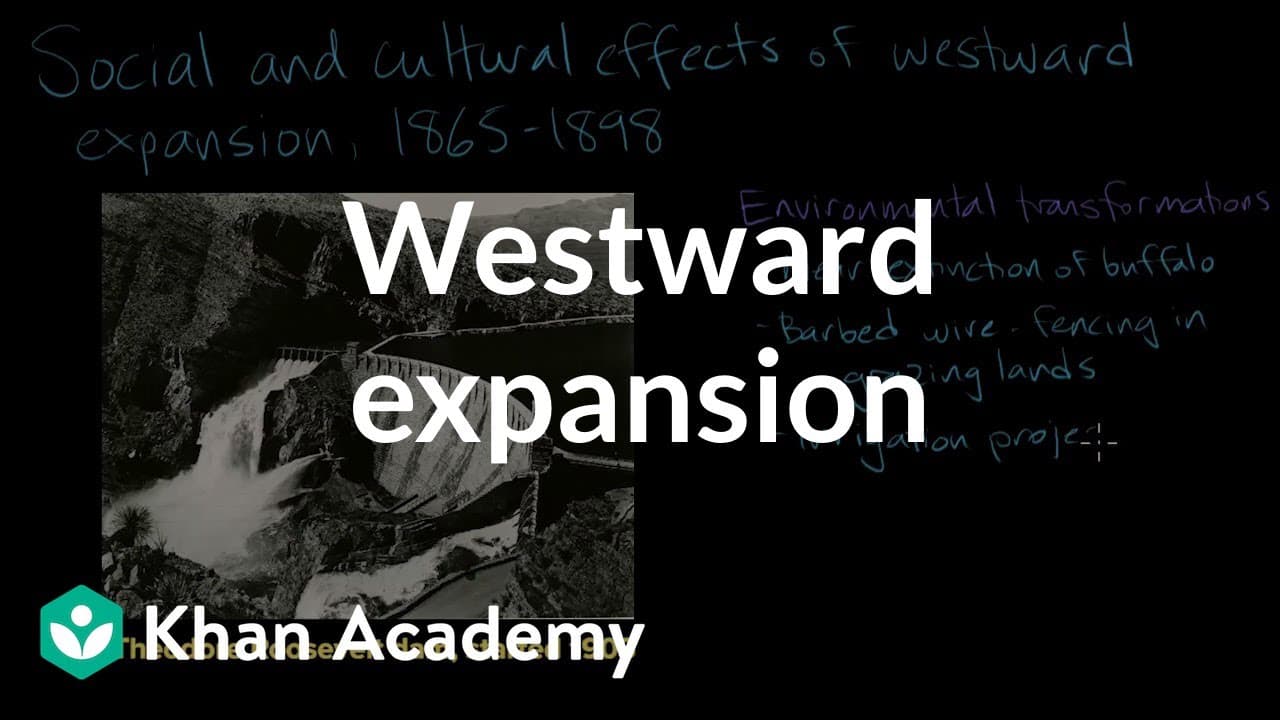
Westward expansion led to the near extinction of the American bison, as well as the development of barbed wire that fenced off communal grazing lands. Massive irrigation projects were also undertaken to supply water to arid areas, leading to future issues like the Dust Bowl.
Summary & Key Takeaways
-
Westward expansion in the 19th century was fueled by factors such as the search for farmland, the California Gold Rush, and the construction of the transcontinental railroad.
-
After the Civil War, the US government changed its approach towards Native Americans, confining them to reservations and engaging in conflicts known as the Indian Wars.
-
Westward expansion resulted in violence against Native Americans and minorities, loss of land, cultural assimilation, and environmental transformations.
Read in Other Languages (beta)
Share This Summary 📚
Summarize YouTube Videos and Get Video Transcripts with 1-Click
Try YouTube Summary with ChatGPT & Claude or YouTube Transcript Generator
Explore More Summaries from Khan Academy 📚






Summarize YouTube Videos and Get Video Transcripts with 1-Click
Try YouTube Summary with ChatGPT & Claude or YouTube Transcript Generator