Growing Mars Habitats with Bioreactors [NIAC 2023]
TL;DR
Dr. Kongri Jin is pioneering regolith-based living bricks using bacteria and fungi to craft Martian structures self-sufficiently.
Transcript
when we go to Mars we're going to need to build things roads buildings landing pads things like that and obviously you don't want to bring all of the raw materials from Earth you want to make some of that stuff on site and so what you've got to work with right you've got the regolith and you've got the atmosphere and energy coming from the Sun and ... Read More
Key Insights
- 🤗 Using bacteria and fungi to solidify regolith opens up possibilities for self-sufficient construction on Mars.
- 💁 The project's success relies on finding compatible microbial strains and optimizing growth conditions for efficient brick formation.
- 👷 Mars' unique environment presents challenges in developing construction materials suitable for human colonization.
- 🤳 Automated self-growing and self-repairing properties of living bricks offer sustainable solutions for Martian infrastructure.
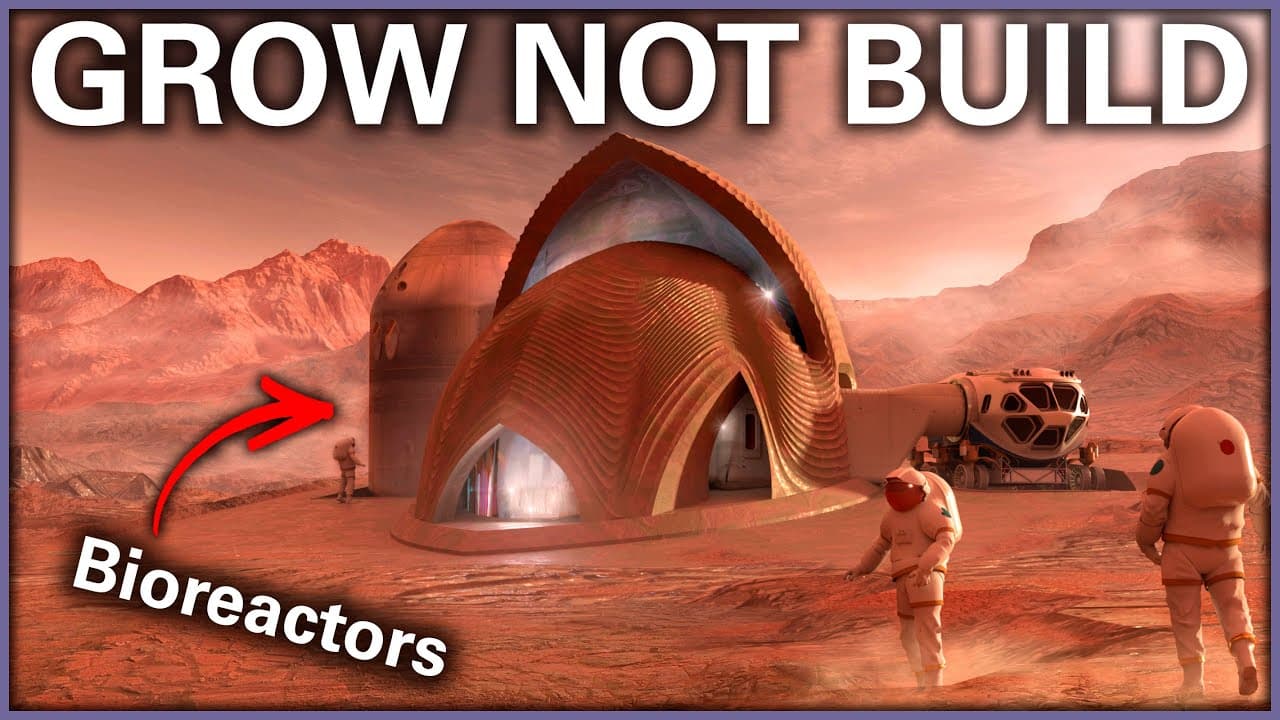
- 🖐️ Bioreactors play a crucial role in nurturing microbial colonies to shape regolith into functional structures.
- 👷 The project highlights the importance of utilizing local resources and innovative technologies for extraterrestrial construction.
- 🏛️ Future experiments testing this technology on Mars will involve bioreactors extracting components from the Martian environment to build structures autonomously.
Install to Summarize YouTube Videos and Get Transcripts
Explore YouTube Video Summarizer or Get YouTube Transcript Extractor
Questions & Answers
Q: How does Dr. Kongri Jin's project aim to facilitate construction on Mars?
Dr. Kongri Jin's project uses bacteria and fungi to convert Martian regolith into living bricks, promoting self-sufficient construction on the planet without the reliance on transported Earth materials.
Q: What are the key components needed from Earth to initiate the construction process on Mars?
Essential components include bacterial and fungal spores, alongside a bioreactor to maintain optimal growth conditions for creating living bricks using local Martian resources.
Q: How do the bacteria and fungus contribute to the strength and cohesion of the living bricks?
Bacteria and fungi play crucial roles in generating calcium carbonate crystals that act as binders, enhancing the adhesion between soil particles and creating robust structures suitable for construction.
Q: What are the primary objectives of Dr. Kongri Jin's NIAC Grant project?
The project aims to identify compatible microbial strains, optimize growth conditions, develop a laboratory-scale bioreactor, and conduct tests to assess the strength and feasibility of the living bricks for Martian construction.
Summary & Key Takeaways
-
Dr. Kongri Jin's innovative project aims to use bacteria and fungi to solidify Martian regolith into bricks and structures for future human colonization.
-
By utilizing bioreactors and local resources on Mars, the technology enables self-sufficient construction without the need to transport materials from Earth.
-
The project involves finding compatible bacterial and fungal strains, optimizing growth conditions, and creating molds to shape regolith into desired structures.
Read in Other Languages (beta)
Share This Summary 📚
Summarize YouTube Videos and Get Video Transcripts with 1-Click
Try YouTube Summary with ChatGPT & Claude or YouTube Transcript Generator
Explore More Summaries from Fraser Cain / Universe Today Podcast 📚





Summarize YouTube Videos and Get Video Transcripts with 1-Click
Try YouTube Summary with ChatGPT & Claude or YouTube Transcript Generator