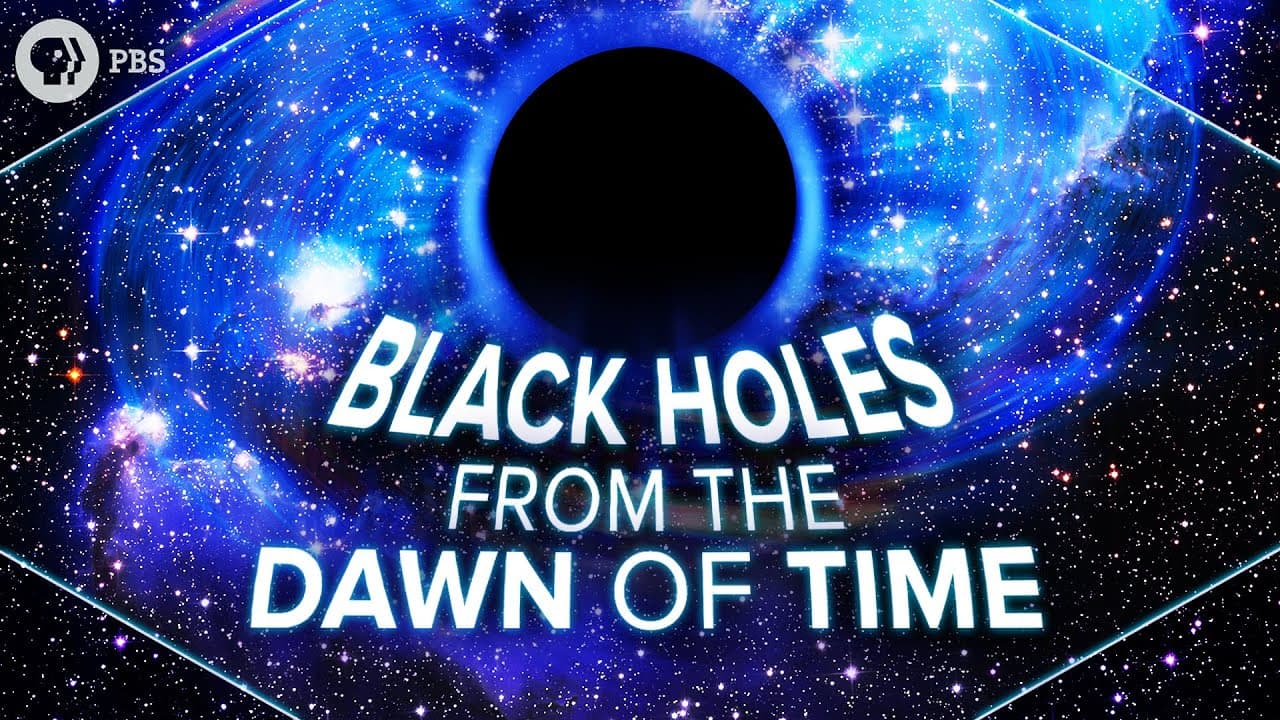
Black Holes from the Dawn of Time
TL;DR
Primordial black holes might exist since the Big Bang.
Transcript
MATT O'DOWD: This episode is supported by the Great Courses Plus. In the very first instant after the Big Bang, the density of matter was so great everywhere that vast numbers of black holes may have formed. These primordial black holes may still be with us. [MUSIC PLAYING] There's no longer any question that black holes exist. LIGO's recent observ... Read More
Key Insights
- Primordial black holes may have formed immediately after the Big Bang due to the universe's high density, potentially still existing today.
- LIGO's detection of gravitational waves confirms black holes' existence, supporting theories about primordial black holes.
- Primordial black holes require a density differential to form, which was possible due to early universe's density fluctuations.
- Different models predict a range of masses for primordial black holes, from a few grams to thousands of solar masses.
- If primordial black holes exist, they might contribute to dark matter, though evidence for this is currently limited.
- Gravitational lensing and microlensing effects can help detect primordial black holes, but current observations limit their possible mass ranges.
- Primordial black holes could have left traces in the cosmic microwave background or geologically, potentially detectable in Earth's crust.
- Close encounters with primordial black holes could disrupt solar system bodies, but smaller ones might pass unnoticed.
Install to Summarize YouTube Videos and Get Transcripts
Explore YouTube Video Summarizer or Get YouTube Transcript Extractor
Questions & Answers
Q: What are primordial black holes?
Primordial black holes are hypothetical black holes that may have formed immediately after the Big Bang due to the extremely high density of matter. Unlike black holes formed from collapsing stars, primordial black holes could have a wide range of masses and might still exist today, potentially contributing to dark matter.
Q: How do primordial black holes form?
Primordial black holes form when regions of the early universe have a high enough density differential to overcome the expansion of the universe. This could happen due to quantum fluctuations during cosmic inflation, leading to some regions collapsing into black holes while others expand.
Q: What evidence supports the existence of primordial black holes?
While direct evidence for primordial black holes is limited, their existence is supported by gravitational wave detections from LIGO and theoretical models of the early universe. Observations of gravitational lensing and microlensing could also provide indirect evidence, though current data limits their possible mass ranges.
Q: Could primordial black holes be dark matter?
Primordial black holes are a candidate for dark matter, but current observations limit their mass ranges to either small asteroid-like masses or larger solar masses. The lack of gravitational lensing and disruption in star systems suggests they are not the primary component of dark matter, though some may still contribute.
Q: How might primordial black holes affect the solar system?
If a primordial black hole passed through the solar system, it could gravitationally disrupt planetary orbits or the Oort cloud, potentially sending comets toward the inner solar system. However, smaller primordial black holes might pass through unnoticed due to their low mass and high speed.
Q: What is the significance of detecting primordial black holes?
Detecting primordial black holes would provide valuable insights into the conditions of the early universe and the nature of dark matter. Their discovery could confirm theories about the universe's density fluctuations and cosmic inflation, offering a deeper understanding of the cosmos's origins.
Q: What challenges exist in detecting primordial black holes?
Detecting primordial black holes is challenging due to their potential small size and lack of obvious gravitational effects. They may not produce significant gravitational lensing or disrupt star systems, making them difficult to observe with current technology. Geological evidence or specific gravitational wave patterns might offer detection possibilities.
Q: How might primordial black holes be detected on Earth?
Primordial black holes passing through Earth could leave detectable traces in crystalline structures due to the energy deposited by their Hawking radiation. Geologists might identify these traces, providing indirect evidence of primordial black holes if they exist in sufficient numbers and masses.
Summary & Key Takeaways
-
Primordial black holes may have formed in the early universe due to high density and density fluctuations, potentially still existing today. These black holes could range in mass from a few grams to thousands of solar masses, depending on the model.
-
Detecting primordial black holes is challenging due to their potential small size and lack of obvious gravitational effects. However, they might contribute to dark matter, and their detection could provide insights into the early universe.
-
Primordial black holes could disrupt solar system bodies if they pass nearby, but smaller ones might pass unnoticed. Their existence and characteristics could be revealed through gravitational lensing or geological evidence on Earth.
Read in Other Languages (beta)
Share This Summary 📚
Summarize YouTube Videos and Get Video Transcripts with 1-Click
Try YouTube Summary with ChatGPT & Claude or YouTube Transcript Generator
Explore More Summaries from PBS Space Time 📚
Summarize YouTube Videos and Get Video Transcripts with 1-Click
Try YouTube Summary with ChatGPT & Claude or YouTube Transcript Generator