AI Language Models & Transformers - Computerphile
TL;DR
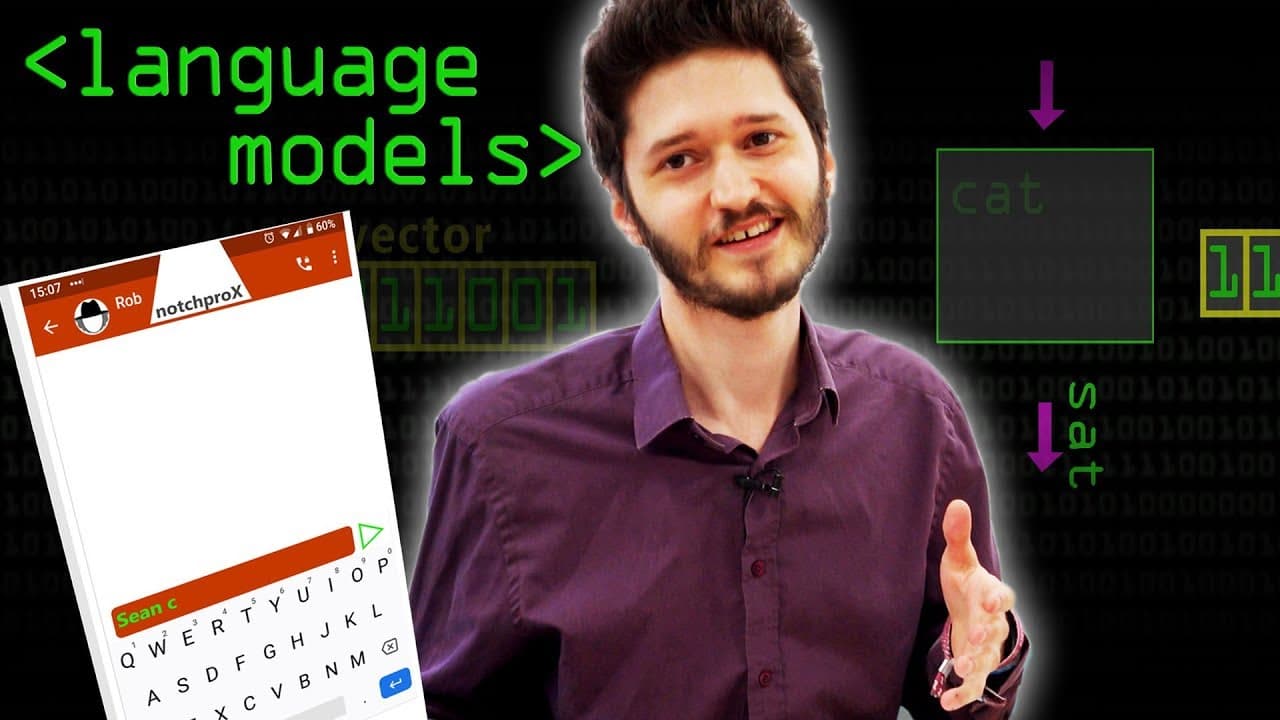
Language models, such as GPT-2, are powerful tools that can generate text based on probability distributions. Transformers, a type of neural network architecture, are especially effective at language modeling tasks.
Transcript
cSo I wanted to make a video about GPT - 2 Because it's been in the news recently this very powerful language model from open AI and I thought it would make sense to start by just doing a video about transformers and language models in general because GPT 2 is a very large Language model implemented as a transformer, but you have a previous video a... Read More
Key Insights
- 🔑 Language models utilize probability distributions to determine the likelihood of a given sequence of words in a language.
- 💁 Transformers, a type of neural network architecture, excel at language modeling tasks by using attention to selectively focus on relevant information.
- 🍉 Recurrent models like RNNs and LSTMs struggle with maintaining long-term dependencies in language modeling.
- ❓ Language models can be used for various tasks such as text generation, translation, summarization, and enhancing other language-related tasks.
- 💨 Transformers offer better performance and faster computation compared to RNNs due to their parallelizable nature.
- 🥳 Attention allows language models to selectively pay attention to certain parts of the input or output, making them more interpretable and accurate.
- ✊ GPT-2 by OpenAI aims to explore the potential of language models by training them on larger datasets and increasing computational power.
Install to Summarize YouTube Videos and Get Transcripts
Explore YouTube Video Summarizer or Get YouTube Transcript Extractor
Questions & Answers
Q: What is a language model and what can it be used for?
A language model is a probability distribution that assigns likelihoods to a sequence of tokens or words in a language. It can be used for text generation, translation, summarization, and even enhancing tasks like speech recognition or text recognition from images.
Q: How do transformers differ from recurrent neural networks (RNNs)?
Transformers are a type of neural network architecture that rely heavily on attention instead of recurrence. They can selectively focus on relevant information, making them faster and more parallelizable compared to RNNs.
Q: What are the challenges in maintaining long-term dependencies in language modeling?
RNNs and LSTM models struggle with maintaining long-term dependencies as they have a limited capacity to remember information from the beginning of a sentence. This can lead to issues in generating coherent sentences that build upon previous context.
Q: What is the significance of attention in language models?
Attention allows language models to focus on specific parts of the input or output, making them more interpretable and capable of generating coherent and contextually relevant text.
Summary & Key Takeaways
-
Language models are probability distributions that can determine the likelihood of a sequence of tokens or words in a language.
-
Transformers, a relatively new neural network architecture, excel at language modeling tasks by using attention to selectively focus on relevant information.
-
Recurrent neural networks (RNNs) and LSTM models have been used in the past for language modeling, but they struggle with maintaining long-term dependencies.
Read in Other Languages (beta)
Share This Summary 📚
Summarize YouTube Videos and Get Video Transcripts with 1-Click
Try YouTube Summary with ChatGPT & Claude or YouTube Transcript Generator
Explore More Summaries from Computerphile 📚


Summarize YouTube Videos and Get Video Transcripts with 1-Click
Try YouTube Summary with ChatGPT & Claude or YouTube Transcript Generator