Testing of Lime 3
TL;DR
Exploring volume yield, transverse strength, compressive strength, and chemical analysis tests for lime.
Transcript
hello students in this lesson let us study about some more tests which will be conducted on the line so the test we will be studying here will be the volume yield of quick line transverse strength test compression or compressive strength test and the chemical analysis so let's get started and discuss one by one so the tenth one is the volume yield ... Read More
Key Insights
- 🏆 Volume yield test measures lime putty drainage to adjust consistency.
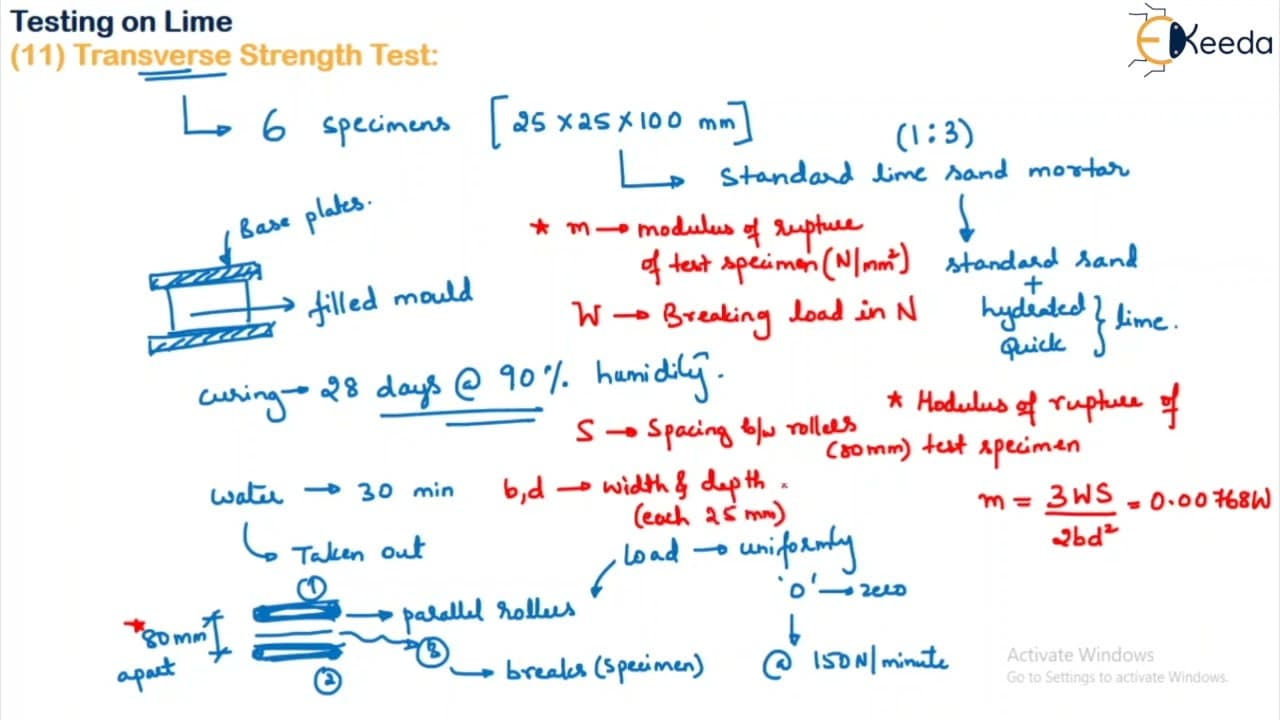
- 📶 Transverse strength test evaluates material strength using modulus of rupture.
- 📶 Compressive strength test assesses cube strength at 14 and 28 days for quality control.
- ⚾ Chemical analysis determines cementation value based on lime composition.
- ❓ Standard procedures and calculations ensure accurate testing results.
- 👷 Quality control measures are crucial for the construction industry.
- ❓ Understanding lime properties is essential for structural stability.
Install to Summarize YouTube Videos and Get Transcripts
Explore YouTube Video Summarizer or Get YouTube Transcript Extractor
Questions & Answers
Q: What is the purpose of the volume yield test for quicklime?
The volume yield test measures the volume of quicklime putty yielded by draining water, determining density and consistency for quality control.
Q: How is the modulus of rupture calculated in the transverse strength test?
The modulus of rupture in the transverse strength test is calculated using the formula involving breaking load, spacing between rollers, and specimen dimensions to assess material strength.
Q: What factors are considered in the compressive strength test of lime sand mortar cubes?
The compressive strength test involves curing cubes in specific conditions, testing at 14 and 28 days, and calculating average compressive strength for quality assessment.
Q: How is the cementation value determined in lime chemical analysis?
The cementation value is calculated using the chemical composition of lime, focusing on silica, aluminum, ferric oxide, calcium oxide, and magnesium oxide contents to assess its properties.
Summary & Key Takeaways
-
Volume yield test involves draining water from lime putty; density calculated using known volume.
-
Transverse strength test uses standard lime sand mortar; calculates modulus of rupture.
-
Compressive strength test examines cube specimens for 14 and 28 days strength; uses lime sand mortar.
Read in Other Languages (beta)
Share This Summary 📚
Summarize YouTube Videos and Get Video Transcripts with 1-Click
Try YouTube Summary with ChatGPT & Claude or YouTube Transcript Generator
Explore More Summaries from Ekeeda 📚


Summarize YouTube Videos and Get Video Transcripts with 1-Click
Try YouTube Summary with ChatGPT & Claude or YouTube Transcript Generator