SN1 Reaction Mechanism
TL;DR
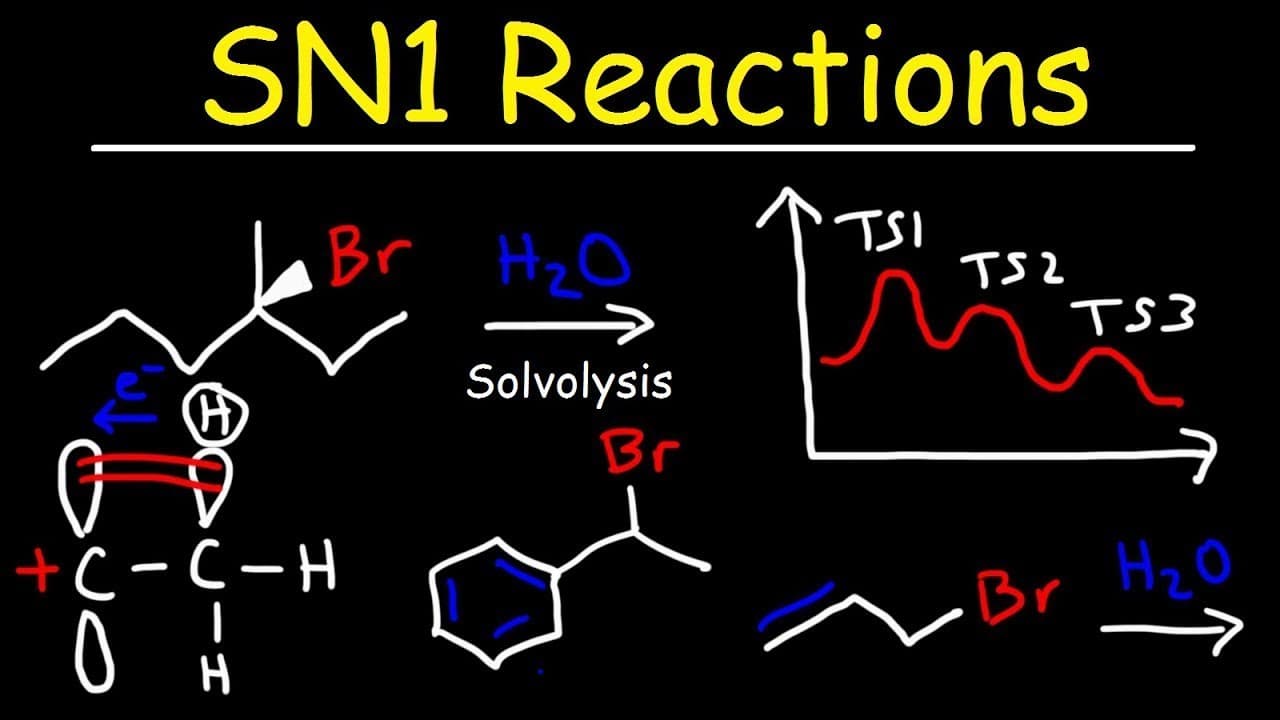
The SN1 reaction mechanism involves the substitution of a leaving group with a nucleophile, with carbocation intermediates. Tertiary alkyl halides favor the SN1 reaction over SN2. The rate of SN1 reactions is unimolecular and depends on the concentration of the substrate but not the nucleophile.
Transcript
in this video we're going to focus on the sn1 reaction mechanism so let's say we have tert-butyl bromide and we wish to react it with potassium iodide what's going to be the major product in this reaction in order to draw the major product all we need to do is replace the leaving group with the nucleophile in this case the nucleophile is the iodide... Read More
Key Insights
- 💁 SN1 reactions involve the substitution of a leaving group with a nucleophile, forming a carbocation intermediate.
- ❓ Tertiary alkyl halides favor the SN1 mechanism due to the stability of the carbocation.
- ❓ SN1 reactions are unimolecular and depend on the concentration of the substrate, but not the nucleophile.
- 🥺 Carbocation rearrangements can occur in SN1 reactions, leading to different products.
- ❓ Primary alkyl halides typically do not undergo SN1 reactions, except for primary allylic alkyl halides.
- 😑 Leaving group stability in SN1 reactions corresponds with ion size, with larger ions being better leaving groups.
- ❓ SN1 reactions can occur with benzohalides, which have a benzylic carbocation intermediate.
Install to Summarize YouTube Videos and Get Transcripts
Explore YouTube Video Summarizer or Get YouTube Transcript Extractor
Questions & Answers
Q: What is the major product in an SN1 reaction with tertiary alkyl halides?
In an SN1 reaction with tertiary alkyl halides, the major product is formed by replacing the leaving group with a nucleophile, typically resulting in a carbocation intermediate and a new compound.
Q: How does the rate of an SN1 reaction depend on the concentration of the nucleophile?
The rate of an SN1 reaction is unimolecular and depends on the concentration of the substrate, not the nucleophile. Increasing the substrate concentration will increase the reaction rate.
Q: Why are tertiary alkyl halides more reactive in SN1 reactions compared to secondary alkyl halides?
Tertiary alkyl halides are more reactive in SN1 reactions due to the stability of the carbocation intermediate. The presence of three methyl groups stabilizes the carbocation through hyperconjugation and the inductive effect, making it easier to form.
Q: Can primary alkyl halides undergo SN1 reactions?
In most cases, primary alkyl halides do not undergo SN1 reactions due to the instability of the primary carbocation. However, primary allylic alkyl halides can undergo SN1 reactions because the allylic carbocation is stabilized through resonance.
Summary & Key Takeaways
-
The SN1 reaction involves replacing a leaving group with a nucleophile, forming a carbocation intermediate. Tertiary alkyl halides prefer the SN1 mechanism.
-
SN1 reactions are unimolecular, with the rate depending on the concentration of the substrate but not the nucleophile.
-
Carbocation rearrangements can occur in SN1 reactions, leading to different products.
Read in Other Languages (beta)
Share This Summary 📚
Summarize YouTube Videos and Get Video Transcripts with 1-Click
Try YouTube Summary with ChatGPT & Claude or YouTube Transcript Generator
Explore More Summaries from The Organic Chemistry Tutor 📚




Summarize YouTube Videos and Get Video Transcripts with 1-Click
Try YouTube Summary with ChatGPT & Claude or YouTube Transcript Generator