How To Convert Between Exponential Form and Radical Form - Algebra
TL;DR
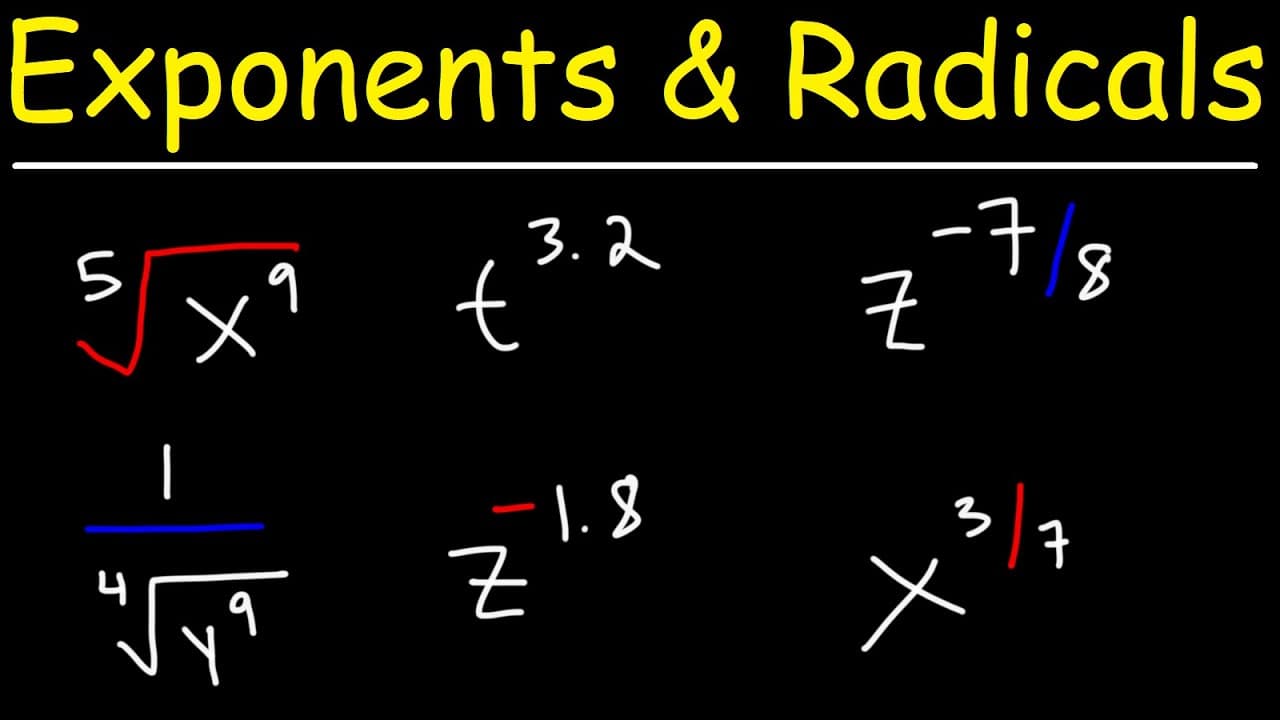
Learn how to convert expressions from exponential form to radical form using the formula a^(m/N) = N√(a^m).
Transcript
in this lesson we're going to talk about how to convert from exponential form to radical form so here's a formula that you want to be familiar with a raised to the m/ N so here we have a rational exponent is equal to the nth root of a raised to the m so here we have a variable in its exponential form and here is how we can convert it into its radic... Read More
Key Insights
- 💁 Exponential form can be converted to radical form using the formula a^(m/N) = N√(a^m).
- 💁 The index number represents the root in radical form, and the exponent represents the power in exponential form.
- 💱 Negative exponents can be eliminated by moving the variable to the denominator and changing the exponent to a positive value.
- ✖️ Decimal exponents can be converted to fractional exponents by multiplying the decimal by a suitable fraction.
- 😑 Expressions with fractional exponents can also be written as the radical form using the index number.
- 💁 The formula for converting from exponential form to radical form is useful in simplifying and solving mathematical expressions.
- 💁 It is important to understand the relationship between exponential form and radical form in order to manipulate and solve equations.
Install to Summarize YouTube Videos and Get Transcripts
Explore YouTube Video Summarizer or Get YouTube Transcript Extractor
Questions & Answers
Q: What is the formula to convert from exponential form to radical form?
The formula is a^(m/N) = N√(a^m), where a is the base, m is the exponent, and N is the index number.
Q: How do you convert x^(1/4) into radical form?
For x^(1/4), the index number is 4, so the expression can be written as the fourth root of x.
Q: How can you convert decimal exponents into fractional exponents?
To convert decimal exponents, such as 2.5, into fractional exponents, you can multiply the decimal by a suitable fraction. For example, 2.5 can be multiplied by 2/2 to become 5/2.
Q: What is the equivalent exponential form of the cube root of y?
The exponential form of the cube root of y is y^(1/3), where y is raised to the power of 1/3.
Summary & Key Takeaways
-
Converting from exponential form to radical form involves using the index number as the root and the exponent as the power.
-
When the exponent is 1, it can be omitted in the radical form.
-
Negative exponents can be eliminated by moving the variable to the denominator and changing the exponent to a positive value.
Read in Other Languages (beta)
Share This Summary 📚
Summarize YouTube Videos and Get Video Transcripts with 1-Click
Try YouTube Summary with ChatGPT & Claude or YouTube Transcript Generator
Explore More Summaries from The Organic Chemistry Tutor 📚



Summarize YouTube Videos and Get Video Transcripts with 1-Click
Try YouTube Summary with ChatGPT & Claude or YouTube Transcript Generator