Business Cycles: Boom and Bust
TL;DR
This tutorial explains what drives business cycles and examines the economic perspectives of Friedrich Hayek and John Maynard Keynes.
Transcript
As we have discussed in other tutorials, the government is constantly working to keep the economy growing. However, economies often unpredictably shrink. While there are booms, there are also busts. We call this a business cycle, or a period of macroeconomic expansion followed by a period of contraction. At times, the business cycle can f... Read More
Key Insights
- 👨💼 Business cycles are periods of macroeconomic expansion and contraction, characterized by unpredictability.
- 😣 Recessions and depressions are economic contractions, with depressions being severe and prolonged.
- ❓ Stagflation, a combination of recession and inflation, is a significant concern for economies.
- 👨💼 Business investment, interest rates, consumer expectations, and external shocks are key variables driving business cycles.
- 🫵 Friedrich Hayek and John Maynard Keynes had contrasting views on government intervention and economic stability during business cycles.
- 👋 Supply-side economics emphasizes the supply of goods, while Keynesian economics focuses on increasing demand.
- 😒 Predicting business cycles accurately is difficult, but economists use leading indicators to forecast them.
Install to Summarize YouTube Videos and Get Transcripts
Explore YouTube Video Summarizer or Get YouTube Transcript Extractor
Questions & Answers
Q: What are the main variables that drive business cycles?
The main variables identified by economists are business investment, interest rates and credit, consumer expectations, and external shocks. If businesses invest in growth and borrowing is easy, economies tend to thrive.
Q: Who were Friedrich Hayek and John Maynard Keynes, and what were their views on business cycles?
Hayek and Keynes were prominent economists during the Great Depression. Hayek emphasized long-term focus, free markets, and increased production and savings for a stable economy. Keynes advocated for government intervention, increased demand, and assistance to businesses during recessions.
Q: What are the two main schools of thought regarding business cycles?
Supply-side economics, influenced by Hayek, believes that the supply of goods drives the economy. Keynesian economics, the predominant perspective today, focuses on increasing demand and encouraging consumer spending.
Q: How do economists try to predict business cycles?
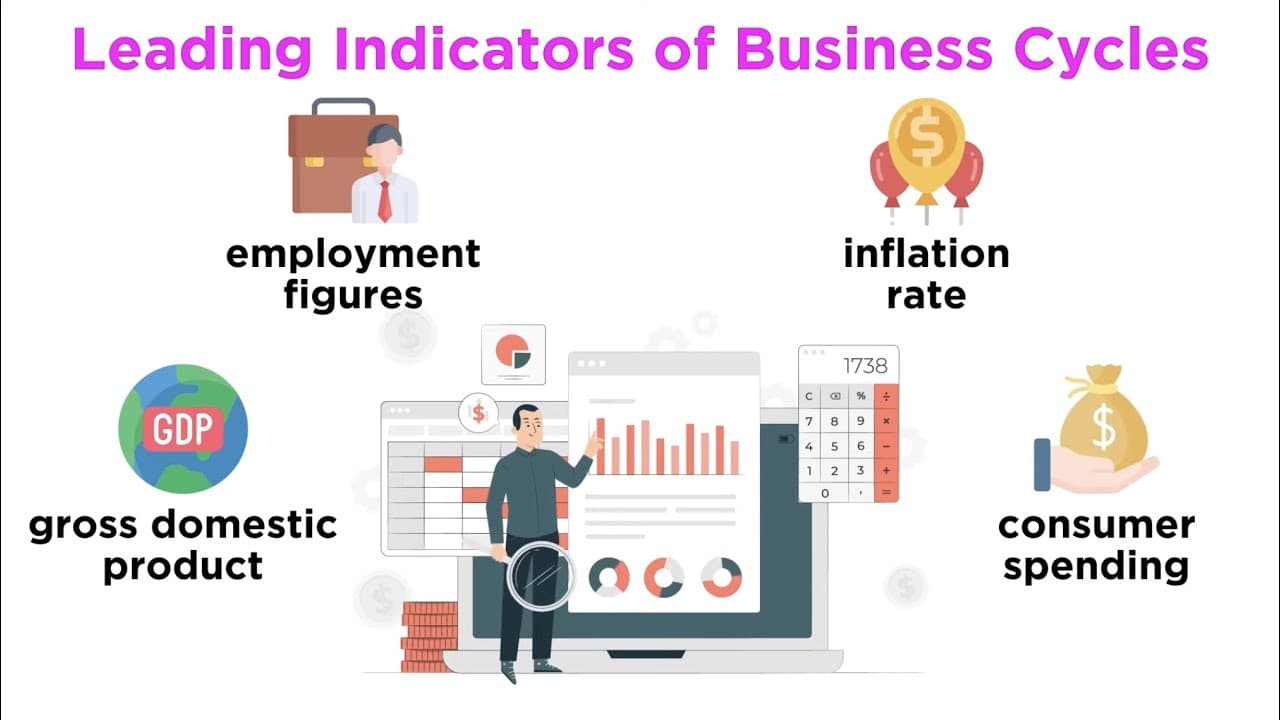
Economists use leading indicators such as GDP, employment figures, inflation rate, and consumer spending to predict business cycles. However, predicting cycles accurately is challenging.
Key Insights:
- Business cycles are periods of macroeconomic expansion and contraction, characterized by unpredictability.
- Recessions and depressions are economic contractions, with depressions being severe and prolonged.
- Stagflation, a combination of recession and inflation, is a significant concern for economies.
- Business investment, interest rates, consumer expectations, and external shocks are key variables driving business cycles.
- Friedrich Hayek and John Maynard Keynes had contrasting views on government intervention and economic stability during business cycles.
- Supply-side economics emphasizes the supply of goods, while Keynesian economics focuses on increasing demand.
- Predicting business cycles accurately is difficult, but economists use leading indicators to forecast them.
- The Keynesian perspective is the predominant school of thought in economics today.
Summary & Key Takeaways
-
Business cycles refer to periods of economic expansion and contraction, which can feel unpredictable and like a rollercoaster ride.
-
A recession is an economic contraction that lasts at least six months, while a depression is a severe and prolonged recession.
-
Stagflation is a combination of recession and inflation, causing high unemployment and rising prices.
Read in Other Languages (beta)
Share This Summary 📚
Summarize YouTube Videos and Get Video Transcripts with 1-Click
Try YouTube Summary with ChatGPT & Claude or YouTube Transcript Generator
Explore More Summaries from Professor Dave Explains 📚

Summarize YouTube Videos and Get Video Transcripts with 1-Click
Try YouTube Summary with ChatGPT & Claude or YouTube Transcript Generator