What Are the Laws of Thermodynamics and Their Importance?
TL;DR
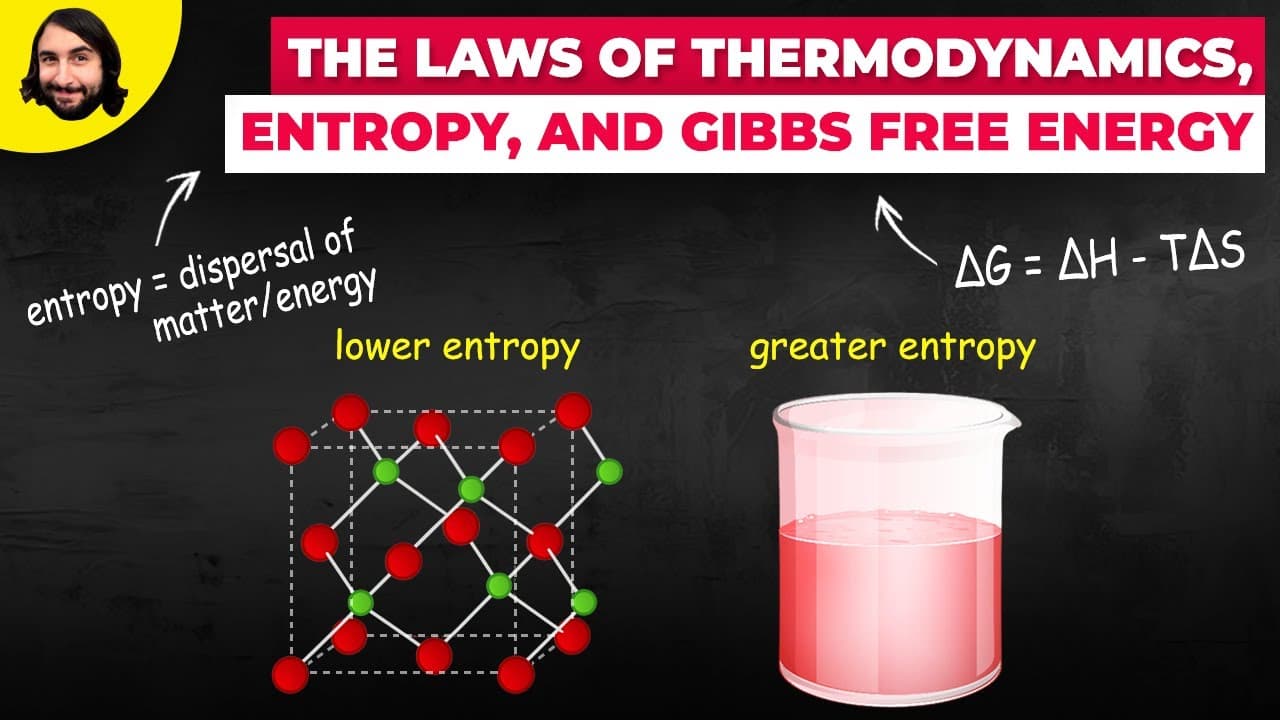
The laws of thermodynamics explain the behavior of energy and the concept of entropy, which quantifies disorder in a system. The first law states that energy is conserved, while the second law posits that the total entropy of a system and its surroundings always increases. Gibbs free energy helps predict whether a process will occur spontaneously based on changes in enthalpy and entropy.
Transcript
professor Dave here, let's learn the laws of thermodynamics the laws of thermodynamics help us understand why energy flows in certain directions and in certain ways. a lot of the concepts described by thermodynamics seem like common sense but there is a layer of math beneath the intuitive level that makes them very powerful at describing systems an... Read More
Key Insights
- 🧠 The laws of thermodynamics help us understand why energy flows in certain directions and in certain ways. There is a layer of math beneath the intuitive level that makes them powerful at describing systems and making predictions.
- 🌡️ The first law of thermodynamics highlights the conservation of energy. Energy is not created or destroyed, only changes forms from potential energy to kinetic energy to heat energy, etc.
- 🔀 The second law of thermodynamics introduces the concept of entropy, which can be described as disorder. The sum of the entropies of a system and its surroundings must always increase.
- 🔃 There is a tendency for systems to go towards higher entropy, meaning more disorder. This is why heat spontaneously flows from hot to cold and not the other way around.
- 💾 Entropy is a measure of how dispersed the energy of a system is amongst the ways that system can contain energy. Increasing the entropy of a system is thermodynamically favorable.
- 🌡️ Enthalpy is a thermodynamic quantity that accurately describes the energy of a system, while entropy describes how energy is distributed within a system.
- 🆓 Gibbs free energy (G) tells us whether a process will be spontaneous or not. If delta G is negative, the process is spontaneous.
- 🔀 Spontaneous processes can be either enthalpically or entropically favorable, or both. The change in Gibbs free energy equation includes change in enthalpy, change in entropy, and temperature.
Install to Summarize YouTube Videos and Get Transcripts
Explore YouTube Video Summarizer or Get YouTube Transcript Extractor
Questions & Answers
Q: What is the first law of thermodynamics?
The first law of thermodynamics states that energy is not created or destroyed, but only changes forms. This means that the total energy of a closed system remains constant.
Q: How is entropy related to disorder?
Entropy is often described as a measure of disorder. In a system, as entropy increases, the energy becomes more dispersed among the possible ways that system can contain energy. This means that higher entropy corresponds to higher disorder.
Q: How does the Gibbs free energy equation determine spontaneity?
The Gibbs free energy equation, ΔG = ΔH - TΔS, combines the changes in enthalpy and entropy to determine if a process is spontaneous. If ΔG is negative, the process is spontaneous, while a positive ΔG indicates a nonspontaneous process.
Q: Can a process be spontaneous if it is energetically favorable but entropically unfavorable?
Yes, a process can still be spontaneous if it is energetically favorable (ΔH < 0) but entropically unfavorable (ΔS < 0). The entropic unfavorability can be minimized at lower temperatures, allowing the energetically favorable process to still occur.
Q: How does soap defy entropy on a small scale?
Soap molecules have polar heads and nonpolar tails, allowing them to spontaneously form structures called micelles. These micelles have highly ordered structures, which can form due to energetically favorable processes. However, this does not violate the second law of thermodynamics, as the overall entropy of the universe still increases.
Summary & Key Takeaways
-
The first law of thermodynamics states that energy is conserved and only changes forms.
-
The second law introduces the concept of entropy, which describes the disorder of a system, and states that the total entropy of a system and its surroundings must increase.
-
The Gibbs free energy equation combines enthalpy and entropy to determine whether a process is spontaneous or not.
Read in Other Languages (beta)
Share This Summary 📚
Summarize YouTube Videos and Get Video Transcripts with 1-Click
Try YouTube Summary with ChatGPT & Claude or YouTube Transcript Generator
Explore More Summaries from Professor Dave Explains 📚

Summarize YouTube Videos and Get Video Transcripts with 1-Click
Try YouTube Summary with ChatGPT & Claude or YouTube Transcript Generator