How Neural Networks Work | Neural Networks Explained
TL;DR
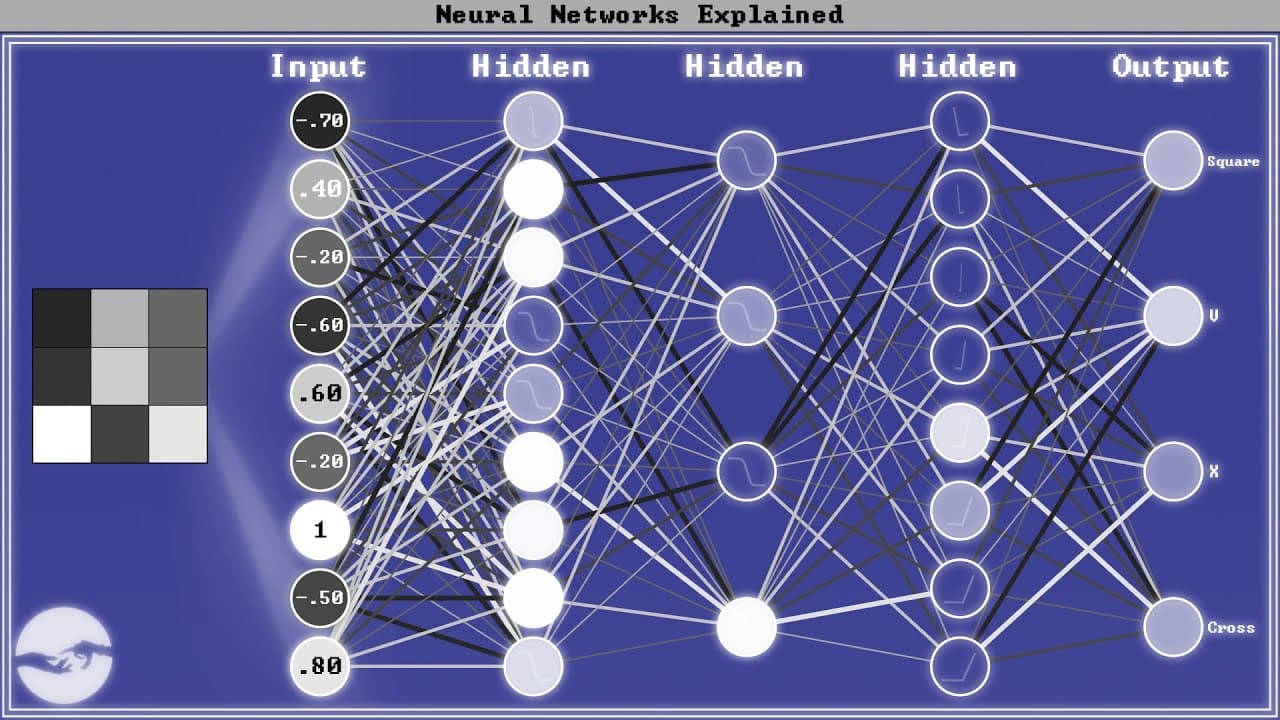
Exploring the intricacies of deep learning, from weights and biases to hyperparameters and feature engineering.
Transcript
To support the production of more high quality content consider supporting us on Patreon or YouTube membership. Additionally, consider visiting our parent company, Earth One, For Sustainable Living Made Simple. In videos past with this deep learning series, we have gone from learning about the origins of the field of deep learning, to how the struc... Read More
Key Insights
- 🧑🏭 Biases in neural networks act as jumpstarts for nodes to reach activation thresholds.
- ❓ Hyperparameters are crucial external configurations for neural network optimization.
- ☠️ Learning rates significantly impact the convergence and performance of deep learning models.
- 🔠 Feature engineering is essential for selecting meaningful input features in deep learning systems.
- ❓ Deep learning automates feature extraction and selection, mitigating issues like the curse of dimensionality.
- 🗯️ Choosing the right type of neural network is crucial for solving specific problems effectively.
- ❓ Deep learning complexity requires a deep understanding of parameters, hyperparameters, and feature engineering.
Install to Summarize YouTube Videos and Get Transcripts
Explore YouTube Video Summarizer or Get YouTube Transcript Extractor
Questions & Answers
Q: What is the purpose of biases in neural networks?
Biases in neural networks act as a jumpstart to help nodes reach activation thresholds, essentially serving as a Y intercept in a linear equation to bias nodes to activate more or less easily.
Q: What are neural network parameters versus hyperparameters?
Neural network parameters, like weights and biases, are internal to the model, while hyperparameters, like the number of nodes or activation functions, are external configurations crucial for model optimization but cannot be learned from data.
Q: How does the learning rate affect deep learning models?
The learning rate influences how quickly an optimization algorithm converges to a minimum, with a well-selected rate crucial for building accurate representations, as low rates cause slow convergence and high rates lead to overfitting.
Q: What is feature engineering in deep learning?
Feature engineering involves selecting input features that accurately describe a problem, distinguishing signal from noise to strengthen model predictions, crucial for the performance of deep learning models.
Summary & Key Takeaways
-
Deep learning complexity is revealed, encompassing the importance of weights, biases, hyperparameters, and feature engineering.
-
Understanding the role of biases in neural networks and the impact of learning representation through gradient descent.
-
Exploring hyperparameters like learning rate and the challenges of feature engineering in deep learning models.
Read in Other Languages (beta)
Share This Summary 📚
Summarize YouTube Videos and Get Video Transcripts with 1-Click
Try YouTube Summary with ChatGPT & Claude or YouTube Transcript Generator
Explore More Summaries from Futurology — An Optimistic Future 📚





Summarize YouTube Videos and Get Video Transcripts with 1-Click
Try YouTube Summary with ChatGPT & Claude or YouTube Transcript Generator