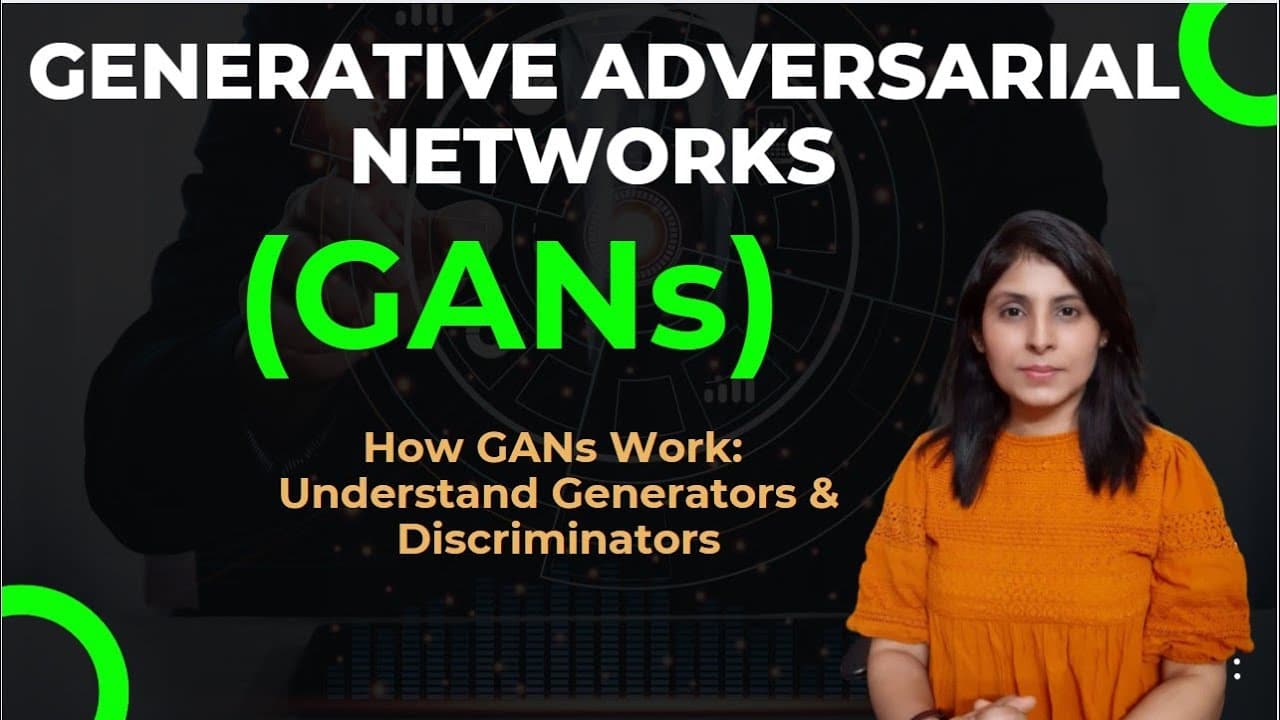
Generative Adversarial Networks: A Beginner's Guide to GANs
TL;DR
Explains Generative Adversarial Networks (GANs) and their architecture.
Transcript
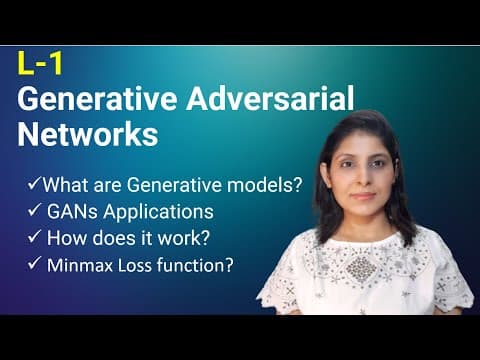
hello everyone my name is arohi and welcome to my channel so guys in my today's video we'll study about generative adversarial networks Gan networks so Gan networks comes under generative Ai and generative AI simply means those algorithms using which you can generate new data and that new data can be uh image or text audio or video okay so using Ga... Read More
Key Insights
- Generative Adversarial Networks (GANs) are part of generative AI, which creates new data like images, text, audio, or video.
- GANs consist of two neural networks: a generator that creates fake data and a discriminator that classifies data as real or fake.
- Different types of GANs include Conditional GANs, which modify images based on conditions, and Stack GANs, which generate images from text descriptions.
- SR GANs, or Super Resolution GANs, enhance the quality of low-resolution images, making them clearer and more detailed.
- The generator starts with random noise, which is transformed through layers to produce an image that mimics real data.
- The discriminator's role is to differentiate between real and fake images, providing feedback to improve the generator's performance.
- Loss functions, like Binary Cross-Entropy, are crucial for training GANs, helping to adjust the networks for better output.
- Training GANs involves multiple epochs, with the generator improving until it can consistently fool the discriminator.
Install to Summarize YouTube Videos and Get Transcripts
Explore YouTube Video Summarizer or Get YouTube Transcript Extractor
Questions & Answers
Q: What are Generative Adversarial Networks (GANs)?
Generative Adversarial Networks (GANs) are a class of artificial intelligence algorithms used to generate new data that resembles a given dataset. They consist of two neural networks, a generator and a discriminator, that work in opposition to each other to improve data generation quality. The generator creates fake data samples, while the discriminator evaluates them against real data, providing feedback for improvement.
Q: How do Conditional GANs differ from other GANs?
Conditional GANs differ from other GANs by incorporating additional information or conditions into the data generation process. This allows them to perform specific tasks, such as transforming images based on certain attributes. For example, Conditional GANs can age a person's photo or convert a sketch into a realistic image by conditioning the generation process on these specific inputs.
Q: What is the role of the discriminator in a GAN?
The discriminator in a GAN acts as a classifier that distinguishes between real and fake data samples. It receives input from both the generator's fake data and real data from the training set. The discriminator's output is a probability value indicating whether the input data is real or fake, which is used to provide feedback to the generator for improving its data generation capabilities.
Q: Why is random noise important in GANs?
Random noise is crucial in GANs as it serves as the initial input for the generator. This noise is transformed through various layers of the generator network to produce a fake data sample. The randomness ensures diversity and variability in the generated data, allowing the generator to create a wide range of outputs that can mimic the real data distribution effectively.
Q: How is the generator's loss calculated?
The generator's loss is calculated based on the discriminator's feedback. The goal of the generator is to produce data that the discriminator classifies as real. The generator's loss function, often a form of Binary Cross-Entropy, measures how well the generator is able to fool the discriminator. A lower loss indicates that the generator is producing more realistic data.
Q: What are SR GANs used for?
SR GANs, or Super Resolution GANs, are used to enhance the resolution of images. They take low-resolution images as input and generate high-resolution versions, improving clarity and detail. This is particularly useful in applications where image quality is crucial, such as in medical imaging or satellite photography, where clear and detailed images are necessary for analysis.
Q: When should the training of a GAN be stopped?
Training of a GAN should be stopped when the generator consistently produces data that the discriminator classifies as real, indicating that the generator has learned to mimic the real data distribution effectively. This is often determined by monitoring the discriminator's output probabilities; if the discriminator is frequently fooled, it suggests that the generator has reached a satisfactory level of performance.
Q: What happens after a GAN is fully trained?
After a GAN is fully trained, the generator can be used independently to generate new data samples. The discriminator is no longer needed, as its primary role during training was to provide feedback for improving the generator. The trained generator can be applied in various practical applications, such as generating realistic images, enhancing image resolution, or creating new data for other AI models.
Summary & Key Takeaways
-
The video introduces Generative Adversarial Networks (GANs), explaining their role in generative AI to create new data from existing datasets. It covers the architecture of GANs, focusing on the generator and discriminator components and their interplay in generating realistic data.
-
Different types of GANs are discussed, including Conditional GANs for image transformation, Stack GANs for text-to-image generation, and SR GANs for enhancing image resolution. The video explains how these networks use random noise as input to generate new, realistic samples.
-
The training process of GANs is highlighted, explaining the importance of loss functions in refining the generator and discriminator. The video concludes with insights on when to stop training, once the generator effectively fools the discriminator, indicating successful data generation.
Read in Other Languages (beta)
Share This Summary 📚
Summarize YouTube Videos and Get Video Transcripts with 1-Click
Try YouTube Summary with ChatGPT & Claude or YouTube Transcript Generator
Explore More Summaries from Code With Aarohi 📚

Summarize YouTube Videos and Get Video Transcripts with 1-Click
Try YouTube Summary with ChatGPT & Claude or YouTube Transcript Generator