The spread of Tobacco Mosaic Virus - Roger Beachy (Donald Danforth Plant Science Center)

TL;DR
Viral replication complexes spread through plant cells via actin filaments.
Transcript
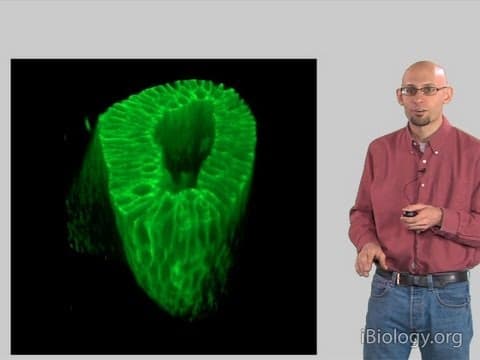
Now what you what we see here is a uh an image of of an infected plant leaf. Now this is a transgenic plant in which the actin um um is labeled also with talon. So you can see the the fluoresence of the actin cytokeleton up here. Of course you can see the uh the location of a plas of a stomata the the holes through which uh oxygen enters and and ga... Read More
Key Insights
- The study uses fluorescently labeled proteins to track the movement of viral replication complexes in plant cells, providing insights into virus spread mechanisms.
- Viral replication complexes, not virions, move from cell to cell, indicating a unique method of virus propagation in plants.
- The initial infection setup takes around 14 hours, after which viral replication complexes begin moving and fusing within the cell.
- Movement of these complexes is dynamic, facilitated by actin filaments, and can be tracked in real-time using microscopy.
- The transition from one cell to another is marked by a significant slowdown in movement, indicating a preparatory phase before infection spreads.
- Once the virus moves to adjacent cells, the replication process accelerates, significantly reducing the time needed for subsequent cell infections.
- The study highlights the importance of plasmodesmata in the intercellular movement of viral replication complexes.
- The research provides a new understanding of plant virus propagation, challenging previous assumptions that virions are the primary agents of cell-to-cell spread.
Install to Summarize YouTube Videos and Get Transcripts
Explore YouTube Video Summarizer or Get YouTube Transcript Extractor
Questions & Answers
Q: How is the movement of viral replication complexes tracked in the study?
The movement of viral replication complexes is tracked using fluorescently labeled proteins that highlight the actin cytoskeleton. This allows researchers to visualize and follow the dynamics of these complexes as they move within and between plant cells, providing insights into the mechanisms of virus spread.
Q: What is the significance of the actin filaments in the virus spread?
Actin filaments play a crucial role in facilitating the movement of viral replication complexes within plant cells. They provide a dynamic framework that supports the transportation of these complexes, enabling them to reach the cell wall and move to adjacent cells, thereby spreading the infection more efficiently.
Q: Why is the initial infection setup time important in the study?
The initial infection setup time is crucial as it marks the period during which viral replication complexes form and begin moving within the cell. Understanding this timeframe helps researchers determine the stages of virus propagation and the factors influencing the speed and efficiency of infection spread throughout plant tissues.
Q: What role do plasmodesmata play in virus propagation?
Plasmodesmata are essential for the intercellular movement of viral replication complexes. They act as channels that facilitate the transfer of these complexes from one cell to another, bypassing the need for virions to move between cells, thus enhancing the speed and efficiency of virus spread in plant tissues.
Q: How does the study challenge previous assumptions about virus propagation?
The study challenges the assumption that virions are the primary agents of virus spread between plant cells. Instead, it reveals that pre-virion complexes, which include viral RNA and replication machinery, are responsible for moving through plasmodesmata, offering a new perspective on virus propagation mechanisms.
Q: What happens to viral replication complexes after 18 hours of infection?
After 18 hours of infection, the movement of viral replication complexes slows significantly, indicating a transition phase before the complexes move to adjacent cells. This slowdown suggests a preparatory period where the complexes become ready for intercellular transfer, facilitating the continued spread of the virus.
Q: How does the study measure the movement of viral replication complexes?
The study measures the movement of viral replication complexes using real-time microscopy. By plotting the rate of movement, researchers can quantify the dynamics of these complexes as they traverse the cell, providing detailed insights into the speed and pattern of virus spread.
Q: What is the impact of this research on understanding plant virus infections?
This research significantly enhances our understanding of plant virus infections by revealing the critical role of viral replication complexes in spreading the infection. It shifts the focus from virions to these complexes, offering new avenues for developing strategies to control and manage plant virus outbreaks.
Summary & Key Takeaways
-
The research investigates the spread of Tobacco Mosaic Virus in plant cells using fluorescently labeled proteins. It reveals that viral replication complexes, rather than virions, move between cells via actin filaments and plasmodesmata, facilitating rapid infection spread.
-
Initial virus setup in an infected cell takes about 14 hours, after which replication complexes actively move and fuse. The spread to adjacent cells accelerates, reducing the time needed for subsequent infections.
-
The study challenges previous assumptions about virus propagation, showing that pre-virion complexes, not virions, are crucial for the rapid spread of infection in plant tissues.
Read in Other Languages (beta)
Share This Summary 📚
Summarize YouTube Videos and Get Video Transcripts with 1-Click
Try YouTube Summary with ChatGPT & Claude or YouTube Transcript Generator
Explore More Summaries from iBiology Techniques 📚



Summarize YouTube Videos and Get Video Transcripts with 1-Click
Try YouTube Summary with ChatGPT & Claude or YouTube Transcript Generator