How To Find The Derivative of a Fraction - Calculus
TL;DR
Learn how to find the derivative of a fraction using the power rule, and understand the rules for finding derivatives of constants and variables.
Transcript
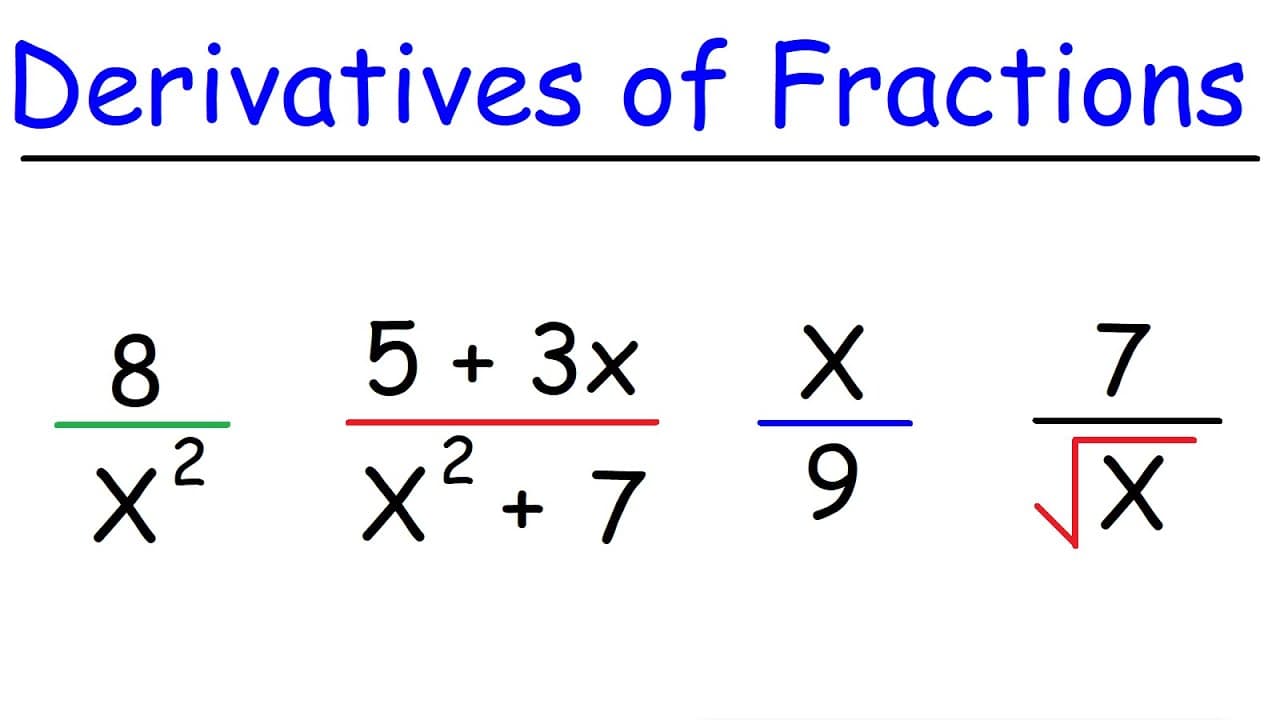
in this video we're going to talk about how to find the derivative of a fraction but before we do that we need to go over some basic rules such as the power rule the derivative of a variable raised to a constant x is the variable n is the constant it's going to be n times x raised to the n minus 1. so let me give you some examples let's say if we w... Read More
Key Insights
- ✊ The power rule is a fundamental concept in finding derivatives.
- 0️⃣ Derivatives of constants are always zero.
- 💱 Moving variables in fractions can change the approach to finding derivatives.
- 📏 The quotient rule is used to find derivatives of fractions with variables in both the numerator and denominator.
Install to Summarize YouTube Videos and Get Transcripts
Explore YouTube Video Summarizer or Get YouTube Transcript Extractor
Questions & Answers
Q: What is the power rule?
The power rule states that the derivative of a variable raised to a constant is the constant times the variable raised to one less than the constant. For example, the derivative of x^2 is 2x.
Q: How do you find the derivative of a constant?
The derivative of a constant is always zero. For example, the derivative of 5 is 0.
Q: How do you find the derivative when the variable is in the numerator?
When the variable is in the numerator of a fraction, you can rewrite the fraction and apply the power rule. For example, the derivative of x/9 is 1/9.
Q: How do you find the derivative when the variable is in the denominator?
When the variable is in the denominator of a fraction, you need to rewrite the expression. Move the variable to the numerator and apply the power rule. Then simplify the expression. For example, the derivative of 8/x is -8/x^2.
Q: What is the quotient rule?
The quotient rule is used to find the derivative of a fraction with variables in both the numerator and denominator. It is expressed as (g * f' - f * g') / g^2, where f is the numerator and g is the denominator.
Summary & Key Takeaways
-
The power rule states that the derivative of a variable raised to a constant is the constant times the variable raised to one less than the constant.
-
To find the derivative of a constant, the derivative is always zero.
-
When the variable is in the numerator of a fraction, the derivative can be found by rewriting the fraction and applying the power rule.
-
When the variable is in the denominator of a fraction, the derivative can be found by moving the variable to the numerator, applying the power rule, and simplifying the expression.
-
The quotient rule is used to find the derivative of a fraction with variables in both the numerator and denominator.
Read in Other Languages (beta)
Share This Summary 📚
Summarize YouTube Videos and Get Video Transcripts with 1-Click
Try YouTube Summary with ChatGPT & Claude or YouTube Transcript Generator
Explore More Summaries from The Organic Chemistry Tutor 📚
Summarize YouTube Videos and Get Video Transcripts with 1-Click
Try YouTube Summary with ChatGPT & Claude or YouTube Transcript Generator