How to Solve Basic Mechanical Wave Problems
TL;DR
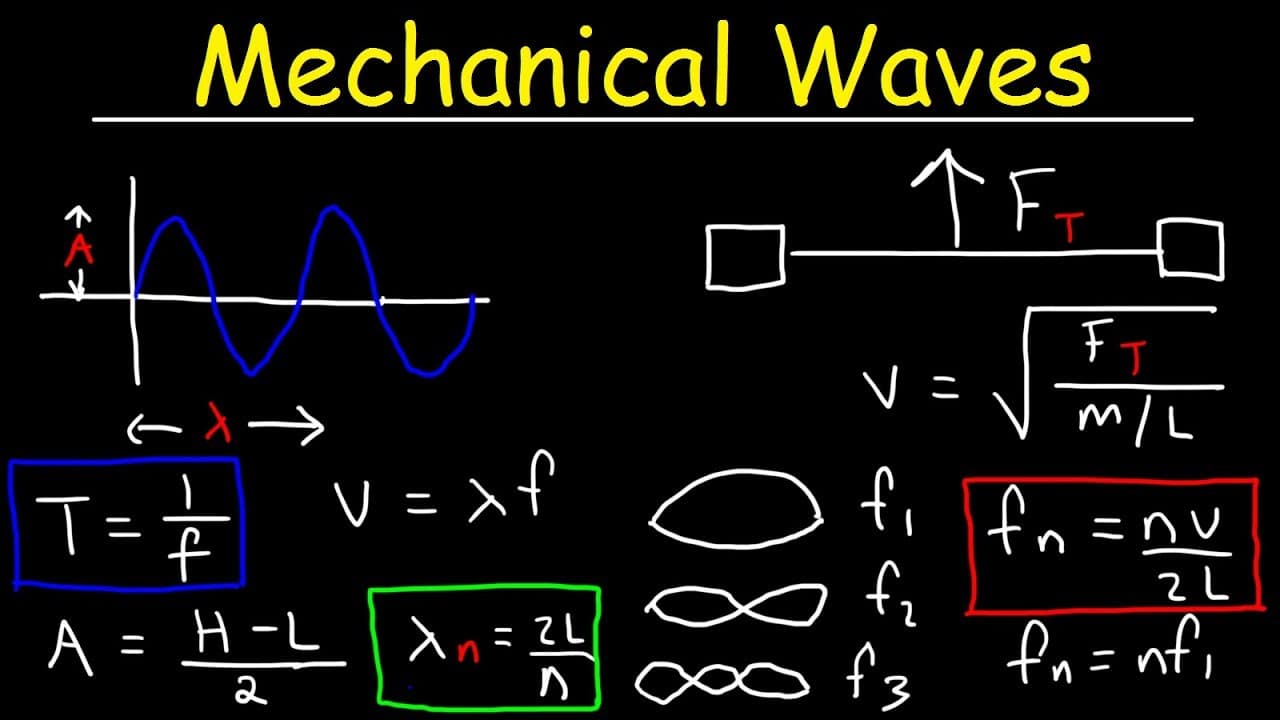
To solve basic mechanical wave problems, calculate amplitude as the distance from the midpoint to the crest, and wavelength as the distance between crests or troughs. The period is the time for one cycle, while frequency is its reciprocal. Use wave speed divided by frequency to find wavelength, and linear density for calculating speed using tension.
Transcript
in this video we're going to work on some basic problems associated with mechanical waves so here we have a graphical representation of a wave what is the amplitude and wavelength of the wave shown below the amplitude is the distance between the midpoint and the highest point of the wave so it's from zero to three so in this example the amplitude i... Read More
Key Insights
- 😘 Amplitude is the distance between the midpoint and the highest/lowest point of a wave, while wavelength is the distance between crests, troughs, or one complete cycle.
- 🥡 The period is the time it takes for one complete cycle, and the frequency is the reciprocal of the period.
- 👋 The amplitude, frequency, and period of a mechanical wave can be calculated from graphical representations.
- 👋 The speed of a wave can be found by dividing the tension force by the linear density of the string.
- 👋 The wavelength of a wave can be determined by dividing the wave speed by the frequency.
- 👋 The fundamental frequency of a wave can be calculated using the equation nv/2l, where n is 1 for the fundamental frequency.
- ✖️ The frequency of a specific harmonic can be found by multiplying the fundamental frequency by the harmonic number.
- 🟰 The number of nodes in a wave is equal to n + 1, and the number of antinodes is equal to n.
Install to Summarize YouTube Videos and Get Transcripts
Explore YouTube Video Summarizer or Get YouTube Transcript Extractor
Questions & Answers
Q: How do you find the amplitude and wavelength of a wave?
The amplitude is the distance between the midpoint and the highest/lowest point of the wave. The wavelength can be found by measuring the distance between crests, troughs, or by calculating the distance of one complete cycle.
Q: How do you calculate the period and frequency of a wave?
The period is the time it takes for one complete cycle. You can time the duration for one complete cycle from graphical representations. The frequency can be found by dividing 1 by the period.
Q: How do you calculate the amplitude and period of a mechanical wave?
To calculate the amplitude, subtract the highest value from the lowest value and divide it by 2. The midpoint can be found by averaging the highest and lowest values. The period can be determined by timing the time it takes for one complete cycle.
Q: Can you explain how to calculate the wavelength and frequency of a wave?
The wavelength is found by dividing the wave speed by the frequency. The frequency can be determined by dividing the wave speed by the wavelength.
Summary & Key Takeaways
-
The video explains how to find the amplitude and wavelength of a wave by measuring the distance between the midpoint and the highest/lowest points of the wave.
-
It demonstrates how to calculate the period and frequency of a wave by timing the time it takes for one complete cycle.
-
It also shows how to determine the amplitude, period, and frequency of a wave based on graphical representations.
Read in Other Languages (beta)
Share This Summary 📚
Summarize YouTube Videos and Get Video Transcripts with 1-Click
Try YouTube Summary with ChatGPT & Claude or YouTube Transcript Generator
Explore More Summaries from The Organic Chemistry Tutor 📚



Summarize YouTube Videos and Get Video Transcripts with 1-Click
Try YouTube Summary with ChatGPT & Claude or YouTube Transcript Generator