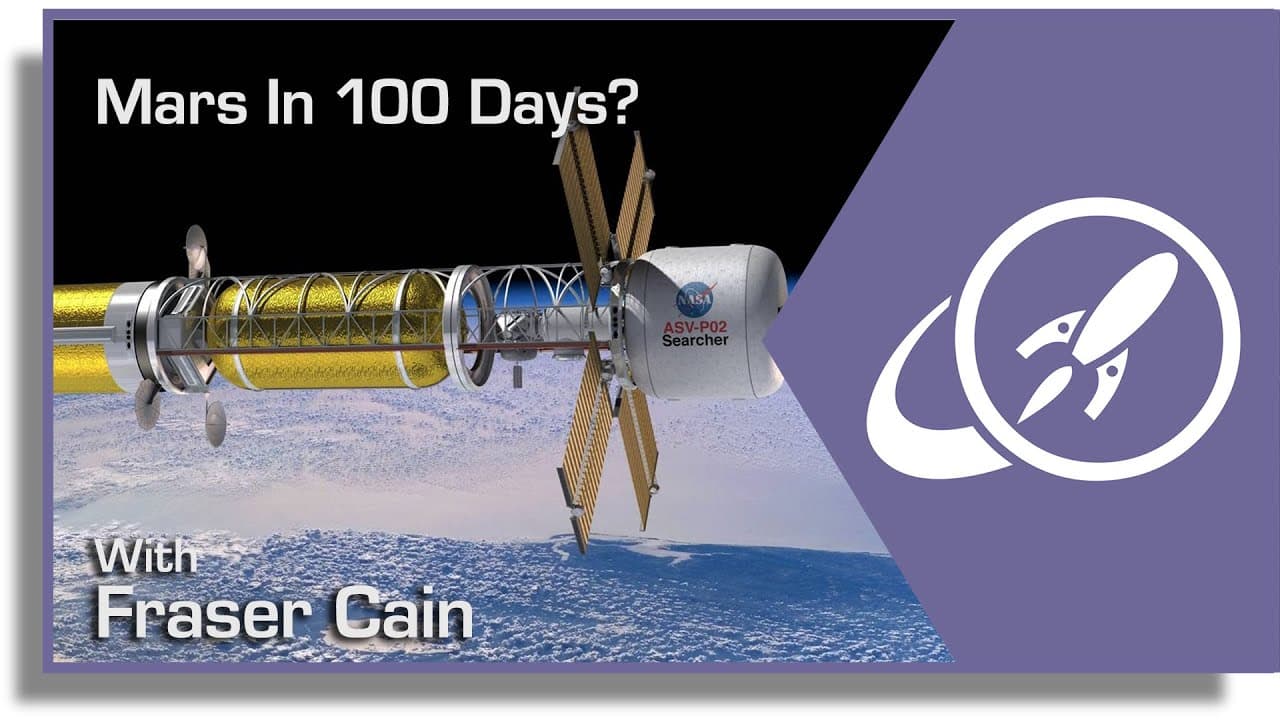
Earth To Mars In 100 Days? The Power Of Nuclear Rockets
TL;DR
Nuclear rockets can shorten space travel times, while fusion drives offer energy-efficient propulsion for interstellar missions.
Transcript
The Solar System is a really big place, and it takes forever to travel from world to world with traditional chemical rockets. But one technique, developed back in the 1960s might provide a way to dramatically shorten our travel times: nuclear rockets. Of course, launching a rocket powered by radioactive material has its own risks as well. Should we... Read More
Key Insights
- 🧑🚀 Nuclear rockets can significantly reduce travel times to Mars, offering quicker missions and fewer resource requirements for astronauts.
- ✋ Fusion drives show promise for energy-efficient propulsion, potentially revolutionizing interstellar missions with high thrust efficiency.
- 👾 Recent funding approvals for nuclear thermal propulsion research indicate a resurgence of interest in advanced space propulsion technologies.
- 👾 Environmental concerns and safety precautions factor into the development of nuclear rockets and fusion drives for future space missions.
- 👾 NASA's historical efforts in nuclear rocket development have paved the way for current advancements in space propulsion technologies.
- 👾 Future space missions may benefit from the utilization of fusion drives, providing rapid transit times and efficient energy generation for spacecraft.
- 👾 Collaboration between research groups and funding support signal a promising future for nuclear rocket and fusion drive technologies in space exploration.
Install to Summarize YouTube Videos and Get Transcripts
Explore YouTube Video Summarizer or Get YouTube Transcript Extractor
Questions & Answers
Q: How do nuclear rockets work and why are they considered for future space travel?
Nuclear rockets use fission reactions to heat hydrogen propellant to high velocities, providing efficient propulsion for faster space travel. They are considered for future missions to reduce resource consumption and radiation exposure for astronauts.
Q: What are the risks associated with nuclear rockets in space travel?
Nuclear rockets pose radiation risks for astronauts due to onboard reactors and dangerous particles in the exhaust. However, the benefits of faster travel times and reduced resource consumption outweigh these risks.
Q: How do fusion drives differ from nuclear rockets in space propulsion?
Fusion drives utilize fusion reactions of helium-3 and deuterium to generate thrust, offering higher specific impulse and energy efficiency compared to traditional nuclear rockets. They show promise for rapid interstellar missions.
Q: What recent advancements have been made in nuclear thermal propulsion research?
Recent funding approvals by the US Congress have renewed interest in nuclear thermal propulsion, with a focus on developing demonstration projects and future mission capabilities.
Summary & Key Takeaways
-
Traditional chemical rockets take months to reach distant planets like Mars, posing challenges with resource consumption and radiation exposure for astronauts.
-
Nuclear rockets, developed in the 1960s, have the potential to cut travel times in half, reducing resource needs and radiation exposure.
-
Fusion drives, using helium-3 and deuterium fusion reactions, offer high thrust efficiency and could revolutionize interstellar missions.
Read in Other Languages (beta)
Share This Summary 📚
Summarize YouTube Videos and Get Video Transcripts with 1-Click
Try YouTube Summary with ChatGPT & Claude or YouTube Transcript Generator
Explore More Summaries from Fraser Cain 📚



Summarize YouTube Videos and Get Video Transcripts with 1-Click
Try YouTube Summary with ChatGPT & Claude or YouTube Transcript Generator