How to Calculate Pressure Using an Open Tube Manometer
TL;DR
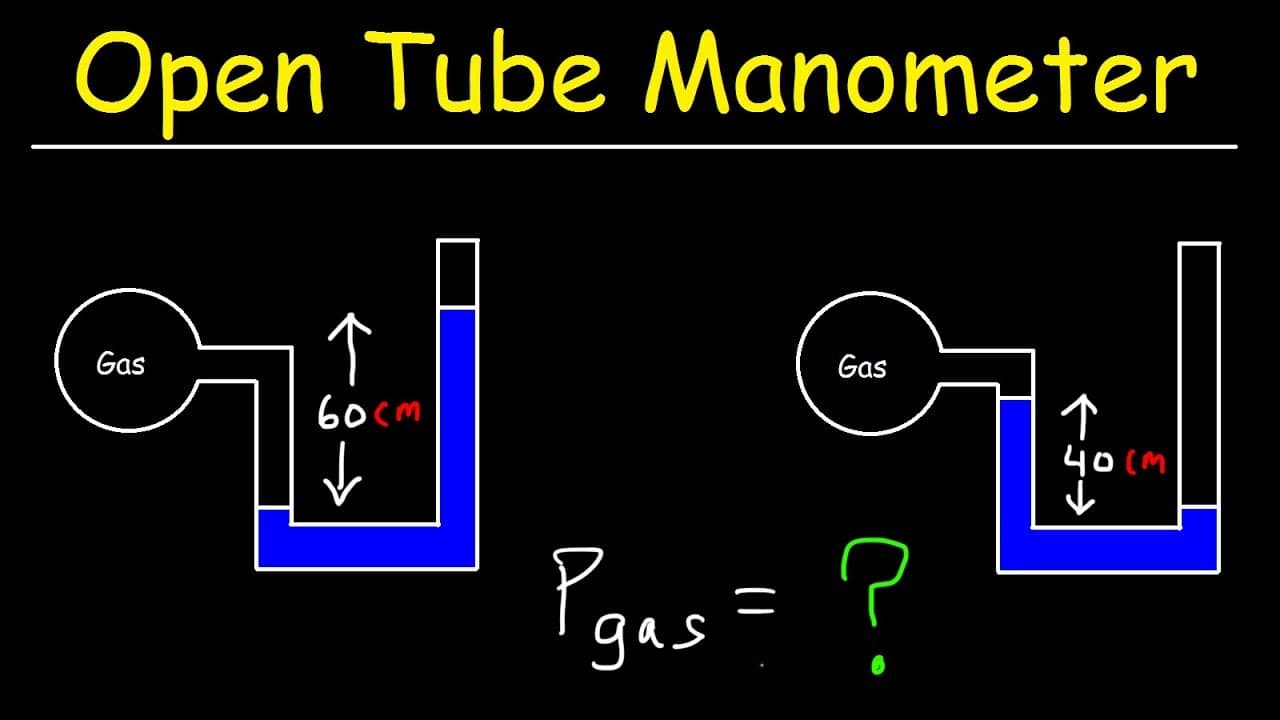
To calculate the pressure of gas using an open tube manometer, equate the pressure on both sides of the tube, considering atmospheric pressure and fluid density. The gauge pressure is the difference between the gas pressure and atmospheric pressure, with negative values indicating gas pressure below atmospheric levels, and positive values indicating above.
Transcript
in this video we're going to focus on solving physics problems associated with open tube manometers so the open tube manometer shown below contains liquid mercury and we're given the density of mercury what is the pressure of the gas in the bulb so this is the reference level and what you need to know is that the downward pressure exerted on the le... Read More
Key Insights
- 🫢 Open tube manometers rely on balancing pressures to measure gas pressure.
- ❓ The pressure of a fluid depends on its density, gravity, and height.
- 🤢 The atmospheric pressure is typically assumed to be 101,325 pascals at sea level.
- 🫢 Gauge pressure is the difference between gas pressure and atmospheric pressure.
- 🫢 Negative gauge pressure indicates the gas pressure is below atmospheric pressure.
- 🫢 Positive gauge pressure indicates the gas pressure is above atmospheric pressure.
- 🫢 The density of an unknown fluid can be calculated using a known gas pressure and the height difference in the manometer.
Install to Summarize YouTube Videos and Get Transcripts
Explore YouTube Video Summarizer or Get YouTube Transcript Extractor
Questions & Answers
Q: How do open tube manometers work?
Open tube manometers measure the pressure of gas in a bulb by comparing it to atmospheric pressure and the weight of fluid in the tube. The pressure on both sides of the tube must be balanced for equilibrium.
Q: What is the formula to calculate the pressure of a fluid?
The pressure of a fluid is equal to the density of the fluid multiplied by gravitational acceleration and the height of the fluid column. This formula, P = ρgh, applies to calculating the pressure due to the weight of the fluid.
Q: How can atmospheric pressure be determined if not given?
If not given, assume the problem is at sea level, where atmospheric pressure is typically around 101,325 pascals. This value can be used to calculate the pressure of gas in the bulb.
Q: How do you calculate gauge pressure?
Gauge pressure is the difference between absolute pressure (the pressure of the gas) and atmospheric pressure. By subtracting the two values, you can find the gauge pressure, which represents the pressure due to the weight of the fluid column.
Summary & Key Takeaways
-
Open tube manometers are used to measure the pressure of gas in a bulb.
-
Pressure on both sides of the tube must be equal for equilibrium.
-
The pressure of a fluid is determined by its density, gravitational acceleration, and height.
Read in Other Languages (beta)
Share This Summary 📚
Summarize YouTube Videos and Get Video Transcripts with 1-Click
Try YouTube Summary with ChatGPT & Claude or YouTube Transcript Generator
Explore More Summaries from The Organic Chemistry Tutor 📚


Summarize YouTube Videos and Get Video Transcripts with 1-Click
Try YouTube Summary with ChatGPT & Claude or YouTube Transcript Generator