What Are Budget Constraints and How Do They Work?
TL;DR
Budget constraints illustrate the maximum quantities of goods that can be purchased within a specified budget. The slope of the budget constraint represents the opportunity cost of acquiring more of an item on the x-axis. Additionally, the law of diminishing marginal utility indicates that as more units of a good are consumed, the satisfaction derived from each additional unit decreases.
Transcript
in this video we're going to talk about budget constraint opportunity costs and the law of diminishing marginal utility so we're going to cover this through an example problem lisa has a budget of twenty dollars to spend on food and transportation for the week the cost of a cheeseburger and a train ticket are four dollars and two dollars respective... Read More
Key Insights
- ❓ Budget constraints depict the maximum quantities of items that can be purchased within a given budget.
- ☺️ The slope of the budget constraint represents the opportunity cost of acquiring an additional item on the x-axis.
- 🚙 The law of diminishing marginal utility states that the utility or satisfaction derived from each additional unit of an item decreases as more of it is consumed.
- 📈 Changing prices and budgets can impact the shape and rotation of the budget constraint graph.
Install to Summarize YouTube Videos and Get Transcripts
Explore YouTube Video Summarizer or Get YouTube Transcript Extractor
Questions & Answers
Q: What does the slope of the budget constraint graph represent?
The slope represents the opportunity cost of acquiring an additional item on the x-axis. In this case, it represents the opportunity cost of purchasing an additional train ticket.
Q: What is the law of diminishing marginal utility?
The law states that as you consume more of a particular item, the satisfaction or utility from each additional unit decreases. This means that as you purchase more cheeseburgers or train tickets, the marginal utility of each additional item decreases.
Q: How does changing the price of coffee or sandwiches affect the budget constraint graph?
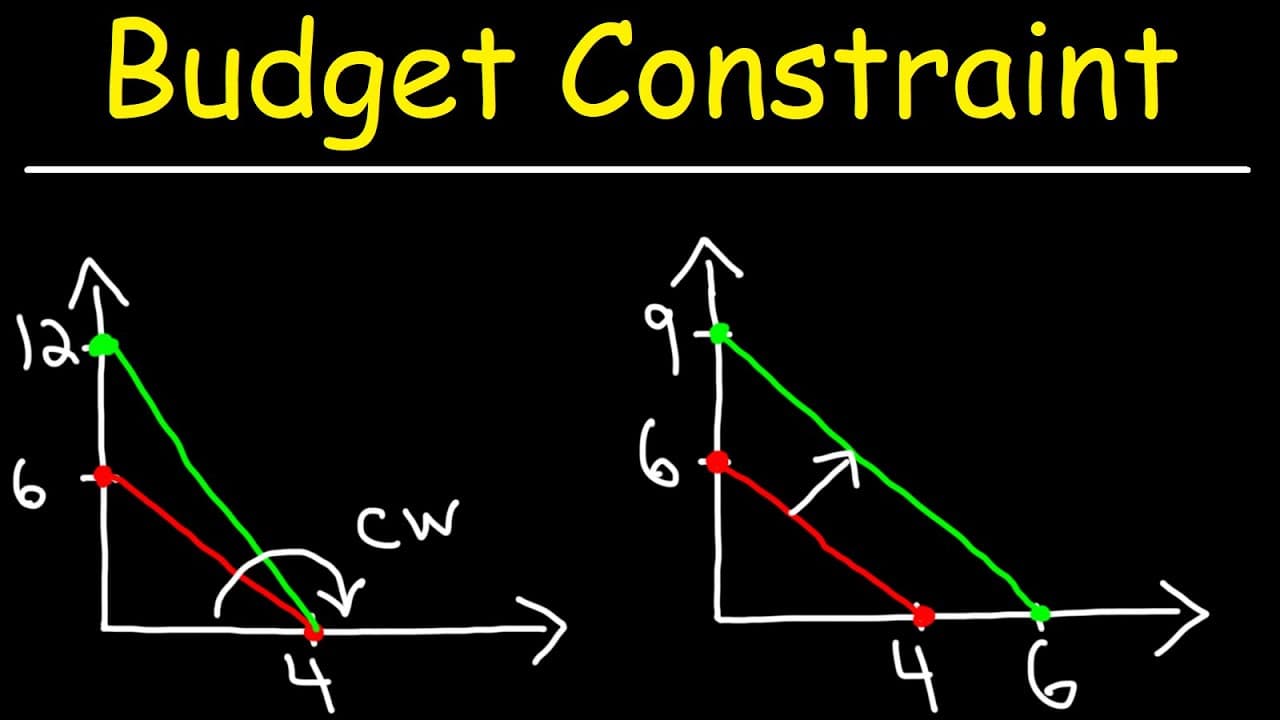
If the price of coffee increases, the budget constraint line rotates counterclockwise around the x-intercept. If the price decreases, the line rotates clockwise. For sandwiches, if the price increases, the line rotates clockwise, and if it decreases, the line rotates counterclockwise.
Q: How does increasing or decreasing the budget affect the budget constraint graph?
Increasing the budget expands the budget constraint line outward, represented by an extension of the y and x-intercepts. Decreasing the budget contracts the line inward, reducing the y and x-intercepts.
Summary & Key Takeaways
-
The video discusses budget constraints and their representation on a graph using the example of Lisa's budget for food and transportation.
-
It explains how to calculate the maximum number of cheeseburgers and train tickets she can buy within her budget.
-
The video shows how to create a budget constraint graph by connecting the points representing the maximum quantities of cheeseburgers and train tickets.
-
It introduces the concept of opportunity costs and explains that the slope of the budget constraint graph represents the opportunity cost of acquiring an additional item on the x-axis.
-
The video demonstrates how to create a budget constraint table and graph using the equation for the budget allocation between two items.
-
It explores the effect of changing prices and budgets on the shape and rotation of the budget constraint graph.
-
The video discusses the concept of diminishing marginal utility and how it applies to the purchase of additional cheeseburgers and train tickets.
Read in Other Languages (beta)
Share This Summary 📚
Summarize YouTube Videos and Get Video Transcripts with 1-Click
Try YouTube Summary with ChatGPT & Claude or YouTube Transcript Generator
Explore More Summaries from The Organic Chemistry Tutor 📚



Summarize YouTube Videos and Get Video Transcripts with 1-Click
Try YouTube Summary with ChatGPT & Claude or YouTube Transcript Generator