How to Use Kirchhoff’s Laws for Circuit Analysis
TL;DR
To analyze circuits using Kirchhoff's Laws, apply the junction rule to set currents entering and leaving a junction equal, and use the loop rule to write equations where the sum of voltage sources equals the sum of voltage drops in a closed loop. This process allows for the calculation of unknown currents and potentials across circuit elements.
Transcript
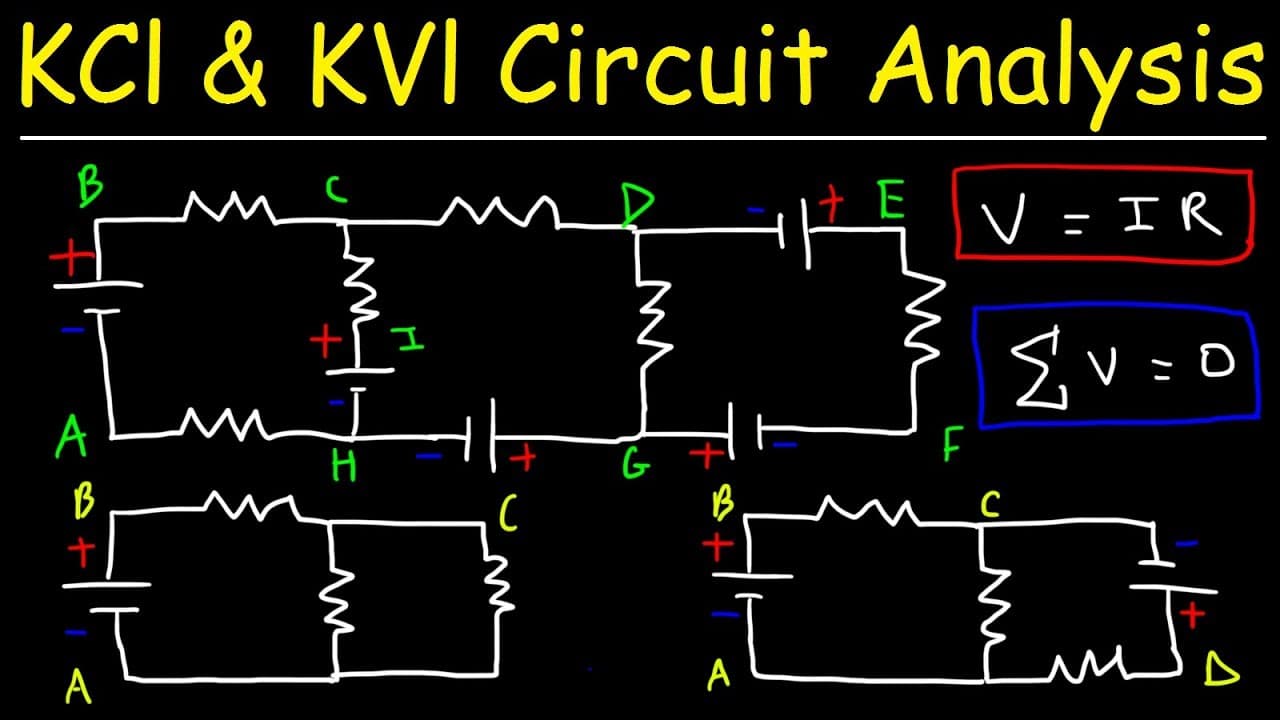
in this video we're going to talk about how to use kirchhoff's junction rule and loop rule to calculate the current in a complex circuit so let's start with this problem we have a resistor in series with two other resistors that are parallel to each other and let's say this resistor has a value of 3 ohms and let's call it r1 this is going to be r2 ... Read More
Key Insights
- 📏 Kirchhoff's junction rule helps maintain the conservation of current in a circuit.
- 📏 Kirchhoff's loop rule helps maintain the conservation of energy in a circuit.
- ⚡ Understanding the direction of voltage and current contributions is crucial for applying Kirchhoff's rules correctly.
- 🥺 Making a sign error in the voltage law equation can lead to incorrect answers.
- 📏 Solving a system of equations with Kirchhoff's rules helps calculate the currents in a complex circuit.
- 😥 The potential at any point in the circuit can be determined relative to a reference potential.
Install to Summarize YouTube Videos and Get Transcripts
Explore YouTube Video Summarizer or Get YouTube Transcript Extractor
Questions & Answers
Q: How do you use Kirchhoff’s laws to calculate current in a complex circuit?
Apply the junction rule to write an equation relating currents entering and leaving each junction. Then apply the loop rule around closed paths, using each resistor’s voltage drop as current times resistance, and solve the resulting system of equations.
Q: What is Kirchhoff’s junction rule or current law?
The total current entering a junction equals the total current leaving it. In the worked circuit, current i1 enters while i2 and i3 leave, producing the equation i1 = i2 + i3.
Q: What is Kirchhoff’s loop rule or voltage law?
The sum of all voltage contributions around a closed loop must equal zero. Voltage lifts are positive and voltage drops are negative in the equations used in the example.
Q: How are voltage-drop and voltage-lift signs determined in a loop equation?
Moving from low potential to high potential gives a voltage lift, while moving from high potential to low potential gives a voltage drop. Across a resistor, traveling with the current produces a drop, while traveling against the current produces a lift.
Q: What loop equations are used for the 24-volt circuit?
For the first loop, the equation is 24 = 3i1 + 4i2. For the second loop, 4i2 - 12i3 = 0, and the junction equation i1 = i2 + i3 supplies the third equation needed for the three unknown currents.
Q: What are the currents through the 3-ohm, 4-ohm, and 12-ohm resistors?
The 3-ohm resistor carries i1 = 4 amps, the 4-ohm resistor carries i2 = 3 amps, and the 12-ohm resistor carries i3 = 1 amp. The junction rule checks out because the entering 4 amps equals the 3 amps plus 1 amp leaving.
Q: How can you verify the Kirchhoff’s-law solution using voltage and Ohm’s law?
Taking the negative-side wire as zero volts makes the battery’s positive side 24 volts. The 3-ohm resistor drops 12 volts because 4 amps times 3 ohms is 12 volts, leaving 12 volts across each parallel resistor; dividing by 4 ohms and 12 ohms confirms currents of 3 amps and 1 amp.
Q: What does a negative calculated current mean?
A negative current means the actual current flows opposite to the arrow initially chosen. Reverse the assumed arrow to express that current as positive; choosing the initial direction incorrectly does not prevent solving the circuit.
Summary & Key Takeaways
-
This video explains how to use Kirchhoff's junction rule and loop rule to calculate current in a complex circuit.
-
Kirchhoff's junction rule states that the current entering a junction is equal to the sum of the currents leaving the junction.
-
Kirchhoff's loop rule states that the sum of all voltage sources in a closed loop is equal to the sum of all voltage drops in the loop.
Read in Other Languages (beta)
Share This Summary 📚
Summarize YouTube Videos and Get Video Transcripts with 1-Click
Try YouTube Summary with ChatGPT & Claude or YouTube Transcript Generator
Explore More Summaries from The Organic Chemistry Tutor 📚




Summarize YouTube Videos and Get Video Transcripts with 1-Click
Try YouTube Summary with ChatGPT & Claude or YouTube Transcript Generator