What Is a Histogram and How Do You Use It?
TL;DR
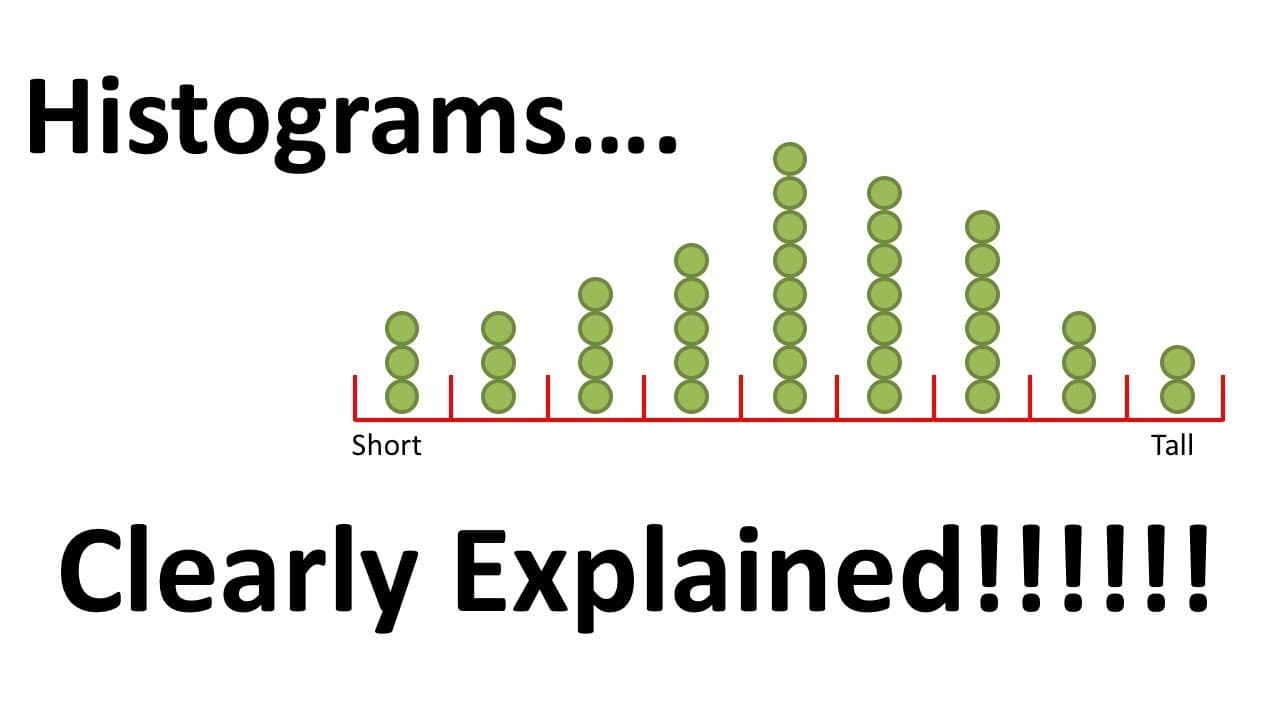
A histogram is a graphical representation that organizes data into bins to illustrate the distribution and frequency of measurements. Selecting the appropriate bin width is essential for effective visualization and interpretation, as too narrow or too wide bins can obscure insights. Histograms are useful for predicting future measurements and justifying the application of specific data distributions.
Transcript
My cat does stats when she sleeps I like to do stats how bout you when I'm awake StatQuest Hello and welcome to StatQuest!!! StatQuest is brought to you by the friendly folks in the genetics department at the University of North Carolina at Chapel Hill Today we're going to be talking front histograms, and they're going to be clearly explained Im... Read More
Key Insights
- ❓ Histograms organize data for easier visualization and interpretation.
- 🧑🦯 Bin width selection is crucial for the effectiveness of histograms.
- 🧡 Taller stacks in a bin indicate higher frequency of measurements within that range.
- 🦻 Histograms aid in predicting the probability of future measurements.
- ❓ Proper histograms can justify the choice of using a specific distribution for data.
- 🧑🦯 Narrow bins provide detailed insights, while wide bins oversimplify data representation.
- 🧑🦯 Experimenting with different bin widths is necessary to create an accurate histogram.
Install to Summarize YouTube Videos and Get Transcripts
Explore YouTube Video Summarizer or Get YouTube Transcript Extractor
Questions & Answers
Q: How do histograms help in visualizing data distribution?
Histograms group data into bins, showing the frequency of measurements within each range, providing a clear picture of the data's distribution.
Q: Why is choosing the right bin width important in creating histograms?
Selecting an appropriate bin width ensures that the histogram accurately represents the data distribution without oversimplifying or overcomplicating it.
Q: Can histograms be used to predict future measurements?
Yes, by analyzing the pattern of measurements in a histogram, one can predict the likelihood of future measurements falling within certain ranges.
Q: How can histograms help in selecting a distribution to approximate data?
Histograms provide insights into the shape and spread of data, helping in choosing the most suitable distribution for data approximation.
Summary & Key Takeaways
-
Histograms organize data into bins for clearer visualization.
-
Taller stacks in a bin indicate more measurements falling into it.
-
Proper bin width selection is crucial for effective data interpretation.
Read in Other Languages (beta)
Share This Summary 📚
Summarize YouTube Videos and Get Video Transcripts with 1-Click
Try YouTube Summary with ChatGPT & Claude or YouTube Transcript Generator
Explore More Summaries from StatQuest with Josh Starmer 📚

Summarize YouTube Videos and Get Video Transcripts with 1-Click
Try YouTube Summary with ChatGPT & Claude or YouTube Transcript Generator