Motor Learning in the Real World
TL;DR
Exploring motor learning through real-world pool billiards study.
Transcript
hi everyone this is rob gray from asu in the perception action podcast again um what i wanted to start doing i'm not sure how often i'll do this but what i wanted to do is to do some short videos where i look at some of my favorite articles from the past year and kind of go through it and kind of put my own spin on them and critique where necessary... Read More
Key Insights
- The study by Haar et al. examines motor learning in real-world tasks using pool billiards, highlighting the limitations of simple tasks in understanding complex motor skills.
- A key issue in motor learning research is the coordination between body parts, which is often overlooked when using simplified tasks like button pressing.
- The study demonstrates the classic power law of practice, where initial performance improvement is rapid, followed by a plateau as participants become more skilled.
- Participants self-organized to an optimal pool shooting technique, known as the pendulum technique, which minimizes shoulder movement and emphasizes elbow rotation.
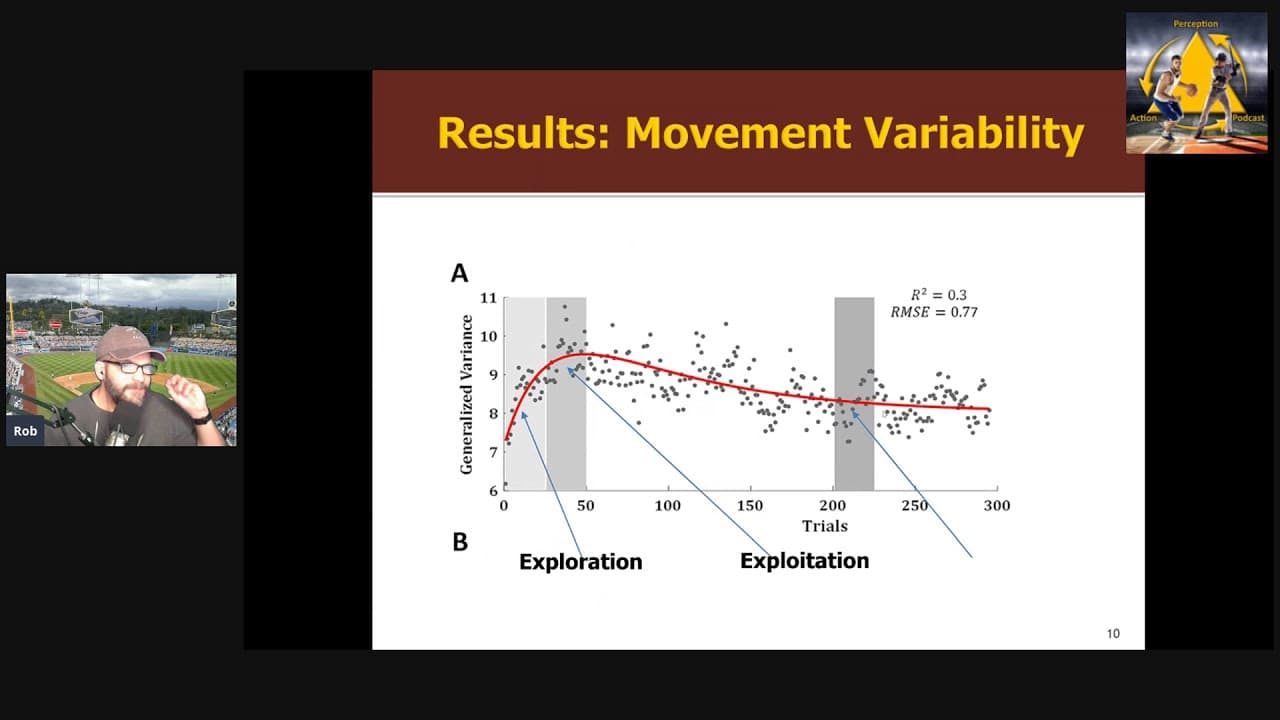
- Movement variability initially increases as participants explore different solutions, then decreases as they exploit the most effective technique.
- The study finds that movement variability decreases with practice, but this is not necessarily evidence of skill, as it occurs under constant task constraints.
- Individual differences in inherent variability affect learning outcomes, emphasizing the need to consider personal traits when designing training interventions.
- The study suggests that task-relevant variability is crucial for learning, especially when constraints are unchanging, while other types of variability become important when adapting to new conditions.
Install to Summarize YouTube Videos and Get Transcripts
Explore YouTube Video Summarizer or Get YouTube Transcript Extractor
Questions & Answers
Q: What is the main focus of the study by Haar et al.?
The main focus of the study by Haar et al. is to investigate motor learning in real-world tasks using pool billiards as a model. The study aims to address the limitations of using simplified tasks in motor learning research and to explore the complexities of coordination and movement variability in real-world skills.
Q: How does the study address the degrees of freedom problem in motor control?
The study addresses the degrees of freedom problem by examining how participants coordinate different body parts during a pool billiards task. It highlights the complexity of real-world motor skills, where multiple body parts are involved, and contrasts this with simplified tasks that often reduce coordination to a single degree of freedom, thus overlooking the intricacies of motor control.
Q: What is the significance of the pendulum technique in the study?
The pendulum technique is significant in the study as it represents an optimal shooting technique in pool billiards. Participants naturally self-organized to this technique, which minimizes shoulder movement and emphasizes elbow rotation. This finding illustrates how individuals can discover effective strategies through practice, aligning with the concept of self-organization in motor learning.
Q: What pattern of movement variability did the study observe?
The study observed a pattern of movement variability where variability initially increased as participants explored different movement solutions. This was followed by a decrease in variability as participants exploited the most effective techniques. This pattern suggests a process of exploration and exploitation in motor learning, consistent with findings from other studies.
Q: Why is the reduction in movement variability not necessarily evidence of skill?
The reduction in movement variability is not necessarily evidence of skill because it occurs under constant task constraints, where the same movement is repeated without changes in conditions. While consistent movements are observed, true skill involves the ability to adapt to changing constraints, which requires maintaining variability to adjust to different situations.
Q: How do individual differences affect learning outcomes in the study?
Individual differences, particularly in inherent movement variability, significantly affect learning outcomes. The study found that participants with higher initial variability showed more variability even after practice. This suggests that personal traits influence how individuals learn and adapt, emphasizing the need to consider these differences when designing training interventions.
Q: What role does task-relevant variability play in learning?
Task-relevant variability plays a crucial role in learning, especially when constraints are constant. In the study, variability in the elbow, which is relevant to the pool shot, was associated with greater learning. This highlights the importance of focusing on variability that directly impacts task performance, as it can drive improvements in skill acquisition.
Q: What future research directions does the study suggest?
The study suggests future research directions such as comparing different training interventions, like constraint-based or differential learning, and examining the transfer of skills to different conditions. By introducing variable constraints, researchers can better understand how movement variability supports adaptation and skill transfer in dynamic environments.
Summary & Key Takeaways
-
The article by Haar et al. explores the complexities of motor learning through a study on pool billiards, emphasizing the limitations of simple tasks in understanding real-world skills. It highlights the importance of coordination and the degrees of freedom problem in motor control.
-
The study finds that participants self-organize to optimal techniques, such as the pendulum technique in pool, and that movement variability follows a pattern of initial exploration followed by exploitation of effective strategies. These findings align with previous research on motor learning.
-
Individual differences in movement variability play a significant role in learning outcomes, suggesting that personal traits should be considered in training interventions. The study also underscores the importance of task-relevant variability in learning, especially under constant constraints.
Read in Other Languages (beta)
Share This Summary 📚
Summarize YouTube Videos and Get Video Transcripts with 1-Click
Try YouTube Summary with ChatGPT & Claude or YouTube Transcript Generator
Explore More Summaries from Rob Gray 📚
Summarize YouTube Videos and Get Video Transcripts with 1-Click
Try YouTube Summary with ChatGPT & Claude or YouTube Transcript Generator