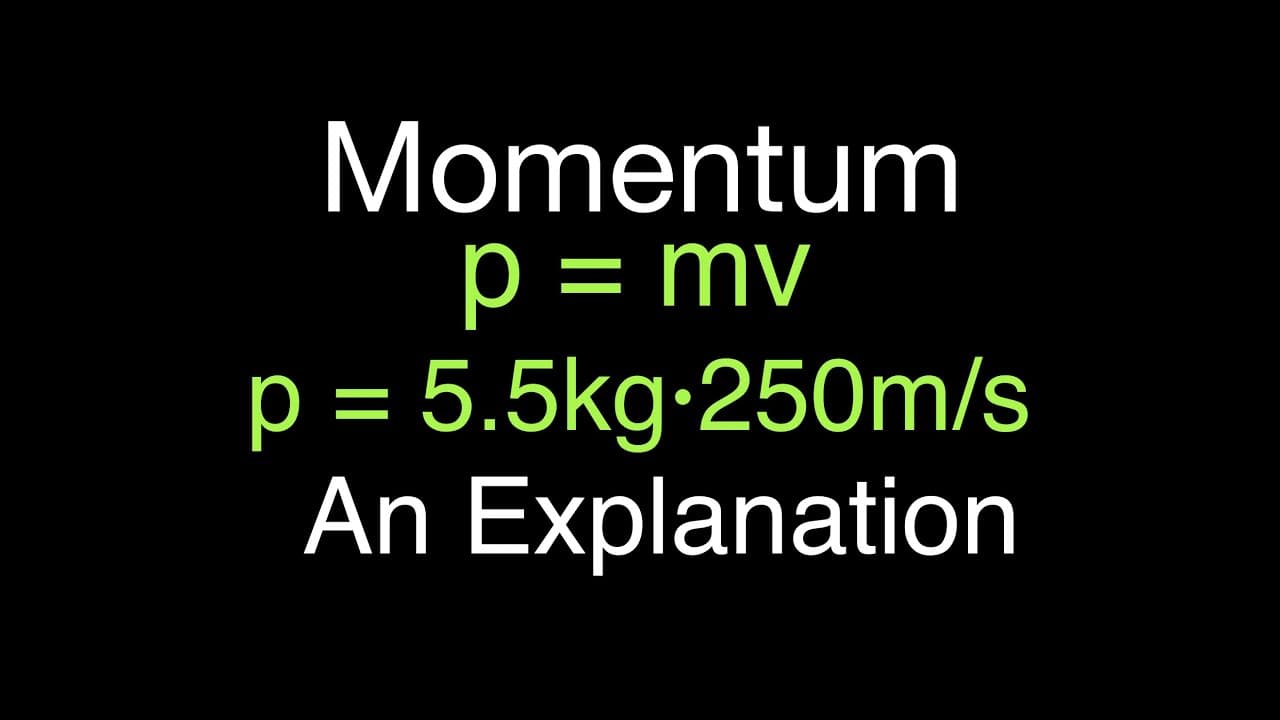
Momentum (1 of 16) An Explanation
TL;DR
Momentum is mass times velocity, a vector quantity with units of kilogram meters per second.
Transcript
okay in today's video I'm going to go over a brief explanation introduction to linear momentum it will also do a short example problem at the end of this video the first thing I like to start with is just a couple simple definitions of momentum momentum is a quantity of motion arising from its mass and its velocity that means basically for an objec... Read More
Key Insights
- 💆 Momentum is mass multiplied by velocity, symbolized as P = M * V.
- ❓ Conservation of momentum states that the total momentum of a system remains constant in the absence of external forces.
- ❓ Momentum is a vector quantity, with both magnitude and direction.
- 🤒 Units of momentum are kilogram meters per second, reflecting mass and velocity.
- 💆 Comparing momentum between objects involves calculating their respective mass-velocity products.
- 😘 Higher velocity can compensate for lower mass in determining momentum.
- 💆 Changing mass or velocity affects an object's momentum, as demonstrated in practical examples.
Install to Summarize YouTube Videos and Get Transcripts
Explore YouTube Video Summarizer or Get YouTube Transcript Extractor
Questions & Answers
Q: What is momentum and how is it calculated?
Momentum is mass times velocity, calculated as P = M * V, where P is momentum, M is mass, and V is velocity.
Q: How is momentum conserved in interactions?
Momentum is conserved in interactions, meaning the total momentum before and after remains constant if no external forces are involved.
Q: Why is momentum considered a vector quantity?
Momentum is a vector because it has magnitude and direction, corresponding to the mass and velocity of the object.
Q: Can momentum be compared between objects with different masses and velocities?
Yes, momentum can be compared by calculating the product of mass and velocity for each object to determine their relative momentum.
Summary & Key Takeaways
-
Momentum is quantified by mass and velocity, calculated as P = M * V.
-
Momentum is conserved in interactions, like other physical quantities such as charge and mass.
-
A practical example compares the momentum of a cannonball and Usain Bolt.
Read in Other Languages (beta)
Share This Summary 📚
Summarize YouTube Videos and Get Video Transcripts with 1-Click
Try YouTube Summary with ChatGPT & Claude or YouTube Transcript Generator
Explore More Summaries from Step by Step Science 📚
Summarize YouTube Videos and Get Video Transcripts with 1-Click
Try YouTube Summary with ChatGPT & Claude or YouTube Transcript Generator