Moments (part 2) | Moments, torque, and angular momentum | Physics | Khan Academy
TL;DR
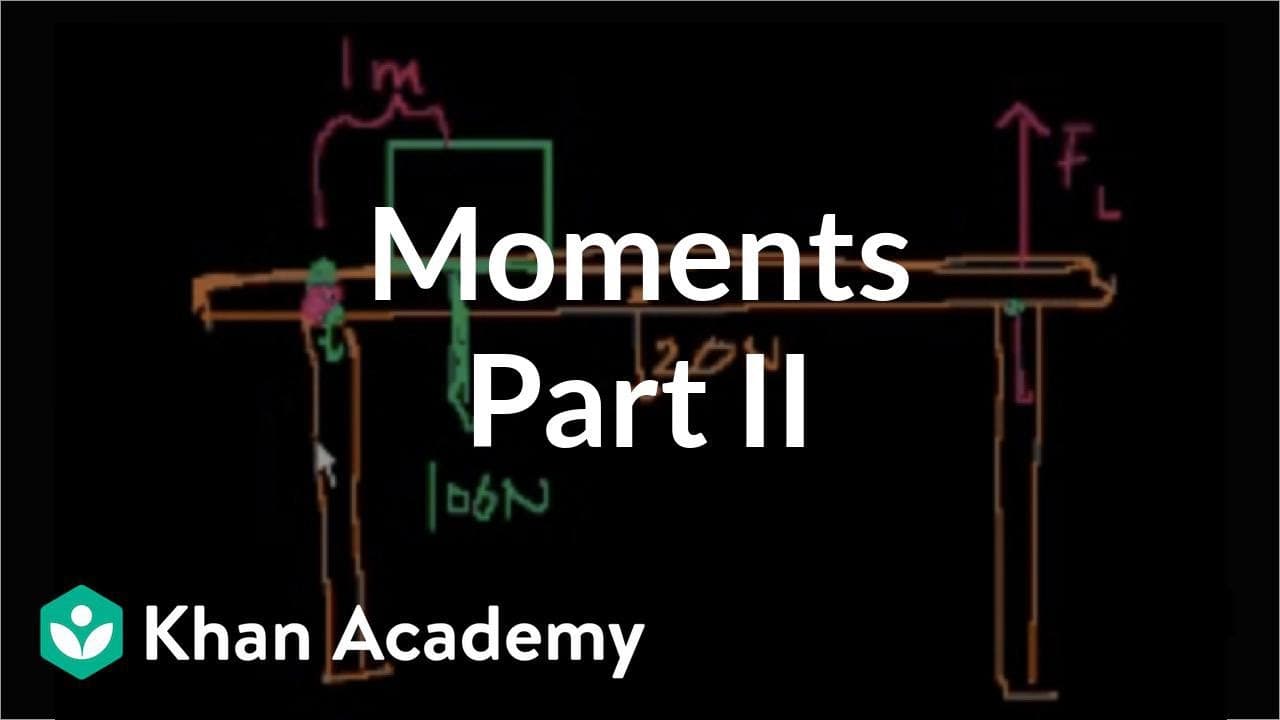
This video explains moment and force problems using examples of a seesaw and a table with legs.
Transcript
I'm going to do a couple more moment and force problems, especially because I think I might have bungled the terminology in the previous video because I kept confusing clockwise with counterclockwise. This time I'll try to be more consistent. Let me draw my lever again. My seesaw. So that's my seesaw, and that is my axis of rotation, or my fulcrum,... Read More
Key Insights
- 🦾 Moments are calculated by multiplying a force with its moment arm distance, considering its direction of rotation.
- 🔄 Clockwise and counterclockwise moments can be balanced by ensuring their sums are equal.
- 🏋️ Moment problems are useful in understanding weight distribution and force exertion on supporting structures.
- 🏋️ The distribution of weight influences the forces exerted on supporting structures.
- 🈸 Moments have practical applications in engineering and physics.
- ⚖️ The balance of moments can determine the stability and functionality of structures.
- 🎨 Calculating moments helps analyze and optimize the design of structures.
Install to Summarize YouTube Videos and Get Transcripts
Explore YouTube Video Summarizer or Get YouTube Transcript Extractor
Questions & Answers
Q: How can moments be calculated in a force problem?
Moments can be calculated by multiplying the force with its moment arm distance. Clockwise and counterclockwise moments are determined based on the direction of rotation.
Q: What does it mean when a moment is clockwise or counterclockwise?
Clockwise moments cause rotation in the clockwise direction, while counterclockwise moments cause rotation in the counterclockwise direction.
Q: How can moment problems be applied in real-life scenarios?
Moment problems are relevant in structural engineering, architecture, and physics, where the distribution of weight and forces needs to be analyzed and balanced.
Q: How does the distribution of weight affect the force exerted on supporting structures?
The closer a weight is to a supporting structure, the more force it will exert on that structure. The distribution of weight determines the amount of force each supporting structure needs to bear.
Summary & Key Takeaways
-
The video introduces the concept of moments in physics, using a seesaw as an example.
-
It demonstrates how to calculate clockwise and counterclockwise moments using forces and their moment arm distances.
-
Another example is given using a table with legs, where the balancing of weight distribution is explained.
Read in Other Languages (beta)
Share This Summary 📚
Summarize YouTube Videos and Get Video Transcripts with 1-Click
Try YouTube Summary with ChatGPT & Claude or YouTube Transcript Generator
Explore More Summaries from Khan Academy 📚

Summarize YouTube Videos and Get Video Transcripts with 1-Click
Try YouTube Summary with ChatGPT & Claude or YouTube Transcript Generator