Lecture 13 - Medical statistics part 2
TL;DR
Lecture on quantitative data analysis in medical statistics.
Transcript
good morning everybody and today we will we will continue our discussion about medical statistics yeah uh this part of our education of your education of our study is long part and today we will continue we will be second part and today we will look at quantitative data analysis so uh in previous lecture i told you about the importance of checking ... Read More
Key Insights
- Understanding the type of distribution in a dataset is crucial for choosing the correct analysis method, such as normal or non-normal distribution.
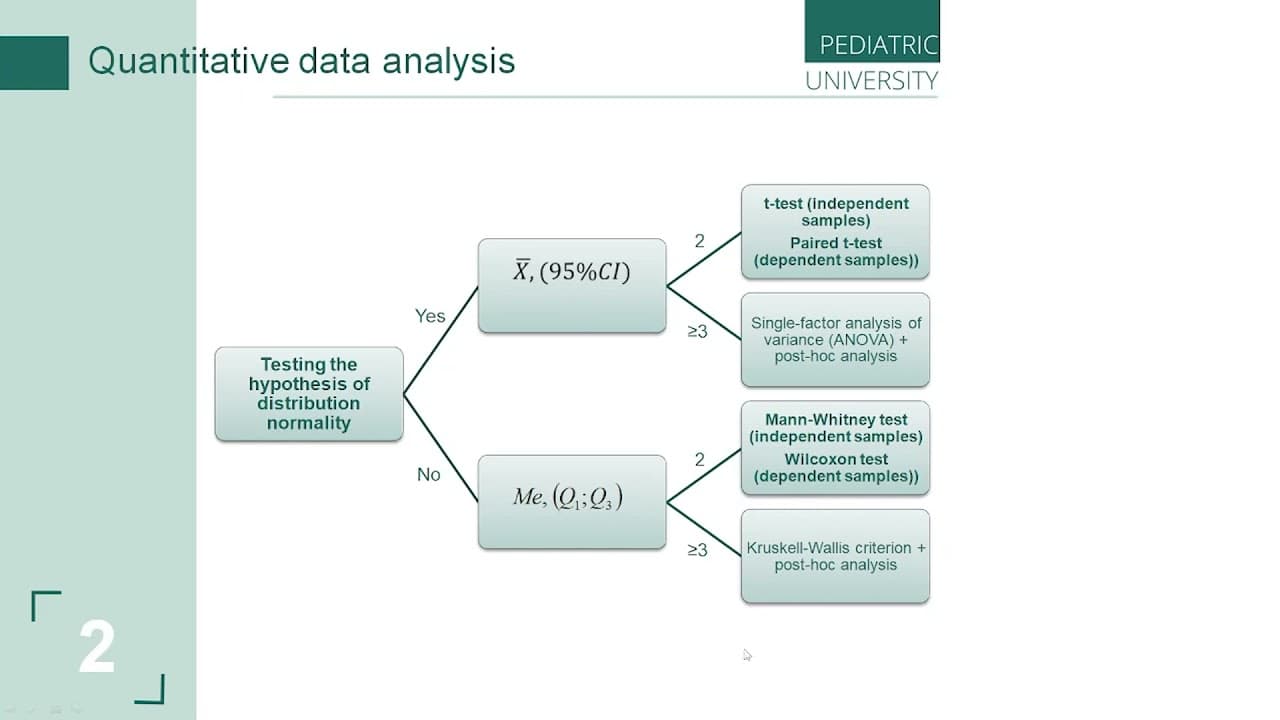
- For quantitative data analysis, the normality of distribution is often tested using Shapiro-Wilk or Kolmogorov-Smirnov tests, depending on sample size.
- When comparing two independent groups with normally distributed data, the Student's t-test is used, while the paired t-test is for dependent samples.
- For non-normal distributions, non-parametric tests like Mann-Whitney U test for independent samples and Wilcoxon signed-rank test for dependent samples are employed.
- The lecture emphasizes the importance of confidence intervals and standard deviation in presenting quantitative data results.
- The concept of hypothesis testing is central, with null and alternative hypotheses guiding the analysis of statistical significance.
- The lecture introduces the historical context of statistical tests, such as the Student's t-test, developed by William Gossett under a pseudonym.
- The session concludes with an overview of how to approach quantitative data analysis, highlighting various tests based on sample size and distribution type.
Install to Summarize YouTube Videos and Get Transcripts
Explore YouTube Video Summarizer or Get YouTube Transcript Extractor
Questions & Answers
Q: How is the normality of a dataset tested in quantitative analysis?
The normality of a dataset is tested using statistical tests such as the Shapiro-Wilk test for samples with fewer than 50 items, and the Kolmogorov-Smirnov test for larger samples. These tests help determine if the data follows a normal distribution, which is crucial for selecting the appropriate analysis method.
Q: What statistical test is used for comparing two independent groups with normal distribution?
For comparing two independent groups with normally distributed data, the Student's t-test is used. This test evaluates whether there is a statistically significant difference between the means of the two groups, assuming the data is normally distributed and variances are homogeneous.
Q: What is the alternative to the Student's t-test for non-normal distributions?
For non-normal distributions, the Mann-Whitney U test is used for independent samples, and the Wilcoxon signed-rank test is used for dependent samples. These non-parametric tests do not assume normal distribution and are suitable for analyzing data that does not meet the assumptions of the t-test.
Q: Why is hypothesis testing important in statistical analysis?
Hypothesis testing is important because it provides a structured method for making inferences about a population based on sample data. It involves formulating a null hypothesis and an alternative hypothesis and using statistical tests to determine if there is enough evidence to reject the null hypothesis, thus assessing the significance of the results.
Q: What is the historical significance of the Student's t-test?
The Student's t-test was developed by William Gossett under the pseudonym 'Student' while working at the Guinness brewery. Due to confidentiality agreements, he could not publish under his own name. The test has become a fundamental tool in statistics for comparing means between two groups, especially when sample sizes are small.
Q: How are confidence intervals used in quantitative data analysis?
Confidence intervals are used to estimate the range within which the true population parameter lies with a certain level of confidence, usually 95%. They provide context to the mean value by indicating the precision of the estimate and are often presented alongside standard deviation to give a fuller picture of the data's variability.
Q: What role does sample size play in choosing statistical tests?
Sample size influences the choice of statistical tests, particularly when assessing normality. Smaller samples may require tests like Shapiro-Wilk, while larger samples might use Kolmogorov-Smirnov. Additionally, the power of a test and the ability to detect significant differences are affected by sample size, impacting the reliability of the results.
Q: What is the significance of using non-parametric tests in data analysis?
Non-parametric tests are significant because they do not assume a normal distribution of data, making them versatile for analyzing non-normally distributed data. They are particularly useful when data violates the assumptions of parametric tests, allowing for robust analysis of ordinal data or data with outliers.
Summary & Key Takeaways
-
The lecture focuses on quantitative data analysis in medical statistics, emphasizing the importance of understanding data distribution. It covers methods for testing normality and choosing appropriate statistical tests based on distribution type.
-
Key statistical tests discussed include the Student's t-test for normally distributed data and non-parametric tests like the Mann-Whitney U test for non-normal distributions. The importance of hypothesis testing and confidence intervals is highlighted.
-
Historical context is given for some statistical tests, and the session concludes with a comprehensive overview of quantitative data analysis, preparing students for future studies in medical statistics.
Read in Other Languages (beta)
Share This Summary 📚
Summarize YouTube Videos and Get Video Transcripts with 1-Click
Try YouTube Summary with ChatGPT & Claude or YouTube Transcript Generator
Explore More Summaries from Анна Разинова 📚

Summarize YouTube Videos and Get Video Transcripts with 1-Click
Try YouTube Summary with ChatGPT & Claude or YouTube Transcript Generator