Lecture 4 Hemodynamics
TL;DR
Lecture on hemodynamics covering blood flow and cardiovascular system.
Transcript
good morning everybody's uh i glad to see you and maybe you glad to hear me uh today we will discuss with you uh the most romantic topic of physique start to learn this topic this is the hemodynamics to begin with we will analyze the word hemodynamic swissy and this work word is greek and consists of two words gem this is blood and dynamics... Read More
Key Insights
- Hemodynamics is the study of blood movement in the body, crucial for understanding cardiovascular physiology and oxygen delivery to tissues.
- Blood consists of cells suspended in plasma; 46% of blood is not liquid, impacting hydrodynamics in vessels.
- The cardiovascular system is a closed system with the heart as a pump and vessels for blood flow, including arteries, veins, and capillaries.
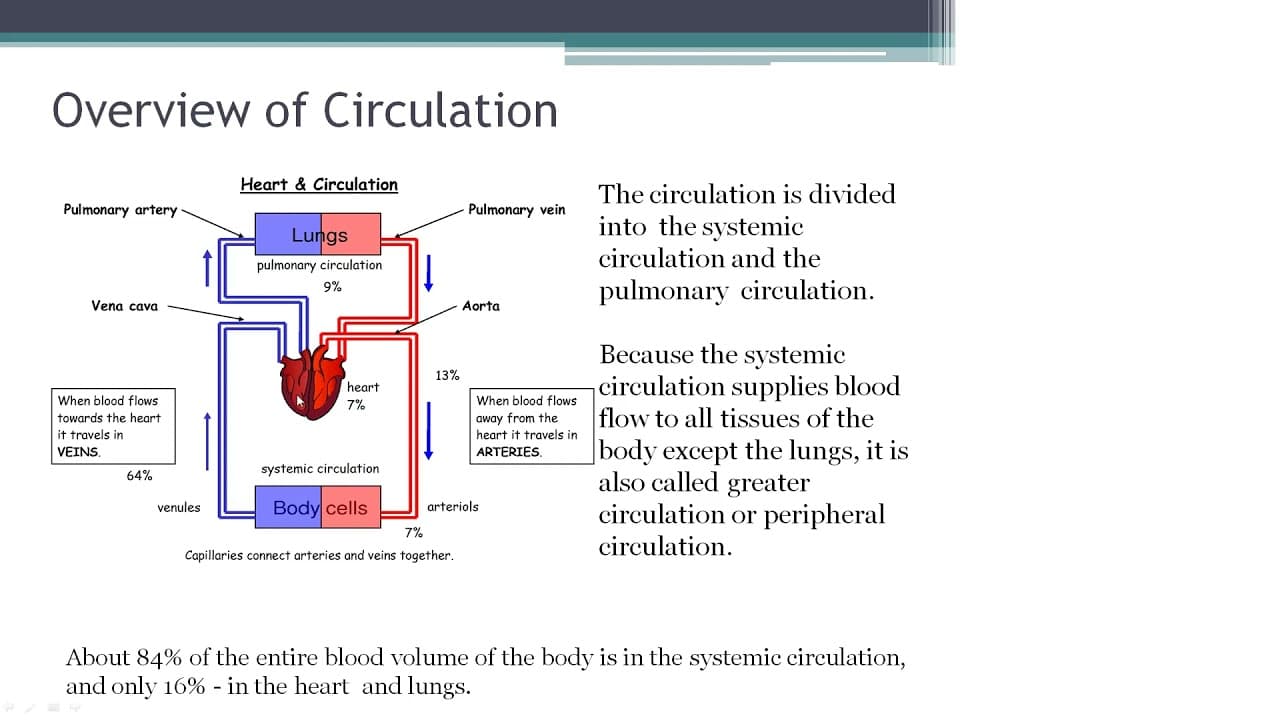
- Two main blood circulation pathways exist: systemic (large) and pulmonary (small), each with distinct roles in oxygen and nutrient delivery.
- Fluid characteristics like density and pressure are essential for understanding liquid behavior in vessels, governed by laws like Pascal's and Archimedes'.
- The Bernoulli equation applies to hemodynamics, indicating energy conservation in fluid flow, but with limitations in the human body.
- Viscosity influences blood flow, with blood being a non-Newtonian fluid, affecting resistance and flow dynamics.
- Understanding blood pressure measurement, including systolic and diastolic values, is vital for assessing cardiovascular health.
Install to Summarize YouTube Videos and Get Transcripts
Explore YouTube Video Summarizer or Get YouTube Transcript Extractor
Questions & Answers
Q: What is hemodynamics?
Hemodynamics is the study of blood flow and its movement through the circulatory system. It is an essential part of cardiovascular physiology, involving the forces and principles governing blood circulation. Understanding hemodynamics is crucial for ensuring adequate oxygen and nutrient delivery to tissues and maintaining overall cardiovascular health.
Q: What is the composition of blood?
Blood is composed of cells suspended in plasma. It includes red blood cells (erythrocytes), white blood cells (leukocytes), and platelets. Red blood cells make up the majority of blood cells, giving blood its red color due to hemoglobin. Plasma, the liquid part of blood, constitutes about 54% of blood, while 46% is cellular, impacting hydrodynamics in vessels.
Q: What are the main pathways of blood circulation?
The main pathways of blood circulation are the systemic (large) and pulmonary (small) circulations. The systemic circulation begins in the left atrium and involves oxygen-rich blood being distributed throughout the body. The pulmonary circulation starts in the right ventricle, where blood is oxygenated in the lungs before returning to the heart. Both pathways are crucial for efficient oxygen and nutrient delivery.
Q: How does fluid density and pressure affect blood flow?
Fluid density and pressure are key factors in understanding blood flow dynamics. Density affects the number of molecules per unit volume, while pressure influences fluid movement through vessels. Laws like Pascal's and Archimedes' describe how pressure is transmitted and how buoyant forces act on substances, impacting how blood circulates within the cardiovascular system.
Q: What is the Bernoulli equation's role in hemodynamics?
The Bernoulli equation describes energy conservation in fluid flow, indicating that the sum of static, dynamic, and hydrostatic pressures remains constant along a streamline. In hemodynamics, it helps understand blood flow dynamics, although its application is limited due to the complex and variable nature of the human circulatory system. It provides insights into pressure and flow relationships in vessels.
Q: How does viscosity influence blood flow?
Viscosity is a measure of a fluid's resistance to flow, impacting blood movement through vessels. Blood is a non-Newtonian fluid, meaning its viscosity depends on factors like shear rate and temperature. This affects resistance and flow dynamics, influencing how easily blood circulates, especially in smaller vessels. Understanding viscosity is crucial for assessing blood flow efficiency and cardiovascular health.
Q: What is the significance of blood pressure measurement?
Blood pressure measurement is vital for assessing cardiovascular health. It involves measuring systolic (maximum) and diastolic (minimum) pressures, reflecting the force of blood against artery walls. Accurate measurement, often using the Korotkoff method, helps diagnose hypertension and monitor heart function. Understanding blood pressure dynamics aids in evaluating cardiovascular risk and ensuring effective treatment.
Q: What are the types of fluid flow in vessels?
Fluid flow in vessels can be laminar or turbulent. Laminar flow is orderly, with fluid moving in parallel layers, common in normal conditions. Turbulent flow is chaotic, involving mixing and oscillations, occurring in areas like the aorta or heart. The Reynolds number helps determine flow type, with higher values indicating turbulence. Understanding flow types is crucial for assessing blood movement and potential cardiovascular issues.
Summary & Key Takeaways
-
Hemodynamics is the study of blood flow, crucial for oxygen delivery. Blood comprises cells and plasma, with 46% being non-liquid, affecting hydrodynamics. The cardiovascular system includes the heart and vessels, with systemic and pulmonary circulation pathways.
-
Fluid characteristics like density and pressure are vital for understanding vessel behavior, governed by laws like Pascal's. Bernoulli's equation applies to hemodynamics, but with limitations. Viscosity impacts blood flow, with blood being a non-Newtonian fluid.
-
Blood pressure measurement, including systolic and diastolic values, is essential for cardiovascular health assessment. Understanding these concepts aids in comprehending blood movement and its physiological implications in the human body.
Read in Other Languages (beta)
Share This Summary 📚
Summarize YouTube Videos and Get Video Transcripts with 1-Click
Try YouTube Summary with ChatGPT & Claude or YouTube Transcript Generator
Explore More Summaries from Анна Разинова 📚
Summarize YouTube Videos and Get Video Transcripts with 1-Click
Try YouTube Summary with ChatGPT & Claude or YouTube Transcript Generator