How to Write Chemical Formulas with Polyatomic Ions
TL;DR
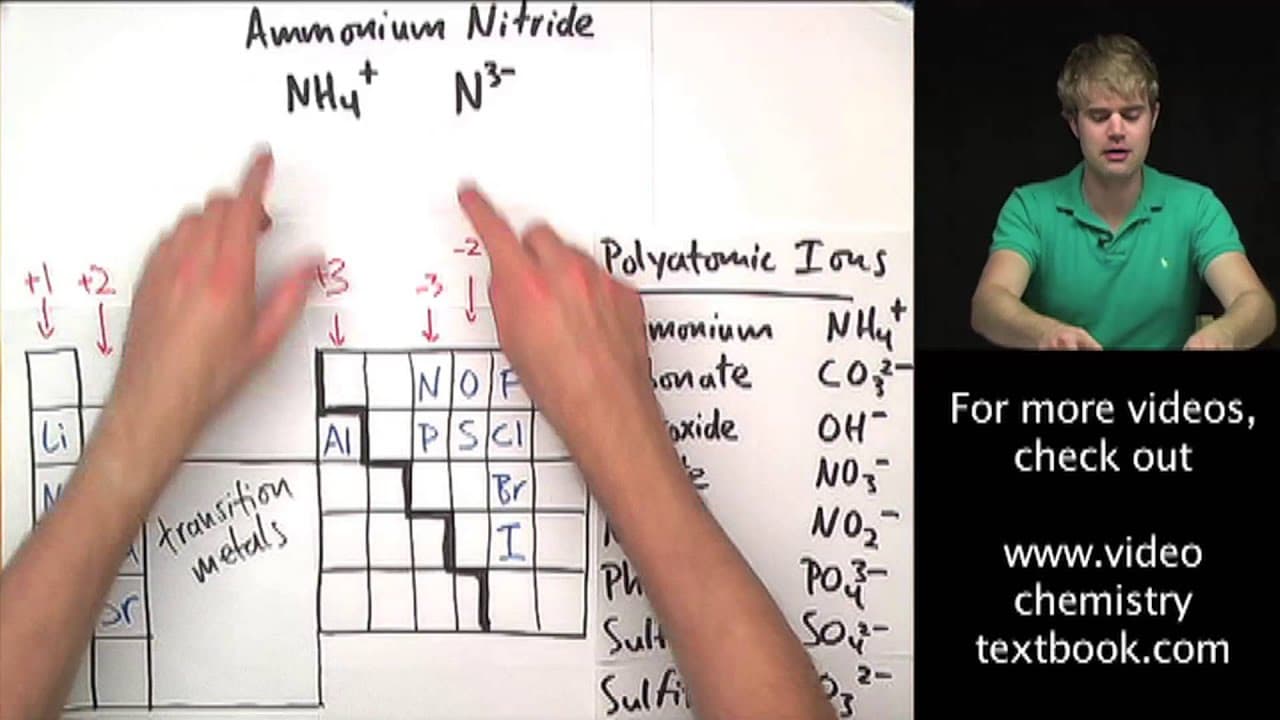
To write chemical formulas with polyatomic ions, balance the charges of the ions and elements using a periodic table. Memorizing common polyatomic ions, like Nitrate (NO3-) and Ammonium (NH4+), is crucial for accurate formula writing. Use parentheses to indicate the quantity of polyatomic ions when necessary and ensure that the charges balance correctly.
Transcript
Let's learn how to write chemical formulas for compounds that have polyatomic ions in them. So what's a polyatomic ion? Well, it's what happens when a bunch of atoms come together and they connect together and form a big clump. That clump itself has a charge. So here's a list of some of my polyatomic ions and it has stuff on it like Nitrate which i... Read More
Key Insights
- 💁 Polyatomic ions are clumps of atoms with distinct charges formed by bonding.
- 😑 Balancing charges between polyatomic ions and elements is crucial in writing accurate chemical formulas.
- 😑 Memorizing polyatomic ions is essential to avoid confusion and accurately represent compounds.
- 💁 Periodic table information helps in determining the charges of elements and polyatomic ions in compound formulas.
- 🤩 Understanding the charges and components of polyatomic ions is key to writing correct chemical formulas.
- 😑 Multiple polyatomic ions can be combined in compound formulas by balancing charges.
- 😑 Polyatomic ions have fixed charges that must be considered when writing compound formulas.
Install to Summarize YouTube Videos and Get Transcripts
Explore YouTube Video Summarizer or Get YouTube Transcript Extractor
Questions & Answers
Q: What are polyatomic ions and how do they form?
Polyatomic ions are groups of atoms bonded together that carry a charge due to the arrangement of their atoms in a clump. Atoms combine to form these ions which have distinct charges.
Q: How do you balance charges when writing chemical formulas with polyatomic ions?
To balance charges, determine the charges of individual ions from the periodic table, then adjust the number of ions in the formula until the positive and negative charges balance out, ensuring overall charge neutrality.
Q: Why is it necessary to memorize polyatomic ions when writing chemical formulas?
Memorizing polyatomic ions is essential to correctly identifying and using them in compound formulas without confusion. This avoids errors in charge balancing and helps in accurately representing compounds.
Q: Is there a method to determine polyatomic ion charges without memorization?
Unfortunately, there isn't a reliable method to determine polyatomic ion charges without memorization. It's crucial to learn and internalize these charges to write accurate chemical formulas for compounds.
Summary & Key Takeaways
-
Polyatomic ions form when atoms bond, creating clumps with charges.
-
To write chemical formulas with polyatomic ions, balance charges using periodic table information.
-
Memorize polyatomic ions to avoid confusion and correctly write compound formulas.
Read in Other Languages (beta)
Share This Summary 📚
Summarize YouTube Videos and Get Video Transcripts with 1-Click
Try YouTube Summary with ChatGPT & Claude or YouTube Transcript Generator
Explore More Summaries from Tyler DeWitt 📚
Summarize YouTube Videos and Get Video Transcripts with 1-Click
Try YouTube Summary with ChatGPT & Claude or YouTube Transcript Generator