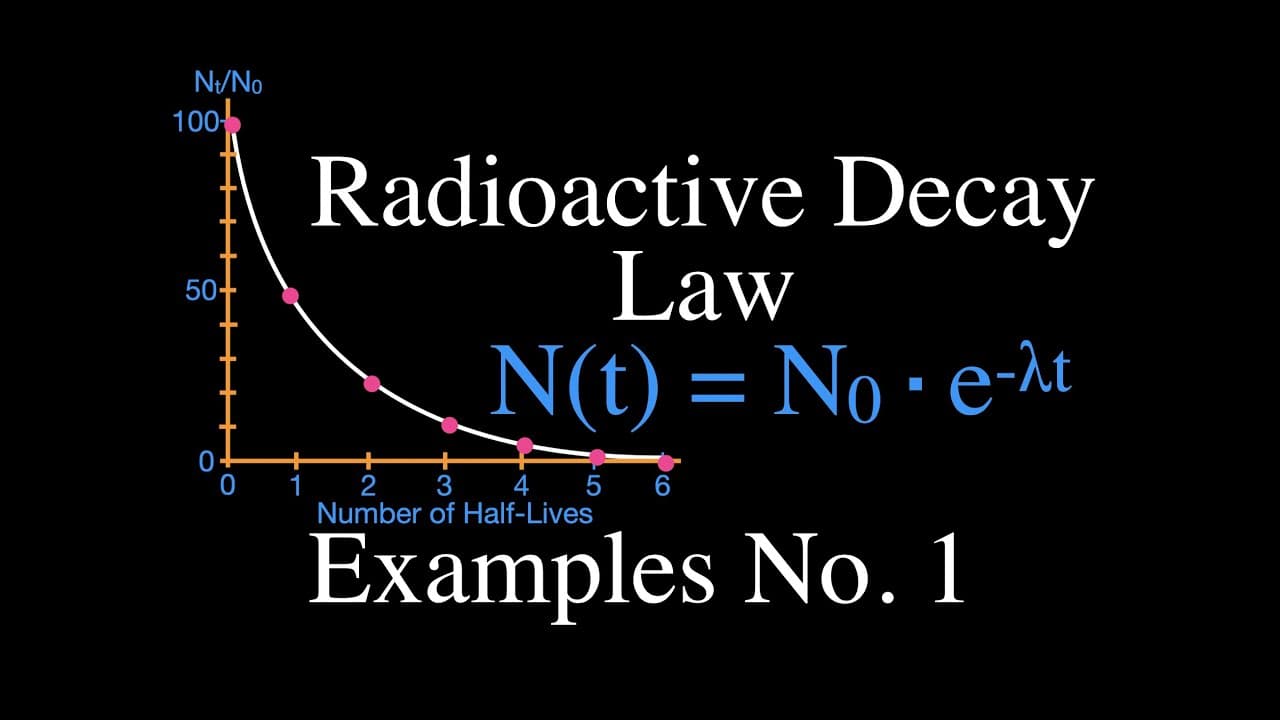
Radioactivity (12 of 16) Radioactive Decay Law, Examples Problems
TL;DR
Solving for remaining radioactive nuclei & half-life using decay law examples.
Transcript
okay as you can see in today's video I am going to go over some examples already I have kala that is the radio after kala right there I think I have three examples we're gonna go over please don't forget before we do this bottom right hand corner subscribe to my channel click on that button right there subscribe to my channel get all my excellent p... Read More
Key Insights
- ☢️ Radioactive decay involves exponential decrease in radioactive nuclei over time.
- 😒 Decay law equation uses decay constant and time to calculate remaining radioactive nuclei.
- 🥡 Half-life represents the time taken for half of the radioactive nuclei to decay.
- 👮 Understanding decay law is fundamental in studying nuclear physics and chemistry.
- ☠️ Decay constant determines the rate of decay in radioactive substances.
- 👮 Proper unit conversions are essential when using decay law equations.
- ☢️ Solving for remaining radioactive nuclei requires accurate calculations and application of mathematical principles.
Install to Summarize YouTube Videos and Get Transcripts
Explore YouTube Video Summarizer or Get YouTube Transcript Extractor
Questions & Answers
Q: How do you calculate the number of radioactive nuclei remaining after a specific time?
To calculate the remaining radioactive nuclei, use the decay law equation with the given values of decay constant, initial nuclei count, and time elapsed.
Q: What is the significance of the decay constant in radioactive decay calculations?
The decay constant represents the rate at which radioactive nuclei decay per unit time, influencing the exponential decrease in the number of radioactive nuclei over time.
Q: How can one determine the half-life of a radioactive sample from decay law calculations?
By using the equation linking the half-life to the decay constant, one can derive the half-life value from the given decay constant in the context of radioactive decay.
Q: Why is understanding radioactive decay and decay law essential in nuclear physics and chemistry?
Knowledge of radioactive decay and decay law is crucial for various applications, including radiometric dating, medical imaging, and nuclear power generation, providing insights into the behavior of unstable nuclei.
Summary & Key Takeaways
-
Demonstrates solving for remaining radioactive nuclei using decay law.
-
Shows how to find the half-life of a radioactive sample.
-
Provides step-by-step examples for understanding radioactive decay.
Read in Other Languages (beta)
Share This Summary 📚
Summarize YouTube Videos and Get Video Transcripts with 1-Click
Try YouTube Summary with ChatGPT & Claude or YouTube Transcript Generator
Explore More Summaries from Step by Step Science 📚

Summarize YouTube Videos and Get Video Transcripts with 1-Click
Try YouTube Summary with ChatGPT & Claude or YouTube Transcript Generator