What Was the Feudal System in the Middle Ages?
TL;DR
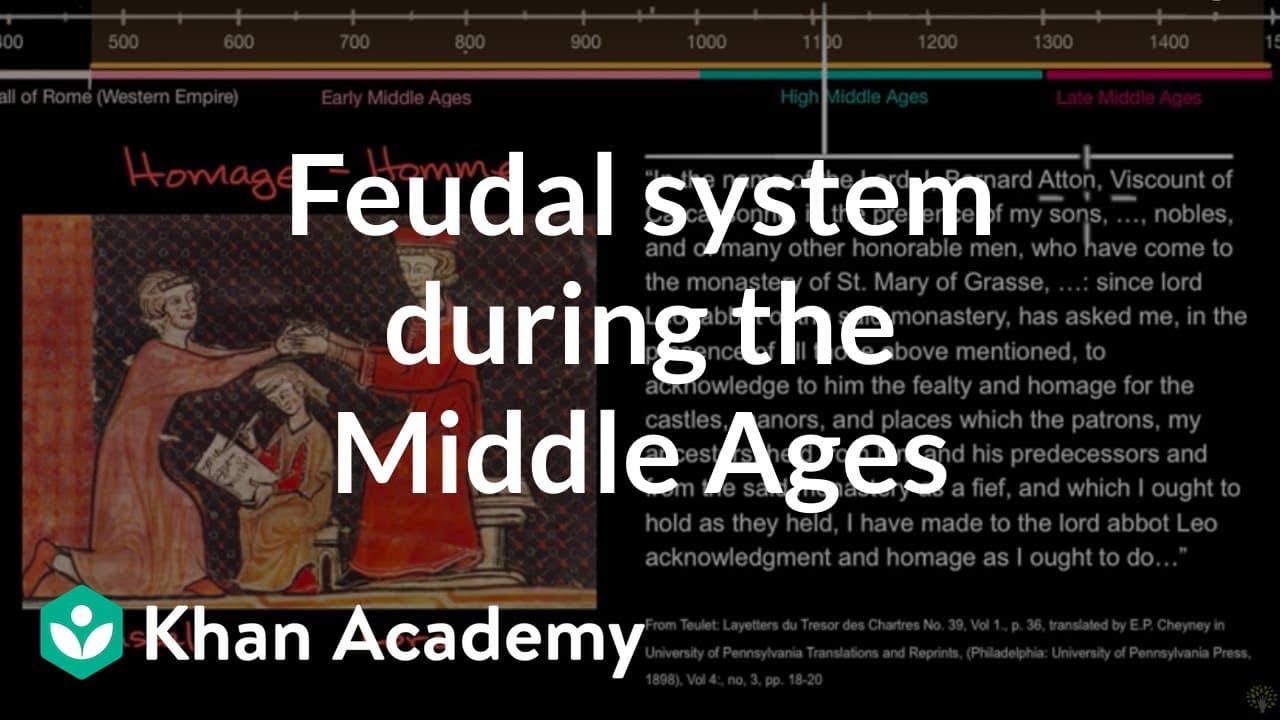
The feudal system in the Middle Ages was a hierarchical structure where land was exchanged for loyalty and service. Monarchs granted land to nobles, such as dukes and counts, who then had their own vassals, including knights and serfs, forming a complex network of obligation and governance. This system influenced how territories were managed and power was distributed throughout medieval Europe.
Transcript
- [Instructor] Talk about in other videos, the Middle Ages refers to that roughly 1,000 year period of time in Europe from the end of the Western Roman empire in 476 until we get to about 1,000 years later with the emergence of the Renaissance and the Age of Exploration. And we associate it with knights in shining armor and their code of chivalry, ... Read More
Key Insights
- 🍂 The Middle Ages spanned approximately 1000 years, from the fall of the Western Roman empire to the emergence of the Renaissance.
- 🏝️ The feudal system was the predominant governing structure in the Middle Ages, with land ownership and loyalty as the foundation.
- 🏝️ Kings granted land to nobles, such as dukes and counts, who in turn granted land to their own vassals.
- 🐕🦺 The hierarchy in the feudal system was based on the exchange of land for service and loyalty.
- 🥹 Knights played a significant role in the feudal system, often holding land and providing military service.
- ✊ The feudal system was complex and could differ from region to region, making it difficult to keep track of titles and power dynamics.
- 🍧 The church was a powerful institution during the Middle Ages, with bishops and abbots having significant influence.
Install to Summarize YouTube Videos and Get Transcripts
Explore YouTube Video Summarizer or Get YouTube Transcript Extractor
Questions & Answers
Q: What is the feudal system?
The feudal system was a social and political structure in the Middle Ages where land was granted by the king to nobles in exchange for loyalty and service.
Q: How were territories divided in the feudal system?
Territories were divided into kingdoms, duchies, counties, and manors, with each level of nobility ruling over their own vassals.
Q: What was the role of a knight in the feudal system?
Knights were skilled mounted soldiers who were often granted land (fief) by a lord in exchange for military service. They could also hold titles such as duke or count.
Q: How did the feudal system contribute to social hierarchy?
The feudal system created a clear hierarchy where kings were at the top, followed by nobles of varying ranks. The lower social classes, like serfs and peasants, worked the land for the nobles.
Summary & Key Takeaways
-
The Middle Ages refers to a 1,000 year period in Europe from the fall of the Western Roman empire to the emergence of the Renaissance and Age of Exploration.
-
The feudal system was the governing structure in the Middle Ages, where land was granted by the king to nobles in exchange for loyalty and service.
-
The hierarchy included kings, dukes, counts, and knights, each with their own territories and vassals.
Read in Other Languages (beta)
Share This Summary 📚
Summarize YouTube Videos and Get Video Transcripts with 1-Click
Try YouTube Summary with ChatGPT & Claude or YouTube Transcript Generator
Explore More Summaries from Khan Academy 📚




Summarize YouTube Videos and Get Video Transcripts with 1-Click
Try YouTube Summary with ChatGPT & Claude or YouTube Transcript Generator