What Is the Unusual SN1 Reaction Mechanism with Methanol?
TL;DR
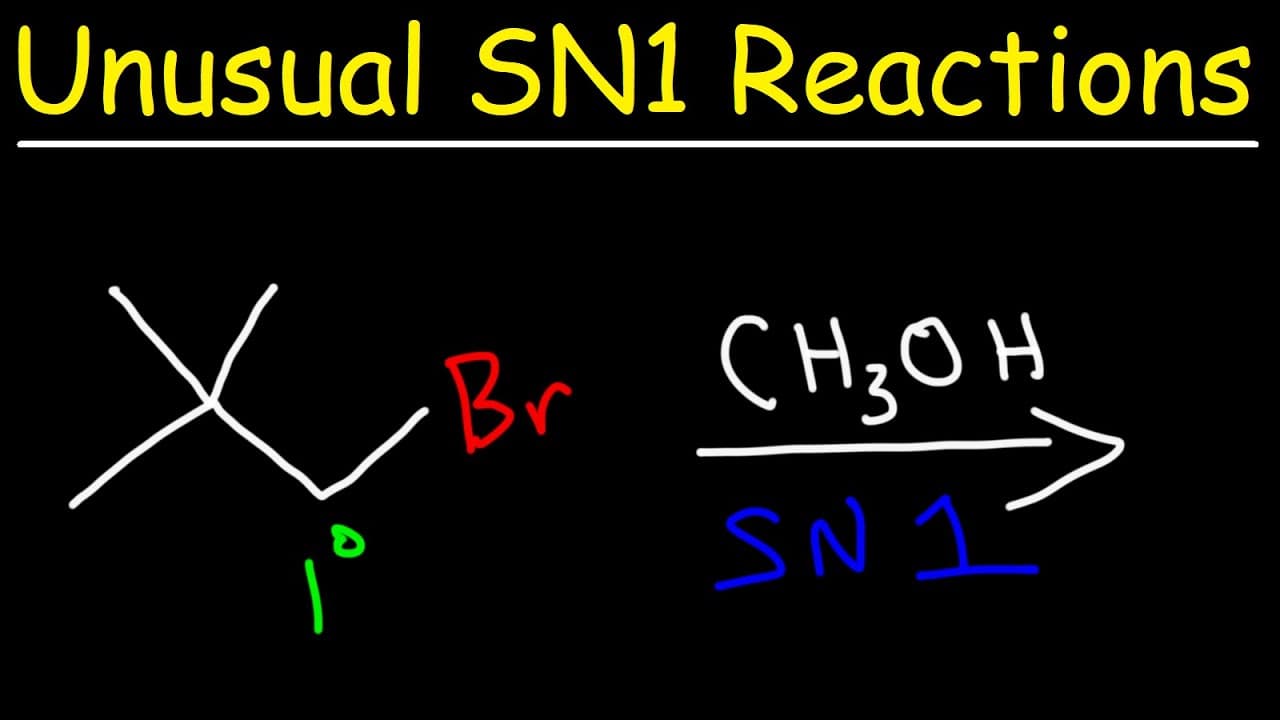
The reaction of bromo 2,2-dimethylpentane with methanol is more likely to proceed via the SN1 mechanism due to the presence of a bulky terpene group and a weak nucleophile. Despite the primary alkyl halide typically favoring SN2 reactions, a methyl shift stabilizes the intermediate, allowing for the formation of a tertiary carbocation and making SN1 the preferred pathway.
Transcript
consider the reaction shown on the screen what we have here is one bromo 2 2 dimethylpentane now when you look at this structure and seeing it mixed with methanol what product will we get in this reaction and also what mechanism will the reaction proceed by would you say it's going to be the sn1 mechanism or would you say the sn2 mechanism and also... Read More
Key Insights
- ❓ The reaction between bromo 2,2-dimethylpentane and methanol can proceed through both Sn1 and Sn2 mechanisms.
- 👥 The primary alkyl halide favors Sn2 reactions, but the presence of a bulky terpene group and weak nucleophile (methanol) make Sn1 more likely.
- 💁 The Sn1 mechanism involves the formation of a primary carbocation, which can be stabilized through a methyl shift.
- 👊 The Sn2 mechanism involves methanol attacking the carbon from the back and resulting in the product without carbocation formation.
- 👻 The protic solvent (methanol) favors the Sn1 mechanism by stabilizing the carbocation intermediate and allowing the reaction to proceed through a slower, stepwise fashion.
- ❓ Primary alkyl halides are less likely to undergo Sn1 reactions due to the instability of primary carbocations.
- 💁 The formation of a tertiary carbocation through a methyl shift allows the reaction to proceed through Sn1 mechanism without the formation of a primary carbocation.
Install to Summarize YouTube Videos and Get Transcripts
Explore YouTube Video Summarizer or Get YouTube Transcript Extractor
Questions & Answers
Q: What is the difference between Sn1 and Sn2 mechanisms?
Sn1 mechanism involves the formation of a carbocation intermediate, while Sn2 mechanism does not form a carbocation and proceeds through a one-step concerted reaction.
Q: Why is the Sn1 mechanism more likely in this reaction?
The presence of a primary alkyl halide adjacent to a bulky terpene group and weak nucleophile (methanol) favors Sn1 mechanism over Sn2.
Q: How does the Sn1 mechanism proceed in this reaction?
In the Sn1 mechanism, the leaving group (bromine) first leaves, forming a primary carbocation. This carbocation undergoes a methyl shift to form a more stable tertiary carbocation, which then reacts with methanol.
Q: What is the role of the protic solvent in this reaction?
The protic solvent (methanol) favors the Sn1 mechanism by stabilizing the carbocation intermediate and allowing the reaction to proceed through a slower, stepwise fashion.
Q: Can the reaction still proceed through the Sn2 mechanism?
Yes, the Sn2 mechanism is still possible in this reaction. However, it is less likely due to the sterically hindered primary alkyl halide and the presence of factors favoring the Sn1 mechanism.
Q: Why is the formation of a primary carbocation unfavorable?
Primary carbocations are highly unstable compared to secondary and tertiary carbocations. They are less likely to form in reactions involving primary alkyl halides and are usually avoided due to their instability.
Summary & Key Takeaways
-
The reaction between bromo 2,2-dimethylpentane and methanol can lead to two different products depending on the mechanism.
-
The primary alkyl halide favors Sn2 reactions, but the presence of a bulky terpene group and weak nucleophile makes Sn1 more likely.
-
Sn1 mechanism involves the formation of a primary carbocation, which can be stabilized through a methyl shift.
-
The Sn2 mechanism involves methanol attacking the carbon from the back and resulting in the product without carbocation formation.
Read in Other Languages (beta)
Share This Summary 📚
Summarize YouTube Videos and Get Video Transcripts with 1-Click
Try YouTube Summary with ChatGPT & Claude or YouTube Transcript Generator
Explore More Summaries from The Organic Chemistry Tutor 📚


Summarize YouTube Videos and Get Video Transcripts with 1-Click
Try YouTube Summary with ChatGPT & Claude or YouTube Transcript Generator