Products
Features
YouTube Video Summarizer
Summarize YouTube videos
Web & PDF Highlighter
Highlight web pages & PDFs
Chat with PDF
Ask any PDF questions with AI
Ask AI Clone
Chat with your highlights & memories
Audio Transcriber
Transcribe audio files to text
Glasp Reader
Read and highlight articles
Kindle Highlight Export
Export your Kindle highlights
Idea Hatch
Hatch ideas from your highlights
Integrations
Obsidian Plugin
Notion Integration
Pocket Integration
Instapaper Integration
Medium Integration
Readwise Integration
Snipd Integration
Hypothesis Integration
Apps & Extensions
Chrome Extension
Safari Extension
Edge Add-ons
Firefox Add-ons
iOS App
Android App
Discover
Discover
Ideas
Discover new ideas and insights
Articles
Curated articles and insights
Books
Book recommendations by great minds
Posts
Essays and notes from readers
Quotes
Inspiring quotes collection
Videos
Curated videos and summaries
Explore Glasp
Glasp Story
How we grew from 0 to 3 million users
Glasp Newsletter
Weekly insights and updates
Glasp Talk
Interview series with great minds
Glasp Blog
Latest news and articles
Glasp Use Cases
Learn how others use Glasp
Build & Support
Glasp API
Access Glasp's API for developers
MCP Connector
Connect Glasp to Claude & ChatGPT
Community
Glasp Reddit Community
Students
Student discount and benefits
FAQs
Frequently Asked Questions
AboutPricing
DashboardLog inSign up

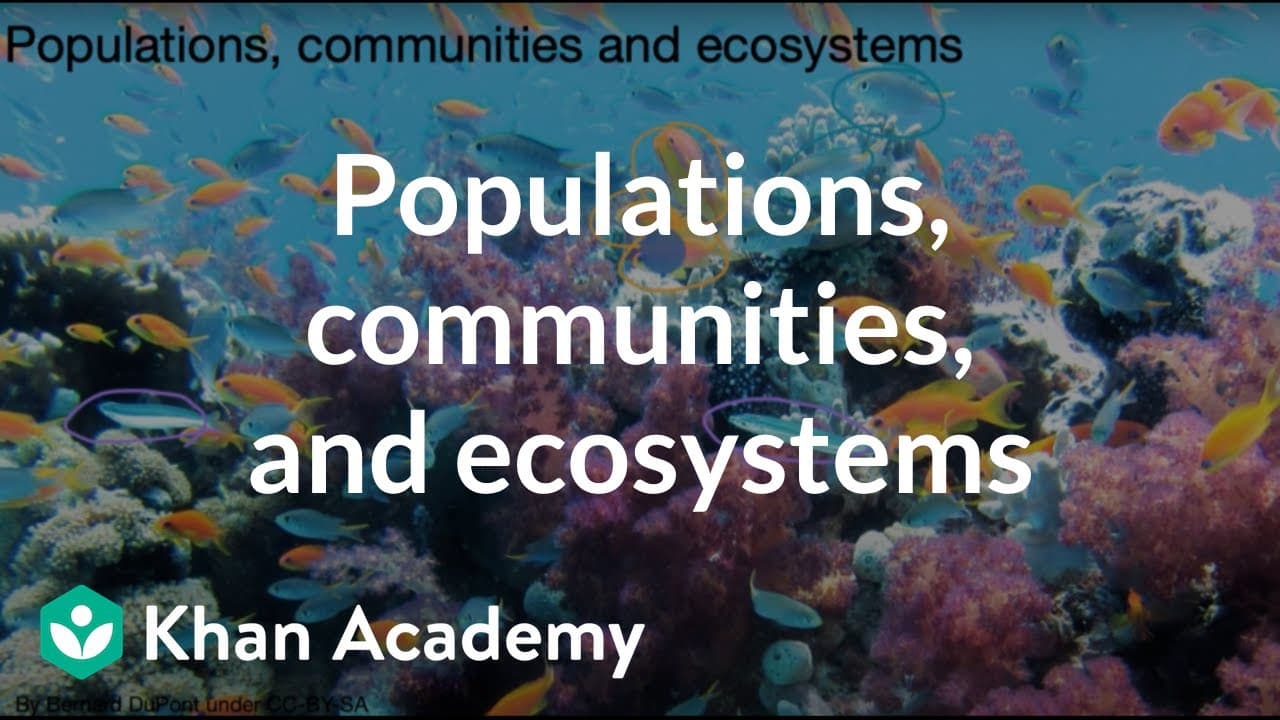
What Are Populations, Communities, and Ecosystems?
March 3, 2022
by
Khan Academy
YouTube video player
What Are Populations, Communities, and Ecosystems?

TL;DR

Populations consist of individuals of the same species in a given area, while communities include all the different species living together. Ecosystems encompass both these living organisms and their non-living surroundings, such as water and air, highlighting the complex interactions that sustain life.

Transcript

  • [Instructor] In biology, it's useful to have some shared language so we can communicate and describe the world around us in ways that we can all understand together. So here, we're going to talk about populations, communities, and ecosystems. And as we will see, these are all related ideas. So first of all, a population is talking about the membe... Read More

Key Insights

  • 🫒 Populations refer to a specific species in an area, communities involve multiple populations living together, and ecosystems include both living organisms and non-living elements of an environment.
  • ❓ Communities consider the interactions between different species, including competition, predation, and mutualism.
  • 🚱 Organisms within ecosystems interact with both living and non-living components for vital resources and survival.
  • 🫒 The concept of populations, communities, and ecosystems provides a shared language for biologists to understand and communicate the dynamics of living organisms and their environment.
  • 🌱 Populations, communities, and ecosystems can consist of various organisms, from large animals to microorganisms and plants.
  • ♻️ Understanding the relationships between populations, communities, and ecosystems is essential in studying ecology and how organisms interact within their environments.
  • ❓ Ecosystems are dynamic and are constantly influenced by the interactions between different populations and their physical surroundings.

Install to Summarize YouTube Videos and Get Transcripts

Explore YouTube Video Summarizer or Get YouTube Transcript Extractor

Summary & Key Takeaways

  • Populations are groups of individual organisms of the same species in a particular area.

  • Communities are composed of populations of different species that live in the same area.

  • Ecosystems include all living organisms and non-living elements, such as water, air, and soil, and how they interact with each other.


Read in Other Languages (beta)

English

Share This Summary 📚

Summarize YouTube Videos and Get Video Transcripts with 1-Click

Download browser extensions on:

Try YouTube Summary with ChatGPT & Claude or YouTube Transcript Generator

Explore More Summaries from Khan Academy 📚
2003 AIME II problem 15 (part 1) | Math for fun and glory | Khan Academy thumbnail
2003 AIME II problem 15 (part 1) | Math for fun and glory | Khan Academy
Khan Academy
Solving the matrix vector equation | Matrices | Precalculus | Khan Academy thumbnail
Solving the matrix vector equation | Matrices | Precalculus | Khan Academy
Khan Academy
Monkeys for the queen thumbnail
Monkeys for the queen
Khan Academy
Red blood cells in human body (scientific notation word problem) | Pre-Algebra | Khan Academy thumbnail
Red blood cells in human body (scientific notation word problem) | Pre-Algebra | Khan Academy
Khan Academy
Reflecting functions: examples | Transformations of functions | Algebra 2 | Khan Academy thumbnail
Reflecting functions: examples | Transformations of functions | Algebra 2 | Khan Academy
Khan Academy
Antiparallel structure of DNA strands | Biology | Khan Academy thumbnail
Antiparallel structure of DNA strands | Biology | Khan Academy
Khan Academy

Summarize YouTube Videos and Get Video Transcripts with 1-Click

Download browser extensions on:

Try YouTube Summary with ChatGPT & Claude or YouTube Transcript Generator

Apps & Extensions

  • Chrome Extension
  • Safari Extension
  • Edge Add-ons
  • Firefox Add-ons
  • iOS App
  • Android App

Key Features

  • YouTube Video Summarizer
  • Web & PDF Summarizer
  • Web & PDF Highlighter
  • Chat with PDF
  • Ask AI Clone
  • Audio Transcriber
  • Glasp Reader
  • Kindle Highlight Export
  • Idea Hatch

Integrations

  • Obsidian Plugin
  • Notion Integration
  • Pocket Integration
  • Instapaper Integration
  • Medium Integration
  • Readwise Integration
  • Snipd Integration
  • Hypothesis Integration

More Features

  • APIs
  • MCP Connector
  • Blog & Post
  • Embed Links
  • Image Highlight
  • Personality Test
  • Quote Shots
  • Open Graph Checker

Company

  • About us
  • Our Story
  • Blog
  • Community
  • FAQs
  • Job Board
  • Newsletter
  • Pricing
Terms

•

Privacy

•

Guidelines

© 2026 Glasp Inc. All rights reserved.