What Is the Mechanism of Halogenation of Alkenes?
TL;DR
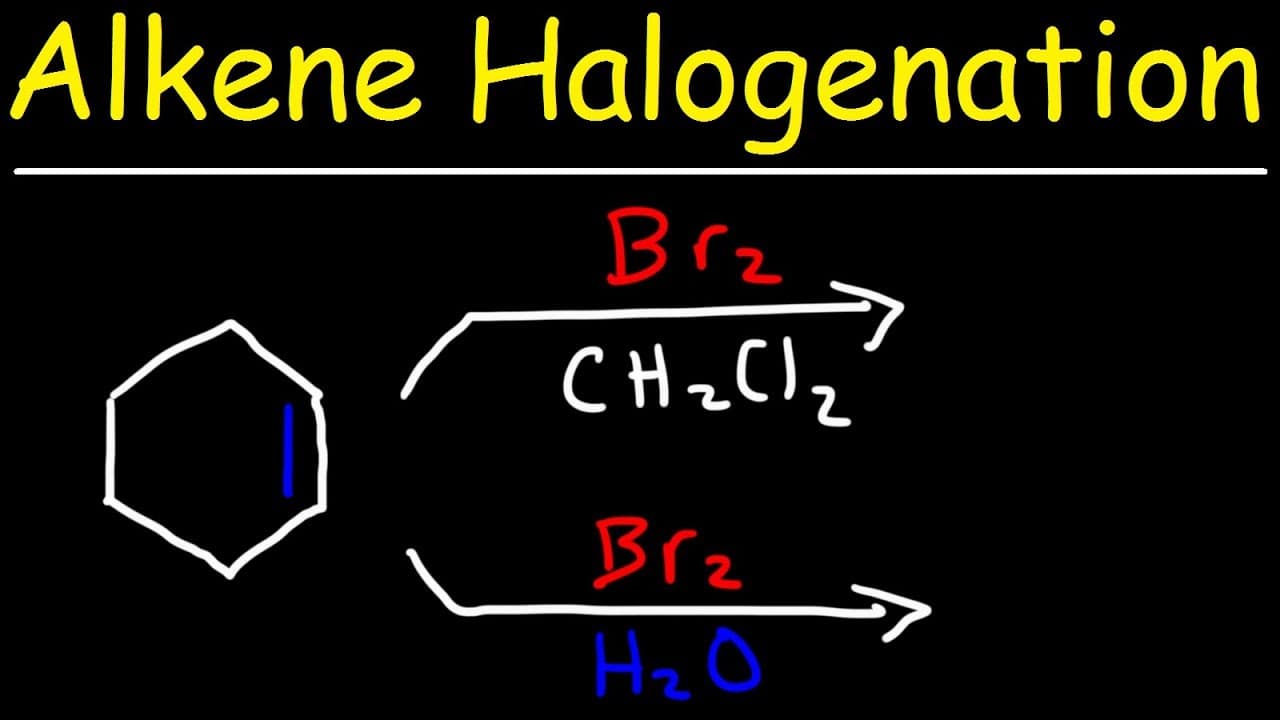
The mechanism of halogenation of alkenes involves a reaction with halogens, creating a cyclic bromonium ion intermediate, which allows for anti-addition of bromine atoms across the double bond. The stereochemistry varies: cis alkenes yield a racemic mixture while trans alkenes can produce meso compounds or enantiomers, depending on symmetry. Halohydrin formation incorporates water, adding an OH group to the more substituted carbon.
Transcript
in this video we're going to go over the halogenation of alkenes and also the halohydrin formation reaction so let's start with cyclohexene and let's react it with br2 bromine each bromine atom has three lone pairs attached to it now the double bond is the nucleophile and it's going to attack the electrophile which is bromine expelling a bromide io... Read More
Key Insights
- 💁 The halogenation of alkenes involves the formation of a cyclic bromonium ion intermediate.
- 😑 The regiochemistry of the halogenation reaction depends on the nucleophile attacking the bromonium ion.
- ❓ Cis alkenes in the halogenation reaction produce a racemic mixture of products.
- ❓ Trans alkenes in the halogenation reaction can produce either meso compounds or a pair of enantiomers.
- 💦 Halohydrin formation involves the addition of both a halogen and water to an alkene.
- 🫀 The oxygen atom of water attacks the more substituted carbon atom.
- 💁 In halohydrin formation, the stereochemistry depends on the configuration of the starting alkene.
Install to Summarize YouTube Videos and Get Transcripts
Explore YouTube Video Summarizer or Get YouTube Transcript Extractor
Summary & Key Takeaways
-
The halogenation of alkenes involves the reaction of an alkene with a halogen, such as bromine, to form a cyclic bromonium ion intermediate. This intermediate is then attacked by a bromide ion, resulting in the addition of two bromine atoms across the double bond.
-
The stereochemistry of the halogenation reaction depends on the starting alkene. Cis alkenes produce a racemic mixture of products, while trans alkenes can produce either meso compounds (if symmetrical) or a pair of enantiomers (if unsymmetrical).
-
Halohydrin formation involves the reaction of an alkene with a halogen and water. The oxygen atom of water attacks the more substituted carbon of the double bond, resulting in the addition of an OH group and a bromine atom to the alkene.
Read in Other Languages (beta)
Share This Summary 📚
Summarize YouTube Videos and Get Video Transcripts with 1-Click
Try YouTube Summary with ChatGPT & Claude or YouTube Transcript Generator
Explore More Summaries from The Organic Chemistry Tutor 📚





Summarize YouTube Videos and Get Video Transcripts with 1-Click
Try YouTube Summary with ChatGPT & Claude or YouTube Transcript Generator