WHICH TANK FILLS FIRST? ft. Simone Giertz
TL;DR
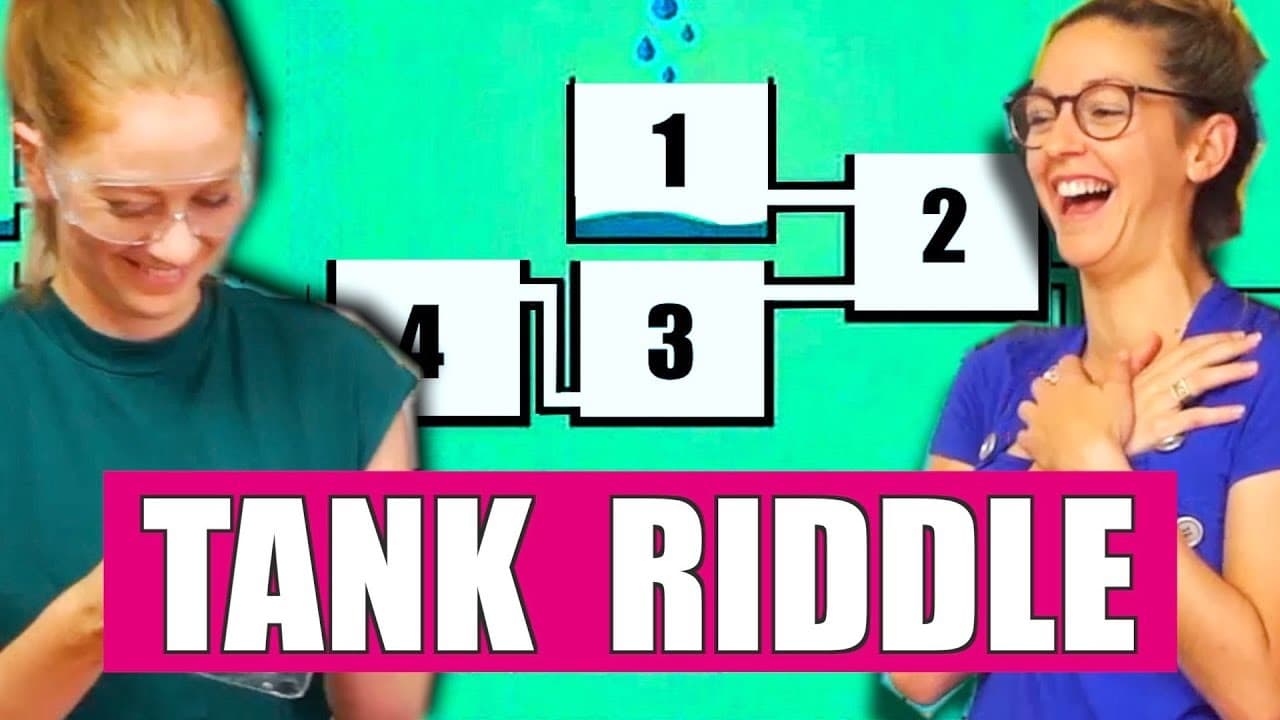
Containers three and four fill to the brim at about the same time under ideal assumptions, so the riddle has no definitive single-container answer. In the physical experiment, container four spilled first because it had been moved below container three after an inlet problem. The outcome depends on fluid speed, construction accuracy, gravity, and what “full” means. Read on to see how Pascal’s law explains the ideal result.
Transcript
Thank you to 23andMe for supporting PBS Digital Studios. Are we ready to try this? I think we're ready to try it. What do you think is going to happen? I honestly haven't thought about it. Do you know what's going to happen? Hey. I'm Dianna. You're watching "Physics Girl." And you may have seen this riddle before. It went pretty viral in 2016. ... Read More
Key Insights
- 🖤 Viral riddles often lack specific physical assumptions, making it difficult to definitively answer them.
- 👮 Pascal's law, which explains the transmission of pressure in incompressible fluids, is relevant to the riddle of the filling containers.
- 💄 The riddle's answer depends on many unknown variables, making it impossible to determine the definitive outcome.
- 🎨 Imperfections in materials and experimental design can affect the outcome of the experiment.
- ☠️ The experiment suggests that, ideally, all containers should fill up at the same rate.
- 🙂 Container four is likely to fill up slightly faster than container three in the given experiment.
- 🍃 The riddle is a trick question and intentionally leaves too many unknown variables.
Install to Summarize YouTube Videos and Get Transcripts
Explore YouTube Video Summarizer or Get YouTube Transcript Extractor
Questions & Answers
Q: Which tank fills first in the riddle featuring Simone Giertz?
Under ideal conditions, containers three and four fill to the brim at about the same time. In the actual experiment, container four spilled first because it had been moved lower than container three, so the result did not establish a universal winner.
Q: Why don’t containers one and two fill first?
As soon as containers one and two reach the height of their outlets, the liquid pours into the next bucket. They therefore do not continue filling to the brim under the experiment’s setup.
Q: How does Pascal’s law explain the result?
Pascal’s law says that a pressure change in one part of an incompressible fluid is transmitted without loss throughout the fluid. Because water is approximately incompressible, containers three and four should remain at the same level and fill at the same rate once they are connected, assuming an infinitesimally slow inflow.
Q: Why did container four spill before container three in the experiment?
The inlet from container three to container four initially went too high, so the model was adjusted by moving container four downward. That left container four lower than container three, causing it to spill first.
Q: What assumptions were used to test the tank-filling riddle?
The experiment assumed that gravity points downward and that “filled” means filled to the brim. It also assumed that water enters through the top as a relatively slow trickle compared with its movement through the other pipes.
Q: Can physics determine a definitive winner for this riddle?
Not from the riddle as presented, because it leaves too many relevant conditions unspecified. The outcome depends on factors such as how accurately the materials are cut and how quickly the fluid flows into the system.
Q: What did Simone Giertz predict before the experiment?
Simone predicted that the liquid would travel through the connecting pipes and that the later containers would rise together. She also expected the earlier containers to reach their outlets and spill before they could fill to the brim.
Q: Why is the tank puzzle considered a trick question?
It is considered a trick question because it omits physical assumptions needed to select one definitive answer. In an idealized setup, containers three and four fill at about the same time, while imperfections can make one spill before the other.
Summary & Key Takeaways
-
The riddle asks which container will fill up first out of several containers.
-
The experiment is conducted using containers and a model of the riddle to test predictions.
-
Pascal's law is applied to explain that, ideally, all containers should fill up at the same rate, but imperfections and unknown variables make it impossible to determine the definitive answer.
Read in Other Languages (beta)
Share This Summary 📚
Summarize YouTube Videos and Get Video Transcripts with 1-Click
Try YouTube Summary with ChatGPT & Claude or YouTube Transcript Generator
Explore More Summaries from Physics Girl 📚






Summarize YouTube Videos and Get Video Transcripts with 1-Click
Try YouTube Summary with ChatGPT & Claude or YouTube Transcript Generator