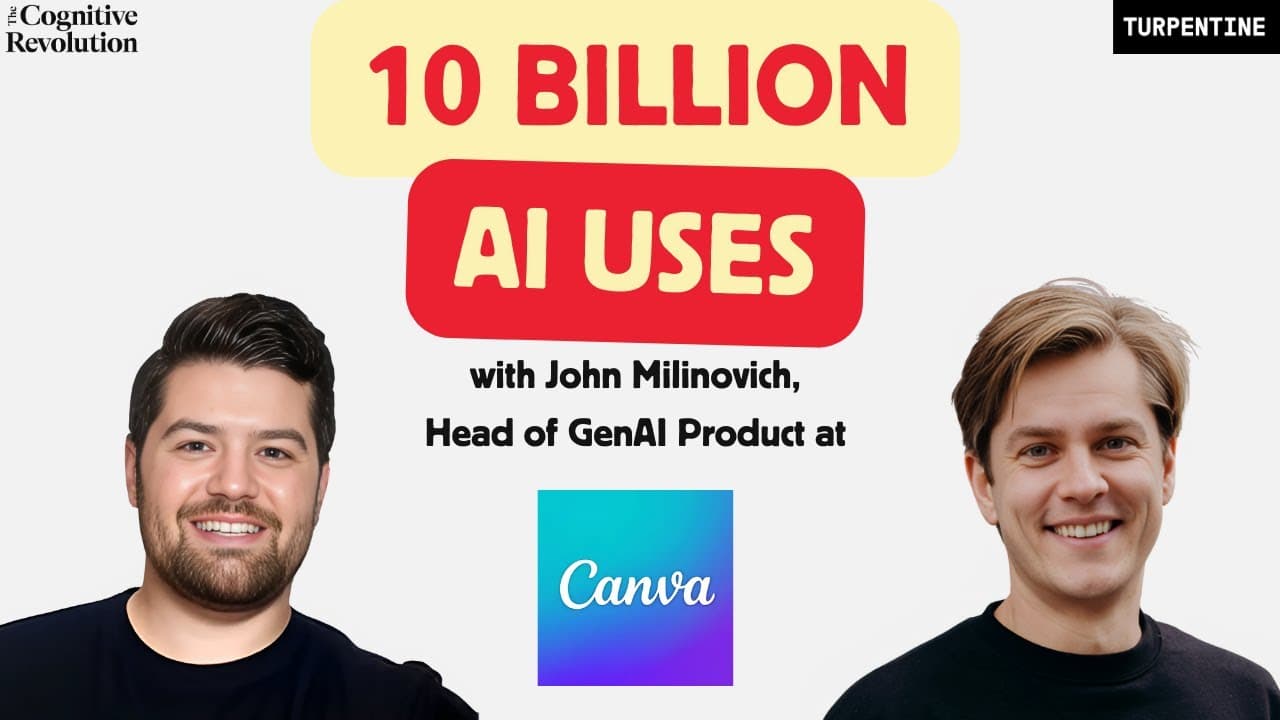
Designing the Future: Inside Canva's AI Strategy with John Milinovich, GenAI Product Lead at Canva
TL;DR
Exploration of Canva's AI strategies for design and creativity.
Transcript
at the highest level there's like Automation and augmentation what people want from automation is to remove the ick from something that's just super annoying to do as a user you know what you want the outcome to be but you just kind of want it done for you the other dimension here is augmentation which is I am fundamentally in the driver seat I am ... Read More
Key Insights
- Canva's AI strategy focuses on both automation and augmentation, aiming to simplify design tasks and enhance user creativity.
- The transition from object-level to concept-level manipulation in design is a key innovation in Canva's AI integration.
- Canva's Dreamlab offers a text-to-image generation product, expanding use cases beyond traditional design needs.
- Fine-tuning foundation models and maintaining problem orientation are crucial for effective AI product development.
- AI is transforming fields like architecture by offering new tools for conceptual and functional design enhancements.
- Maintaining human intervention in design processes ensures that personal taste and creativity remain central.
- Evaluating AI models involves a combination of offline and online assessments to ensure quality and user satisfaction.
- The application layer of AI, particularly in non-traditional tech industries, presents significant opportunities for growth and innovation.
Install to Summarize YouTube Videos and Get Transcripts
Explore YouTube Video Summarizer or Get YouTube Transcript Extractor
Questions & Answers
Q: What is Canva's approach to AI in design?
Canva focuses on both automation and augmentation in AI integration. Automation aims to simplify repetitive tasks, while augmentation enhances user creativity by providing tools to transform abstract ideas into concrete designs. This dual approach seeks to balance efficiency with creative empowerment.
Q: How does Canva's Dreamlab enhance design capabilities?
Dreamlab is a text-to-image generation product that expands Canva's design capabilities beyond traditional needs. It allows users to create images based on text prompts, providing a new level of creativity and flexibility. This feature demonstrates Canva's commitment to integrating AI in a way that enhances user experience and broadens design possibilities.
Q: What role does human intervention play in AI-powered design?
Human intervention remains crucial in AI-powered design to ensure personal taste and creativity are preserved. While AI can automate and augment design processes, the human element is essential for making final adjustments and ensuring the output aligns with individual or brand aesthetics. This balance helps maintain the unique value of human creativity.
Q: How does Canva evaluate the effectiveness of its AI models?
Canva employs a combination of offline and online evaluations to assess AI model effectiveness. Offline evaluation involves rigorous guidelines and trained evaluators to ensure quality, while online evaluation monitors user engagement and satisfaction. This dual approach helps Canva maintain high standards in its AI-powered design tools.
Q: What is the significance of problem orientation in AI development?
Problem orientation in AI development focuses on understanding and addressing the core problem rather than fixating on specific solutions. This approach encourages flexibility and innovation, allowing developers to pivot and explore new strategies when current solutions fall short. It is essential for creating effective AI products that truly meet user needs.
Q: How is AI transforming fields like architecture?
AI is transforming architecture by providing tools for both conceptual and functional design enhancements. It allows architects to visualize permutations, optimize designs based on environmental factors, and automate routine tasks. This integration of AI enhances creativity and efficiency, offering new possibilities for architectural innovation.
Q: What opportunities does the AI application layer present?
The AI application layer, especially in non-traditional tech industries, offers significant opportunities for growth and innovation. By focusing on specific customer needs and creating intuitive user experiences, AI applications can disrupt traditional services and provide enhanced value. This layer is expected to drive substantial economic returns in the coming years.
Q: What are Canva's priorities when hiring AI engineers?
Canva prioritizes hiring AI engineers who are passionate about design AI, possess a strong growth mindset, and demonstrate problem-solving abilities. Candidates should be curious, adaptable, and willing to tackle complex challenges. Practical experience in using AI to enhance creative processes is highly valued, as is the ability to work collaboratively in a fast-paced environment.
Summary & Key Takeaways
-
John Milinovich discusses Canva's approach to integrating AI into design, emphasizing the balance between automation and augmentation. This strategy aims to simplify tedious tasks while enhancing user creativity, moving from object-level to concept-level design manipulation.
-
Canva's AI innovations include Dreamlab, a text-to-image generation tool, and other features like Magic Write and Magic Layouts, which offer personalized design experiences. These tools highlight Canva's focus on natural AI integration at the point of user need.
-
The conversation touches on the future of AI in design and architecture, the importance of problem orientation in AI development, and the potential of the application layer in AI to transform industries. Evaluating AI models rigorously ensures quality and user satisfaction.
Read in Other Languages (beta)
Share This Summary 📚
Summarize YouTube Videos and Get Video Transcripts with 1-Click
Try YouTube Summary with ChatGPT & Claude or YouTube Transcript Generator
Explore More Summaries from Cognitive Revolution "How AI Changes Everything" 📚



Summarize YouTube Videos and Get Video Transcripts with 1-Click
Try YouTube Summary with ChatGPT & Claude or YouTube Transcript Generator