What Is the Periodic Table and How Is It Organized?
TL;DR
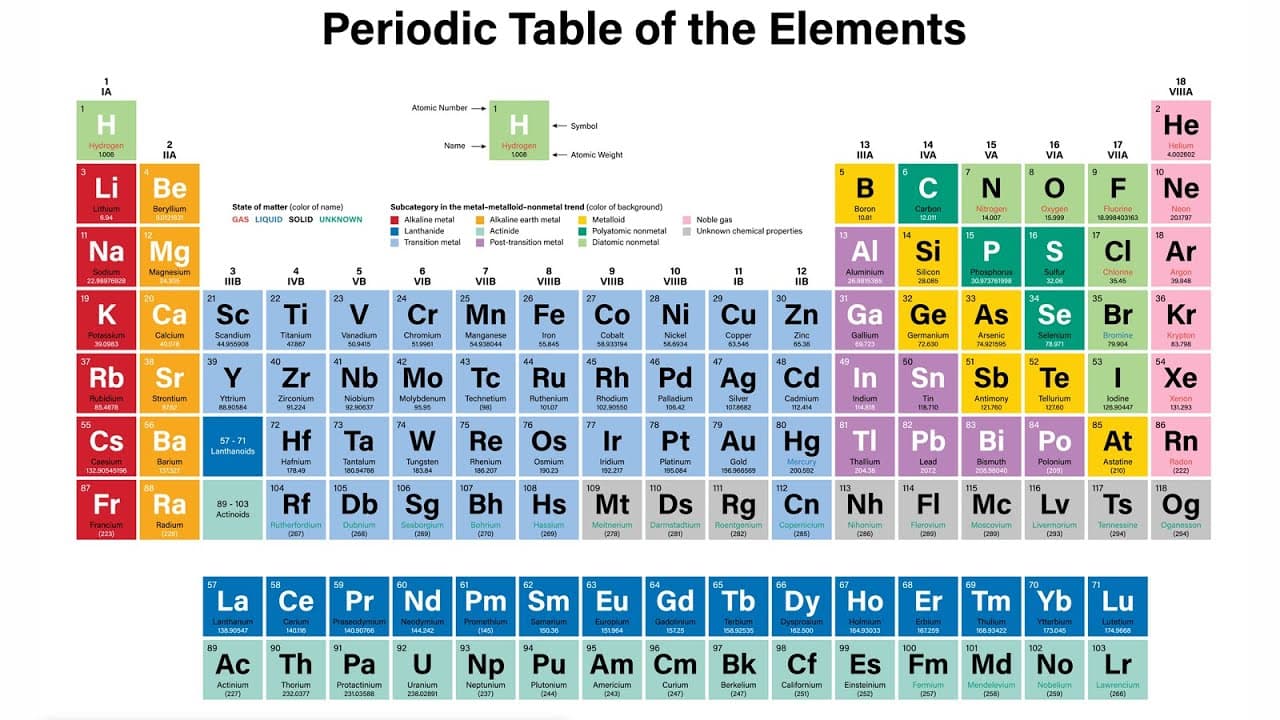
The periodic table is organized into groups (columns) and periods (rows), with elements in the same group sharing similar chemical properties. For example, alkali metals in Group 1 are highly reactive, while noble gases are chemically inert. Understanding the structure of the table helps predict element behavior and ion formation based on valence electrons.
Transcript
in this video we're going to talk about the periodic table of the elements now there's two important things you need to know about this the columns are called groups the rows are called periods so this is group 1 group 2 3 4 5 6 7 8 9 10 11 12. and so forth now the elements in a group share similar chemical properties for instance group one is know... Read More
Key Insights
- #️⃣ The periodic table organizes elements based on their atomic number, which corresponds to the number of protons in the nucleus.
- 🤘 Alkali metals and alkaline earth metals become more reactive as you move down their groups.
- 💁 Transition metals can form ions with multiple oxidation states, while non-metals tend to form anions.
- 🫢 Noble gases are different from other nonmetals, as they are chemically inert and do not react easily.
- 👂 The atomic weight listed on the periodic table accounts for the average mass of isotopes present in nature.
- 🤘 Metalloids are semiconductors that exhibit properties between metals and non-metals.
- 💁 Group numbers and valence electrons correlate, providing information on ion formation.
Install to Summarize YouTube Videos and Get Transcripts
Explore YouTube Video Summarizer or Get YouTube Transcript Extractor
Questions & Answers
Q: Why are alkali metals more reactive as you move down the group?
Alkali metals become more reactive as you move down the group because their reactivity increases with a decrease in melting point and increase in atomic size.
Q: What is the difference between metals and non-metals in terms of ion formation?
Metals tend to give away electrons and form cations with a positive charge, while non-metals tend to take electrons and form anions with a negative charge.
Q: How do isotopes affect the average atomic mass of an element?
Isotopes are different forms of an element with the same number of protons but varying numbers of neutrons. The average atomic mass accounts for the abundance of each isotope, resulting in a decimal value.
Q: What distinguishes noble gases from other nonmetals?
Noble gases are non-reactive and do not readily participate in chemical reactions. They do not want to acquire or give away electrons, making them chemically inert.
Summary & Key Takeaways
-
The periodic table consists of groups (columns) and periods (rows), with elements in the same group sharing similar chemical properties.
-
Alkali metals in Group 1 are highly reactive and become more reactive as you move down the group. They react violently with water.
-
Transition metals can form ions with variable charges, while noble gases are chemically inert and do not readily react with other elements.
Read in Other Languages (beta)
Share This Summary 📚
Summarize YouTube Videos and Get Video Transcripts with 1-Click
Try YouTube Summary with ChatGPT & Claude or YouTube Transcript Generator
Explore More Summaries from The Organic Chemistry Tutor 📚
Summarize YouTube Videos and Get Video Transcripts with 1-Click
Try YouTube Summary with ChatGPT & Claude or YouTube Transcript Generator