Map of Science (and everything else)
TL;DR
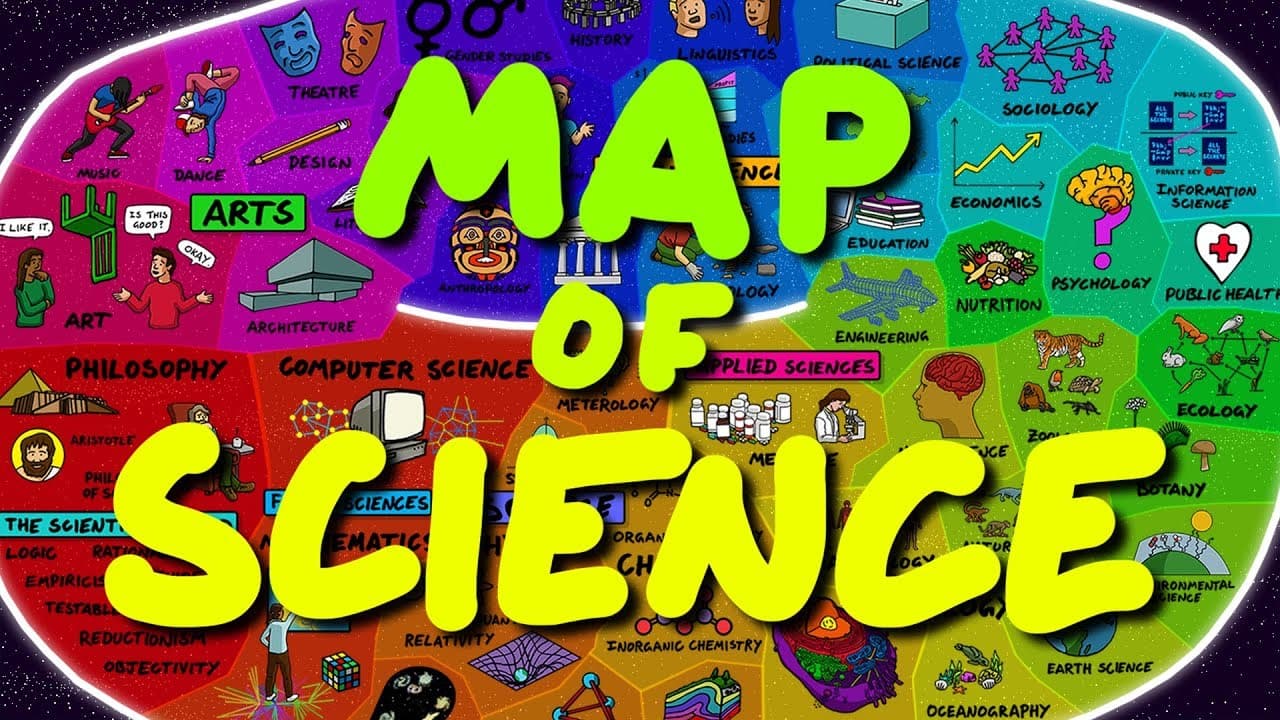
Science aims to understand the universe, while art explores the human condition through subjective expression.
Transcript
The grand aim of science is to figure out how it all works, which includes giant questions like: Where did the Universe come from? What is it really made of? How does all that stuff work and interact with each other? And how is it that human intelligence exists and is able to experience the Universe and probe it with our minds? You know, small stuf... Read More
Key Insights
- 🫚 Science aims to unravel the mysteries of the universe, employing the scientific method rooted in philosophy.
- 💻 Mathematics and computer science are invaluable tools for scientific exploration across various disciplines.
- ❓ The complexity of biological and social systems challenges reductionist approaches in scientific study.
- 😀 The social sciences face difficulties in applying traditional scientific rigor due to the subjective nature of human systems.
- 🥰 Art explores the human condition through subjective expression, posing existential questions and reflecting on the essence of being.
- 🥰 Both science and art share a common goal of pushing boundaries and exploring new realms of understanding.
- 😑 Human endeavor encompasses a wide spectrum of knowledge, ranging from scientific exploration to artistic expression.
Install to Summarize YouTube Videos and Get Transcripts
Explore YouTube Video Summarizer or Get YouTube Transcript Extractor
Questions & Answers
Q: What is the core aim of science and how has it evolved over time?
The core aim of science is to understand the universe's workings. It has evolved from ancient philosophical roots to a systematic methodology called the scientific method, encompassing principles like logic, empiricism, and testable hypotheses.
Q: How do fields like mathematics and computer science contribute to scientific exploration?
Mathematics serves as a crucial tool for describing the natural world accurately, and computer science aids scientists in data analysis and simulation, augmenting human cognitive abilities.
Q: Why do the social sciences face challenges in applying the scientific method?
The social sciences deal with complex human systems that defy reductionist approaches, leading to subjective interpretations. Factors like human behavior's unpredictability challenge traditional scientific rigor.
Q: How does art differ from science in exploring the complexities of the human experience?
Art delves into the subjective, intangible aspects of human existence, tackling profound questions about life, emotions, and purpose that may not be easily explained by scientific methods.
Summary & Key Takeaways
-
Science seeks to understand the universe's origins, composition, and interactions, guided by the scientific method rooted in philosophy.
-
Mathematics and computer science, though not pure sciences, are indispensable tools for scientific exploration.
-
As sciences move from physics to biology, complexities increase, challenging traditional reductionist approaches.
Read in Other Languages (beta)
Share This Summary 📚
Summarize YouTube Videos and Get Video Transcripts with 1-Click
Try YouTube Summary with ChatGPT & Claude or YouTube Transcript Generator
Explore More Summaries from Domain of Science 📚
Summarize YouTube Videos and Get Video Transcripts with 1-Click
Try YouTube Summary with ChatGPT & Claude or YouTube Transcript Generator